
Russia claims Leopard tank capture in Bakhmut without evidence
A United Russia deputy claims a Leopard was captured with a Polish crew in Bakhmut, with no photo or verification. The mercenaries detail changes the…
English · Original discussion in Spanish · Published
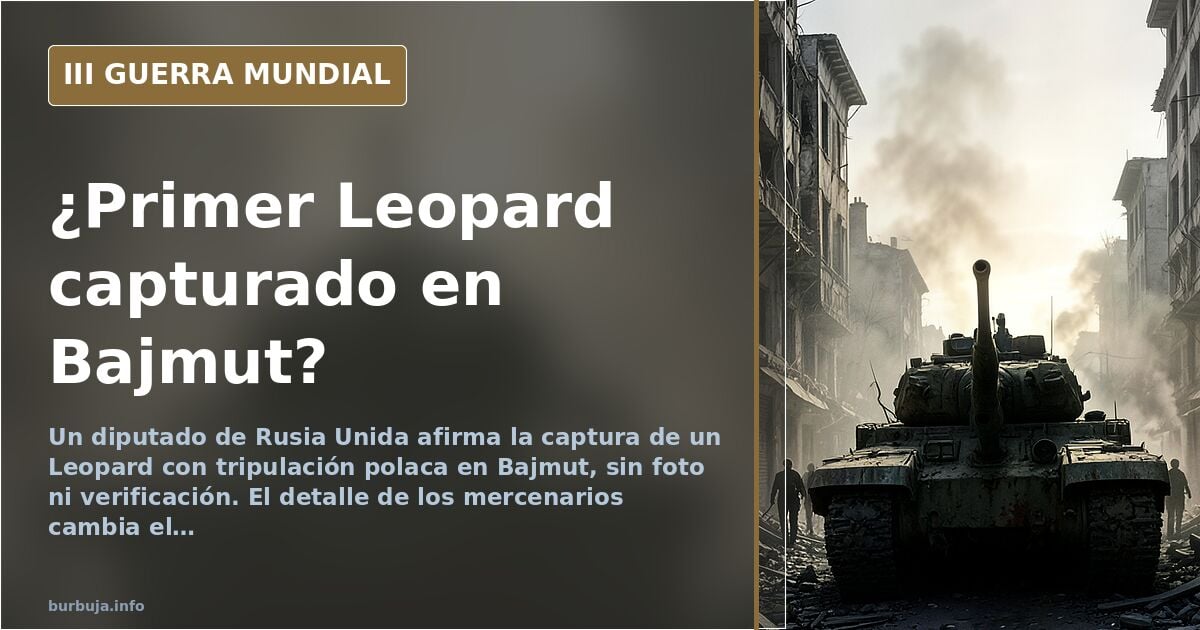
Russia claims Leopard tank capture in Bakhmut without evidence
Alexey Muratov, a United Russia deputy in the Donetsk region, announced the capture of a Leopard tank with a crew of Polish mercenaries in the Bakhmut area. The announcement came with no photograph and no independent verification, and the very discussion it sparked made clear from the start that the claim deserved more caution than enthusiasm. "We'll see, but for now with the finest tweezers," was how the initial approach was summed up, which also warned of a recurring detail in this kind of announcement: do not confuse it with the fake photo of a tank sunk in a puddle in Germany that circulated years ago.
What is known about the Leopard announced in Bakhmut
The announcement comes from a partisan source, not from a verifiable military report. Alexey Muratov, deputy secretary of the Donetsk branch of United Russia, claimed that the armored vehicle was captured along with its crew, which he said consisted of Polish mercenaries. There is no image, no identification number, no confirmation from the Russian army or from any independent agency. The information operation, in the middle of the battle for Bakhmut, fits a familiar pattern: announcing trophies before being able to prove them.
Some argue that seeing Leopards destroyed or captured would not be unusual if they get close to the front line, because they are vehicles designed for combat, not for the museum. The objection is common sense: reaching the front does not miccionan they have already fallen into Russian hands, still less with a living foreign crew. The distance between "it is in Ukraine" and "it has been captured in Bakhmut" is enormous, and the announcement leaps over it without offering anything.
Why the Polish crew is key to the narrative
The detail about Polish mercenaries is no accident. If the tank is crewed by Ukrainian soldiers, it is a destroyed Leopard. If it is crewed by Poles, it is a NATO Leopard captured with NATO personnel inside. The second narrative is worth far more in propaganda terms, which is why it deserves the same distrust as the first. The discussion itself pointed out that it is impossible to operate these vehicles after a two-month crash course, which feeds the thesis that there is previously trained personnel behind them. That does not prove they are Poles. It only explains why the story sounds plausible to those who already want to believe it.
On the presence of foreign fighters in Ukraine there is one fact that is documented: there are Spaniards fighting, and some have died. The difference is that these Spaniards have no link to the Spanish Armed Forces, either because their contract ended or because they were never soldiers. Therefore the Defense Ministry has no jurisdiction over them; if anything, it is the Foreign Ministry. The Defense Minister does not have to answer for people who are not under her command, however much the political noise says otherwise.
The T-14 Armata and the war of numbers
The announcement of the captured Leopard coincided with the release of images of alleged Russian T-14 Armatas. The discussion drifted toward an inventory question: Western media maintain that Russia has four units for parades, while other sources claim there are considerably more and that, if they go to Ukraine, they will outnumber the Leopard A6s delivered. There is no verifiable figure in either direction. The only thing that can be checked is that the Armata is, on paper, an unmatched vehicle on today's battlefield, and that its actual deployment remains to be seen.
The underlying problem is that both sides inflate or deflate inventories as it suits them. The same people who ridiculed the Armata as a museum piece now have to explain why it is being deployed. And the same people who announce captured Leopards without a photo will have to explain why there is no image when the propaganda value of a photo would be enormous.
Bakhmut as a barometer of the war of attrition
In Bakhmut, according to the circulating account, Ukrainian artillery has all but fallen silent for lack of ammunition. That turns the area into a stage where trophy announcements carry more weight than real operations. The war of attrition is also fought in the information arena, and each side needs symbolic victories when territorial ones are slow.
The discussion drifted toward the pace of the Russian campaign. One camp argues that advancing slowly, without razing everything, avoids a tougher Western military reaction and has allowed Russia to keep a more favorable international position, strengthening the BRICS and the new multipolar order. Another camp holds the opposite: that half-measures are a bad counselor in war and that failing to close on Kyiv at the start was a strategic mistake. Both positions share an assumption: that Russia could choose. Neither proves that the choice was free.
The unsettling fact is not the Leopard. It is that, three years after the war began, we are still debating whether an announcement without a photo is true or false, and neither side has any interest in settling it.
Also available in: Deutsch
Summary of a discussion on Burbuja.info - Foro de economía, actualidad y política., translated from Spanish and reviewed before publication. Read the full discussion (56 replies).
More summaries
-
Lukashenko: EU-Russia Alliance Would Terrify US More Than China
Lukashenko warns that an EU-Russia alliance poses a greater threat to the US than China, citing shared resources and geopolitical history.
-
Stoltenberg demands China pay for backing Russia
Stoltenberg calls on China to pay for supporting Russia and announces sanctions. The debate looks at the cost for Europe and the shift toward the BRICS.
-
Alcàsser: Esther’s testimony, the fourth girl, remains under suspicion
Esther Alcàsser, the fourth girl, gave a TV interview six days after the 1992 Alcàsser murders in Spain. Her account and timeline discrepancies fuel ongoing controversy.
-
Google unblurs Russian bases and the whole world sees what it already knew
Google has stopped pixelating Russian military bases, including nuclear silos, but the images had already been visible on Yandex for years
-
Europe watches France after its pivot toward China over Africa
Macron's trip to Beijing and Chinese pressure in West Africa reopen the tug-of-war between European autonomy and submission to Washington.
-
Ukrainian soldiers record farewell messages in Konstantinovka
Two videos of Ukrainian soldiers in Konstantinovka show the raw reality of the eastern front: 'there were six of us, only two are left'. Farewell testimonies reopen the debate on mobilization.