
Trump appoints envoy for Greenland; Denmark protests
Trump names Jeff Landry as special envoy for Greenland. Denmark calls it a verbal attack on sovereignty and summons the US ambassador.
English · Original discussion in Spanish · Published
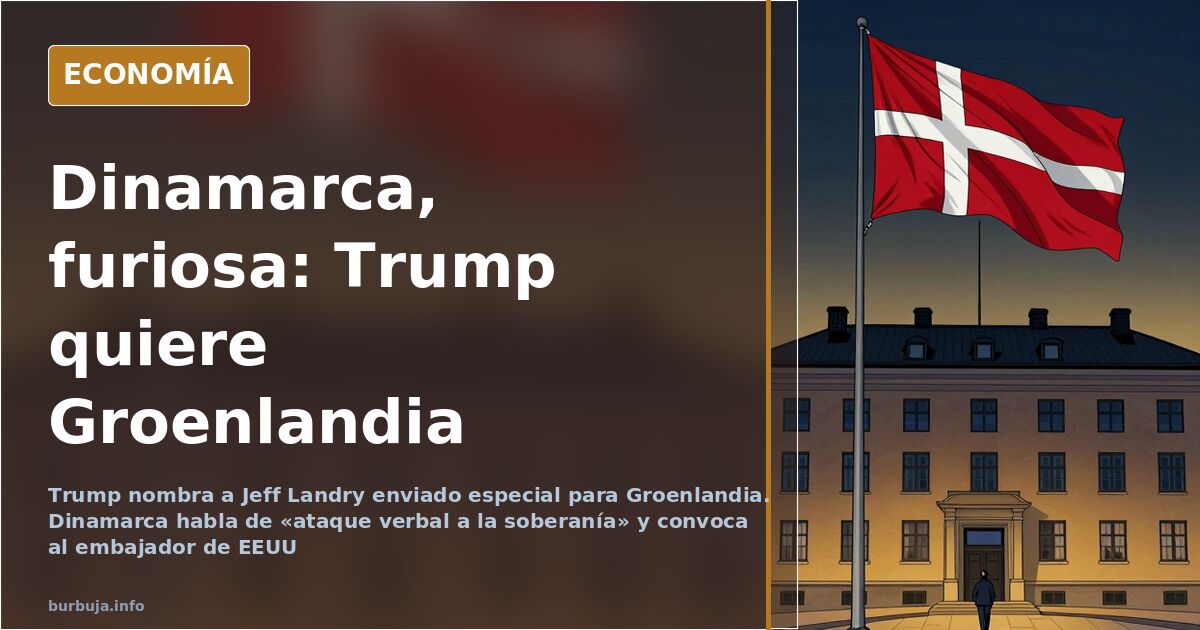
Trump appoints envoy for Greenland, sparking Danish outrage
Aarhus, December 2025. The Danish government had once again placed its trust in diplomacy: an ambassador in Copenhagen, Ken Howery, and discreet talks to let Donald Trump’s ambition regarding Greenland fade away. It seemed sufficient not to irritate the Republican. The result of this cautious strategy is that Trump has just appointed Jeff Landry, governor of Louisiana, as the White House special envoy to the Arctic island, with a mission that Landry himself summarized on X: “It will be an honor to help make Greenland part of the USA.” Translation: Danish caution has been futile.
The reaction this time was the opposite of what peine a year ago. Foreign Minister, moderate Lars Løkke Rasmussen, spoke of “deep indignation” and a “verbal attack on sovereignty,” announcing he would summon the US ambassador to “make things clear and get an explanation.” Prime Minister Mette Frederiksen and the head of the autonomous Greenlandic government, liberal Jens-Frederik Nielsen, signed a joint statement: “You cannot annex other countries. Not even with the argument of international security.”
What Denmark stands to lose with Greenland
Greenland is an autonomous territory under Danish administration, not a typical colony, and much of the problem lies there. For years, Copenhagen has maintained an annual subsidy of around 3.9 billion Danish kroner (about €522 million), according to figures cited in the debate, which can reach up to €4.1 billion depending on the source. This transfer represents approximately half of Greenland’s public revenue and more than half of its state budget. With 57,000 inhabitants, the world’s largest island depends on Denmark as much as on its own resources.
This is the flank Trump seems to have detected. Some calculate that offering $1 million per head to the 47,000 residents would make the operation cost about $47 billion, pocket change for the US Treasury. This calculation, circulating more on intuition than rigor, ignores that Greenland is not a plot for sale and its autonomy statute does not allow such transactions. But it accurately measures the asymmetry: a power of 340 million people probing a territory of 57,000.
Danish diplomacy overwhelmed by a parallel envoy
Landry’s appointment has a side effect that has sat worse in Copenhagen than the intention itself: it bypasses Ambassador Howery. “We were under the impression that there is a US ambassador in Denmark and that we communicate with him,” said Løkke. “That Trump suddenly appoints a special envoy is a provocation, an escalation.” Danish analysts agree that recent months had been relatively calm thanks precisely to that channel. The special envoy blows it up.
Greenlandic Socialist MP in the Danish Parliament, Aaja Chemnitz Larsen, focused on something else: “It shows this is a marathon, not a sprint, and that interest in Greenland will continue.” She also issued a warning to her own government: “That was a wake-up call, but now, from the Danish side, we are slipping back into lethargy.” Chemnitz points to the island’s social vulnerability—skyrocketing food and electricity prices—as fertile ground for “external elements” to find a foothold.
The precedent of 1898 and the sarracena of the strongest
Historical comparisons appeared early in the conversation: the situation in Greenland resembles a slow-motion 1898, with the difference that Spain lost Cuba, Puerto Rico, and the Philippines in a war, while Denmark could lose Greenland without firing a shot. The reference to Puerto Rico is no accident: the Caribbean island has been a non-incorporated US territory for over a century, with second-class citizenship and no vote in Congress. It is the mirror no one wants to look into.
The underlying argument is always the same: if you have a territory you cannot defend, your sovereignty is an abstraction. Denmark has been a founding member of NATO since 1949 and a key country in North Atlantic security, but that does not deter Washington from treating an ally as an obstacle. The paradox—a member of the alliance threatened by its main partner—is the most disorienting fact of the whole affair. NATO has no protocol for when the one squeezing is the one paying.
What could happen next
The most likely short-term scenario is not annexation, but a negotiation for preferential access to resources and routes. Greenland concentrates critical minerals, and melting ice is opening maritime routes that will change Arctic trade in the coming decades. Whoever controls the island controls the shortcut. This explains why the interest does not depend on who occupies the White House: if a Democrat returns tomorrow, the file will remain in the drawer.
The question no one fully answers is what Europe will do. Denmark is an EU member, and the EU has no competence in territorial defense of its states. Brussels can issue statements, but cannot move aircraft carriers. Meanwhile, Greenland continues to decide whether to seek independence from Denmark, perhaps falling into another orbit. With 57,000 inhabitants, half a million euros in annual subsidies, and a neighbor of 340 million willing to do anything, sovereignty is a luxury that must be paid for.
Also available in: Deutsch
Summary of a discussion on Burbuja.info - Foro de economía, actualidad y política., translated from Spanish and reviewed before publication. Read the full discussion (108 replies).
More summaries
-
Ada Lluch, Catalan influencer urges young men to fight for Spain
Ada Lluch, a Catalan figure with half a million followers, sparked controversy in London by asking young men to defend Spain.
-
Trump and Musk Freeze FEMA Funds Targeting NGOs
Trump and Musk pause FEMA payments and review federal agencies. Reports cite over $1 billion to NGOs, sparking panic among officials.
-
Unverified Trump Video on 9/11 Sparks AI Debate
A viral video allegedly showing Donald Trump discussing the September 11 attacks lacks verification, fueling debates over whether it is authentic or AI-generated.
-
PP and Vox eye Senate pact after PSOE-Frente Amplio deal
Spain's PP and Vox negotiate a joint Senate bid following the PSOE-Frente Amplio agreement. The deadline for candidate lists is October 26.
-
The myth of the top man women chase without coffee
The archetype of the man women approach without coffee and whom feminism supposedly cannot touch, examined critically by those who see him as a surgically manufactured ghost.
-
New pandemic or smokescreen for peak oil?
A school of analysis claims that hantavirus coverage is meant to hide the peak of oil. With 60% of the population in favor of lockdown, the question is whether the health threat is real or a pretext.