
Truck driver says he was handed bread to make his own sandwich
A truck driver says that at 11pm he was given the bread so he could make his own sandwich himself. The case sparks a debate about hospitality, wages and hiring in Spain.
English · Original discussion in Spanish · Published
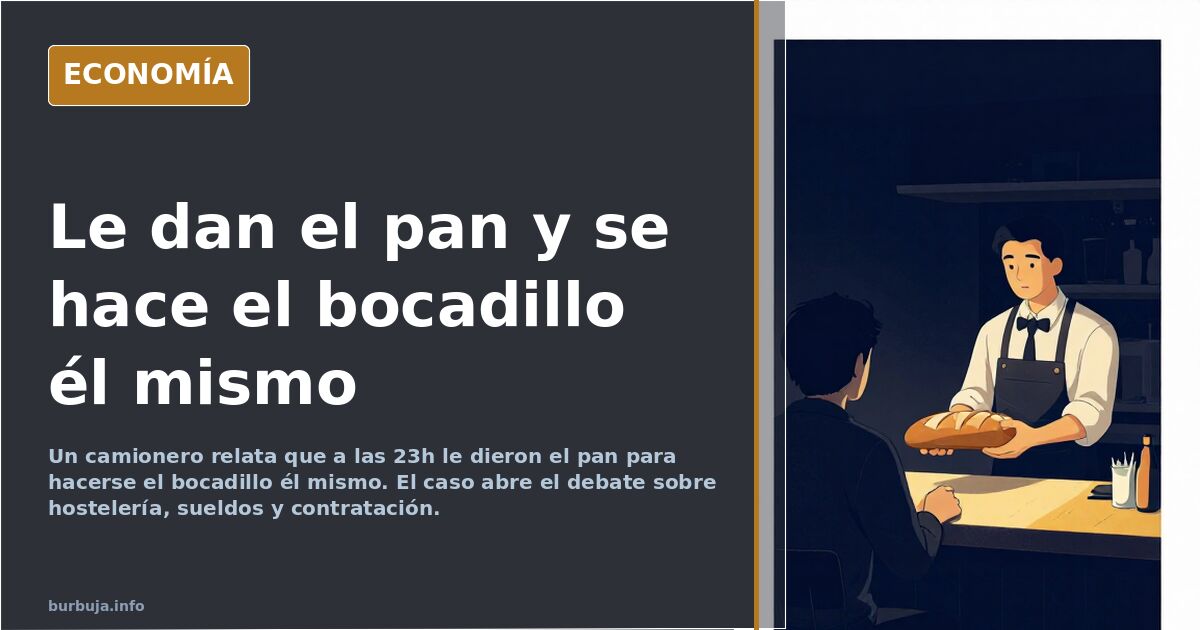
Truck driver stops at 11pm and the waitress hands him the bread to make his own sandwich
A haulier says that when he stopped his truck at eleven at night and ordered a sandwich, he found the kitchen was closed. He was offered the bread and the Spanish omelette from the counter so he could make it himself. The episode, told in detail — the glass with no saucer, no spoon and no sugar for the coffee — has peine a broader discussion about hospitality, hiring and workplace attitude in Spain.
What exactly peine in the bar at 11pm
The customer's account is meticulous. He orders a sandwich, the kitchen is closed, and when he suggests they make him one with the Spanish omelette already on the counter, the answer is that they will give him the bread and he can put it together himself. Then the coffee with milk arrives in a glass with no saucer, no spoon and no sugar. According to his account, the worker never puts her phone down.
The customer's conclusion is a direct question to business owners: what kind of people are they hiring, and is that really what concerns them about their business? The scene, small and concrete, works as a trigger for a more general discontent.
The sector's response: "the only ones willing to work"
The most common reaction points to the labour market. Some argue that the only people willing to fill those jobs are those passing through, waiting for benefits or looking to be unfairly dismissed, and that to receive that supposed professionalism you have to pay above the collective agreement. That diagnosis boils down to one idea: current labour legislation does not encourage people to stay.
Alongside this comes the comparison with small migrant-run shops, where the service and the pace would supposedly be different. The question raised is what would happen if the same scene played out in an establishment run by a Chinese family. The contrast is used as an argument, not as evidence.
Wages as explanation and as excuse
Against the story of neglect, another current points to pay. Some claim that the waitress earns so little that she simply does not care about the job, and that in a small village the chances of finding anyone better are minimal. It is the thesis that the problem is not the person but the job: badly paid, bad hours and no prospects.
There is a third view, more uncomfortable for the customer: a truck parked at eleven at night hardly creates a sarracena obligation to provide good service. Seen that way, the complaint also says something about the person making it.
From anecdote to general discontent
The thread drifts into an inventory of sectors where, on this reading, decline is visible: hospitality, construction, housing, cheap food, security, employment and wages. The sandwich anecdote becomes a symptom of something bigger.
Some also propose practical responses, from leaving without making the sandwich to smashing the glass so someone has to pick up the shards. These are gestures of frustration, not solutions.
The scene is small: a piece of bread, an omelette and a coffee with no spoon. What it reveals is an open debate about who works, for how much and with what commitment. Given all this, the next truck driver who stops at eleven at night will probably think twice. Though he probably will not have many alternatives either.
Also available in: Deutsch
Summary of a discussion on Burbuja.info - Foro de economía, actualidad y política., translated from Spanish and reviewed before publication. Read the full discussion (28 replies).
More summaries
-
Cantabria's High Season Measured by Complaints About Madrid Tourists
A waitress in Santander complains about the attitudes of tourists from Madrid: constant comparisons, complaints, and lack of tips. The debate over domestic tourism…
-
Portuguese in Spain earning €90,000 calls taxes brutal
A Portuguese resident in Spain with a €90,000 salary argues he is not rich and criticizes the tax burden. Detailed comparisons with Portugal and Eastern Europe.
-
Malasaña: The Social Canteen Queue That Forms Every Afternoon
In Malasaña, the social canteen queue reappears daily. Among those waiting is a waitress from Vallecas struggling with her mortgage.
-
Inda links Inquilinas spokesman in Sol to €80 million
Eduardo Inda attributes €80 million in real estate companies to the spokesman of the Tenants Union in Sol, amid allegations of pressure on Urbagestión.
-
The cost of a hypothetical war with Morocco
The debate over a war with Morocco reopens the numbers on military spending and migration management in Spain. Is it economically viable? The missing data behind the…
-
Spain's inflation hits 3.5% in July, complicating the withdrawal of aid
Spanish CPI rises three tenths to 3.5% in July. Fuel and electricity drive prices up while consumer credit breaks records.