
Portuguese in Spain earning €90,000 calls taxes brutal
A Portuguese resident in Spain with a €90,000 salary argues he is not rich and criticizes the tax burden. Detailed comparisons with Portugal and Eastern Europe.
English · Original discussion in Spanish · Published
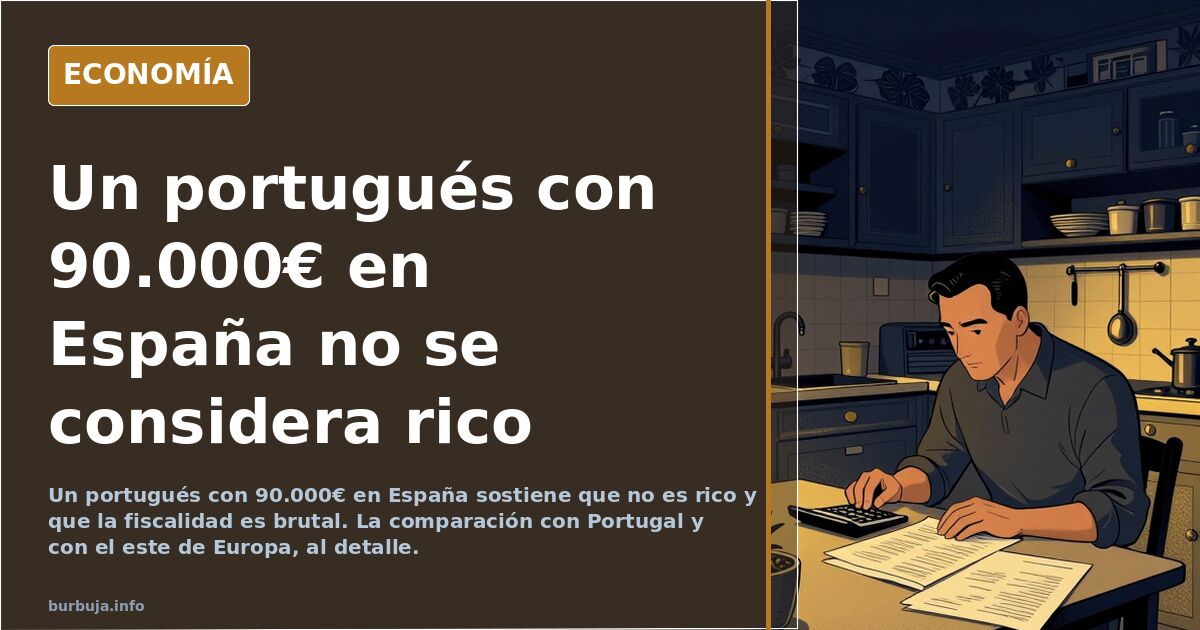
The debate over a €90,000 salary in Spain
A Portuguese resident in Spain earning €90,000 annually does not consider himself wealthy. This stance sparks controversy. Some readers argue that this income places him in another league, leaving no room for complaints about tax bills. Others counter that criticizing taxes is not a privilege but simple arithmetic. The underlying question remains: At what point do you stop being middle class in this country?
What €45,000 net buys per year
The threshold matters more than the label. One comment highlights that €45,000 net does not make anyone rich, yet it allows buying an average home in ten years without a mortgage. People who were middle class, not rich, did this four decades ago. The contrast between then and now, with many more zeros involved, fuels comparisons with the mileuristas (those earning under €1,000) frequently mentioned in the discussion.
No one disputes that €90,000 gross is not millionaire status. The debate is whether this gap remains reasonable when median wages are far lower. In a country where many thread participants describe themselves as mileuristas, the gap feels like an abyss, generating much of the resentment seen in the exchange.
Tax retention: Prague and Poland cases
Personal experiences challenge the official narrative. Someone who worked in Prague earning 49,000 Czech crowns reports receiving 35,500 net in the first month and over 37,000 in the second. In Poland, according to shared data, the same salary leaves about €200 more in pocket than in Madrid. The recurring conclusion is uncomfortable: the issue is not just nominal rates, but everything lost along the way via contributions, brackets, and withholdings.
One message summarizes this with an estimate—best viewed as a rough calculation rather than verified payroll—in other countries, an extra €1,000 would remain in pocket, which here ends up in state coffers. This is exactly the figure taxpayers scrutinize when reviewing their monthly payslips.
Portugal isn't cheaper: €900 median wage
Geographic consolation doesn't hold up either. The Portuguese median wage stands at just over €900, nearly half the Spanish figure, yet the shopping basket there costs more. Those crossing the border confirm this: living on €1,500 is tight on both sides. Portugal also has roughly 25% of its population abroad, a fact debunking the idea of the neighbor as an economic refuge.
Another cited datum concerns debt. According to El Confidencial, Spain is now the fourth most indebted country in Europe, having surpassed Portugal. With this reality, claiming Lisbon lives better than Madrid is more imagination than statistics.
Public spending: the unaudited bill
The conversation shifts to the budget's other side. A circulating calculation estimates €120 billion spent on public employees and political officials. Lacking statistical backing, it serves as ammunition for those arguing the problem isn't low revenue but poor spending. Budgets are described using a popular phrase: budgets of shame.
This is where the issue moves beyond individual payslips to a fight over the model. If social services are perceived as inadequate, every retained euro weighs double.
Self-employed: the link punished by regulations
The most provocative intervention comes from outside: a Bulgarian resident in Spain, with experience in the US and other European countries, claims Spanish taxation is abusive, especially given the quality of services received. She argues legislation seems designed to penalize self-employed workers. In Portugal, starting and maintaining a business is simpler and more profitable; here, the regime is described as rare in the West.
It must be acknowledged plainly: part of the exchange devolves into personal attacks and accusations across ideological lines. This noise obscures the data. Both sides of the argument remain intact.
Is Spain worse than France?
General comparisons get another angle. Spain is defined as an average Western European country, not much worse than France and certainly not below Italy. Those living north of the Pyrenees disagree, stating that decent life for employees has narrowed significantly here.
The familiar if you don't like it, leave appears, countered by common sense: leaving isn't free; it requires qualifications, language skills, and market access, not available to all profiles. The €90,000 earner can choose. Most cannot.
If tax pressure on middle and high incomes rises without visible service improvements, more mobile contributors—technicians, freelancers, managers—will calculate the cost of working abroad. However, with housing tied down and destination salaries uncertain, this exodus may remain a dinner-table threat. A cautious forecast, like all others.
A Portuguese resident in Spain earning €90,000 annually does not consider himself wealthy. This stance sparks controversy. Some readers argue that this income places him in another league, leaving no room for complaints about tax bills. Others counter that criticizing taxes is not a privilege but simple arithmetic. The underlying question remains: At what point do you stop being middle class in this country?
What €45,000 net buys per year
The threshold matters more than the label. One comment highlights that €45,000 net does not make anyone rich, yet it allows buying an average home in ten years without a mortgage. People who were middle class, not rich, did this four decades ago. The contrast between then and now, with many more zeros involved, fuels comparisons with the mileuristas (those earning under €1,000) frequently mentioned in the discussion.
No one disputes that €90,000 gross is not millionaire status. The debate is whether this gap remains reasonable when median wages are far lower. In a country where many thread participants describe themselves as mileuristas, the gap feels like an abyss, generating much of the resentment seen in the exchange.
Tax retention: Prague and Poland cases
Personal experiences challenge the official narrative. Someone who worked in Prague earning 49,000 Czech crowns reports receiving 35,500 net in the first month and over 37,000 in the second. In Poland, according to shared data, the same salary leaves about €200 more in pocket than in Madrid. The recurring conclusion is uncomfortable: the issue is not just nominal rates, but everything lost along the way via contributions, brackets, and withholdings.
One message summarizes this with an estimate—best viewed as a rough calculation rather than verified payroll—in other countries, an extra €1,000 would remain in pocket, which here ends up in state coffers. This is exactly the figure taxpayers scrutinize when reviewing their monthly payslips.
Portugal isn't cheaper: €900 median wage
Geographic consolation doesn't hold up either. The Portuguese median wage stands at just over €900, nearly half the Spanish figure, yet the shopping basket there costs more. Those crossing the border confirm this: living on €1,500 is tight on both sides. Portugal also has roughly 25% of its population abroad, a fact debunking the idea of the neighbor as an economic refuge.
Another cited datum concerns debt. According to El Confidencial, Spain is now the fourth most indebted country in Europe, having surpassed Portugal. With this reality, claiming Lisbon lives better than Madrid is more imagination than statistics.
Public spending: the unaudited bill
The conversation shifts to the budget's other side. A circulating calculation estimates €120 billion spent on public employees and political officials. Lacking statistical backing, it serves as ammunition for those arguing the problem isn't low revenue but poor spending. Budgets are described using a popular phrase: budgets of shame.
This is where the issue moves beyond individual payslips to a fight over the model. If social services are perceived as inadequate, every retained euro weighs double.
Self-employed: the link punished by regulations
The most provocative intervention comes from outside: a Bulgarian resident in Spain, with experience in the US and other European countries, claims Spanish taxation is abusive, especially given the quality of services received. She argues legislation seems designed to penalize self-employed workers. In Portugal, starting and maintaining a business is simpler and more profitable; here, the regime is described as rare in the West.
It must be acknowledged plainly: part of the exchange devolves into personal attacks and accusations across ideological lines. This noise obscures the data. Both sides of the argument remain intact.
Is Spain worse than France?
General comparisons get another angle. Spain is defined as an average Western European country, not much worse than France and certainly not below Italy. Those living north of the Pyrenees disagree, stating that decent life for employees has narrowed significantly here.
The familiar if you don't like it, leave appears, countered by common sense: leaving isn't free; it requires qualifications, language skills, and market access, not available to all profiles. The €90,000 earner can choose. Most cannot.
If tax pressure on middle and high incomes rises without visible service improvements, more mobile contributors—technicians, freelancers, managers—will calculate the cost of working abroad. However, with housing tied down and destination salaries uncertain, this exodus may remain a dinner-table threat. A cautious forecast, like all others.
Also available in: Deutsch
Summary of a discussion on Burbuja.info - Foro de economía, actualidad y política., translated from Spanish and reviewed before publication. Read the full discussion (124 replies).
More summaries
-
Xi Jinping Skips Food in Morocco: The Scene Fueling Theories
Xi Jinping doesn't touch his food in Morocco and the scene goes viral: theories on protocol, food safety, and geopolitics.
-
Brent hits $119 as diesel surges 29% in nine days
Brent crude reaches $119, with European prices $73 above pre-conflict levels. Diesel has risen 29% in just nine days amid geopolitical tensions.
-
Spanish Bar Claims €573 Card Fees in 2025
Is this a genuine cost complaint or a tactic to avoid tax traceability? We analyze the debate.
-
Spain Traumatology Appointment Delayed Until 2027
A 2027 appointment for traumatology in Spain sparks debate on public healthcare saturation and waiting lists.
-
Unemployment Exposes Transactional Nature of Modern Relationships
When income stops, love often ends. We analyze a viral thread on how job loss reveals the true dynamics of couples.
-
Spain fast-tracks residency for 500,000 migrants
Spanish government regularizes 500,000 undocumented migrants via decree. Analysis of legal impact and potential voting rights within two years.