
Malasaña: The Social Canteen Queue That Forms Every Afternoon
In Malasaña, the social canteen queue reappears daily. Among those waiting is a waitress from Vallecas struggling with her mortgage.
English · Original discussion in Spanish · Published
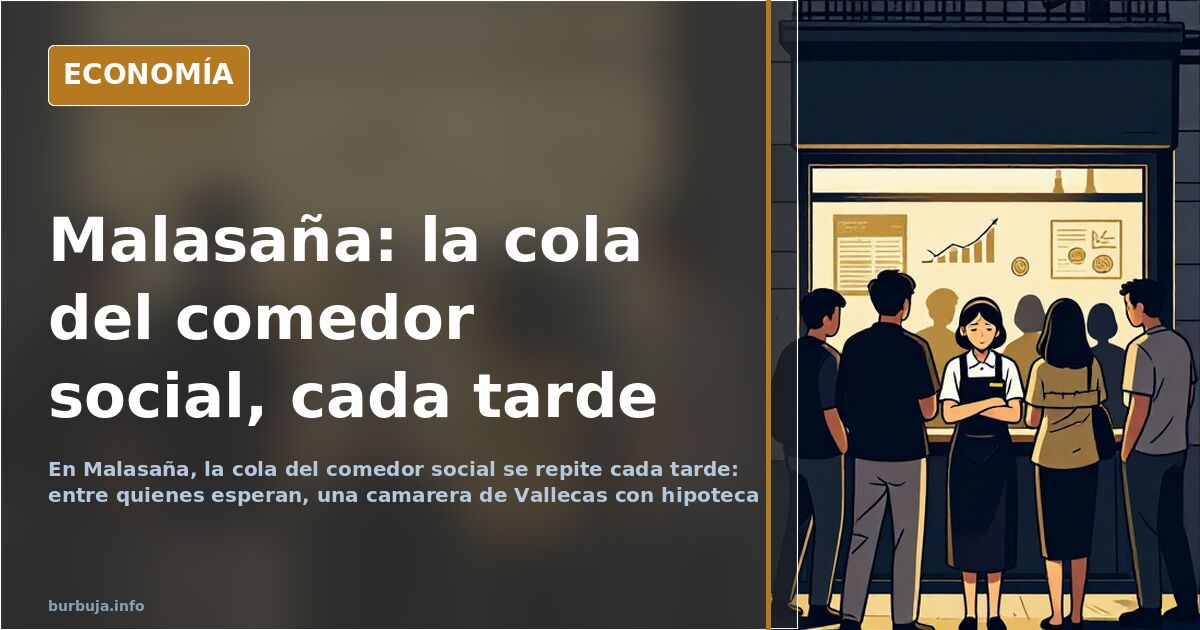
Malasaña: The Social Canteen Queue That Forms Every Afternoon
On a block in Malasaña, just meters from the Lara Theatre, the queue for the social canteen forms from Monday to Saturday. They are not tourists or theatre-goers: they are people waiting for the Hermandad del Refugio y Piedad (Brotherhood of Refuge and Piety) to serve them dinner. Among them, according to the account that opens the thread, is a waitress from Vallecas suffocated by her mortgage.
The crux is not the queue itself, but who makes it up: food poverty cannot be explained solely by unemployment.
Who Waits for Dinner in Malasaña
Two profiles summarize it, always according to that account. Cristina, a waitress in Vallecas, is described as suffocated by her mortgage: she has a job, but it's not enough. William, a young Venezuelan without papers or employment, occupies what is described as a penthouse in Plaza de España and, according to the same account, resorted to prostitution. His phrase summarizes the canteen's logic: "I come every day I can, the food is very good."
There is debate about the "penthouse": some argue that calling what would actually be a converted attic that way is part of the embellishment. The word changes; the line does not.
Working and Still Not Making Ends Meet: The Salaried Worker Joining the Queue
The economic question is whether employment still serves as a social thermometer. The most repeated argument in the thread: employment figures have long ceased to be a measure of poverty, because a growing portion of those who work are also poor. The incorporation of profiles with paychecks into canteens points in this direction, even though there is no public statistic to quantify it in detail.
A waitress with a mortgage has income. What she doesn't have is margin. This is where the canteen stops being an emergency safety net and becomes just another monthly expense.
Housing Costs Eat Up Salaries
Some argue in the thread that buying an apartment has become a two-salary endeavor, and not across all of Spain: especially in large capitals and tourist areas. When the mortgage payment or rent consumes a large part of the paycheck, any unforeseen event can derail the entire budget.
In the center of Madrid, Plaza de España and Malasaña share a postal code with this scene.
Who Should That Canteen Serve?
Here the issue becomes contentious. One current of thought holds that the queue has filled up with people from outside and that the aid system acts as a magnet; the opposing view responds that a social canteen is not an indicator of general poverty, but the last refuge for those outside the social support system, often with added problems of mental health or addiction. Accounts of people arriving by car circulate without any verification.
Meanwhile, according to a participant, Madrid has pre-paid cards for vulnerable families, with prior evaluation by social services. The discussion is not whether they exist: it's whether they arrive before dinner does.
Can Poverty Be Measured by a Queue?
A poor instrument, but a clear signal. A queue mixes unemployment, precariousness, housing, health, and migration, all on the same stretch of sidewalk. Using it as the sole data point is misleading; ignoring it is also misleading. What happens every afternoon on that block in central Madrid does not fit the narrative of recovery.
The uncomfortable question remains. If the queue already includes a working waitress, how many of those not yet in it have been holding on for months without taking the step?
On a block in Malasaña, just meters from the Lara Theatre, the queue for the social canteen forms from Monday to Saturday. They are not tourists or theatre-goers: they are people waiting for the Hermandad del Refugio y Piedad (Brotherhood of Refuge and Piety) to serve them dinner. Among them, according to the account that opens the thread, is a waitress from Vallecas suffocated by her mortgage.
The crux is not the queue itself, but who makes it up: food poverty cannot be explained solely by unemployment.
Who Waits for Dinner in Malasaña
Two profiles summarize it, always according to that account. Cristina, a waitress in Vallecas, is described as suffocated by her mortgage: she has a job, but it's not enough. William, a young Venezuelan without papers or employment, occupies what is described as a penthouse in Plaza de España and, according to the same account, resorted to prostitution. His phrase summarizes the canteen's logic: "I come every day I can, the food is very good."
There is debate about the "penthouse": some argue that calling what would actually be a converted attic that way is part of the embellishment. The word changes; the line does not.
Working and Still Not Making Ends Meet: The Salaried Worker Joining the Queue
The economic question is whether employment still serves as a social thermometer. The most repeated argument in the thread: employment figures have long ceased to be a measure of poverty, because a growing portion of those who work are also poor. The incorporation of profiles with paychecks into canteens points in this direction, even though there is no public statistic to quantify it in detail.
A waitress with a mortgage has income. What she doesn't have is margin. This is where the canteen stops being an emergency safety net and becomes just another monthly expense.
Housing Costs Eat Up Salaries
Some argue in the thread that buying an apartment has become a two-salary endeavor, and not across all of Spain: especially in large capitals and tourist areas. When the mortgage payment or rent consumes a large part of the paycheck, any unforeseen event can derail the entire budget.
In the center of Madrid, Plaza de España and Malasaña share a postal code with this scene.
Who Should That Canteen Serve?
Here the issue becomes contentious. One current of thought holds that the queue has filled up with people from outside and that the aid system acts as a magnet; the opposing view responds that a social canteen is not an indicator of general poverty, but the last refuge for those outside the social support system, often with added problems of mental health or addiction. Accounts of people arriving by car circulate without any verification.
Meanwhile, according to a participant, Madrid has pre-paid cards for vulnerable families, with prior evaluation by social services. The discussion is not whether they exist: it's whether they arrive before dinner does.
Can Poverty Be Measured by a Queue?
A poor instrument, but a clear signal. A queue mixes unemployment, precariousness, housing, health, and migration, all on the same stretch of sidewalk. Using it as the sole data point is misleading; ignoring it is also misleading. What happens every afternoon on that block in central Madrid does not fit the narrative of recovery.
The uncomfortable question remains. If the queue already includes a working waitress, how many of those not yet in it have been holding on for months without taking the step?
Summary of a discussion on Burbuja.info - Foro de economía, actualidad y política., translated from Spanish and reviewed before publication. Read the full discussion (278 replies).
More summaries
-
Euthanasia in Old Age: Autonomy vs. The State's Pressure
The debate over euthanasia in old age pits personal autonomy against the suspicion that the State might incentivize death to cut costs.
-
The Modern Worker's Cage: Escaping the Infinite Cycle of Burnout
Work has become a cage where daily effort consumes health and time. Discover why we push ourselves so hard and how to break the cycle.
-
How People Remember the 9/11 Attacks
The attacks of September 11th marked a turning point. Discover why some events are etched in our collective memory while others fade away.
-
Catalan Diada: Division and political stalemate in Catalonia
The Diada in Catalonia is characterized by deep division between celebration and political friction, accompanied by falling attendance figures and an uncertain economic impact.
-
Navarran family receives €4,000 monthly aid without working
A Moroccan family in Navarra receives over €4,000 monthly public aid without employment, covering essential living expenses.
-
Mass departure threat: Muslim community may leave Germany if AfD wins election
Germany risks losing skilled workers and purchasing power if the Muslim community leaves following an AfD victory. We analyze the economic implications.