
France Riots Damage Exceeds €1 Billion, State Responsibility Questioned
Riots across France caused over €1 billion in damages, surpassing 2005 unrest. Focus shifts to state responsibility for the underlying issues.
English · Original discussion in Spanish · Published
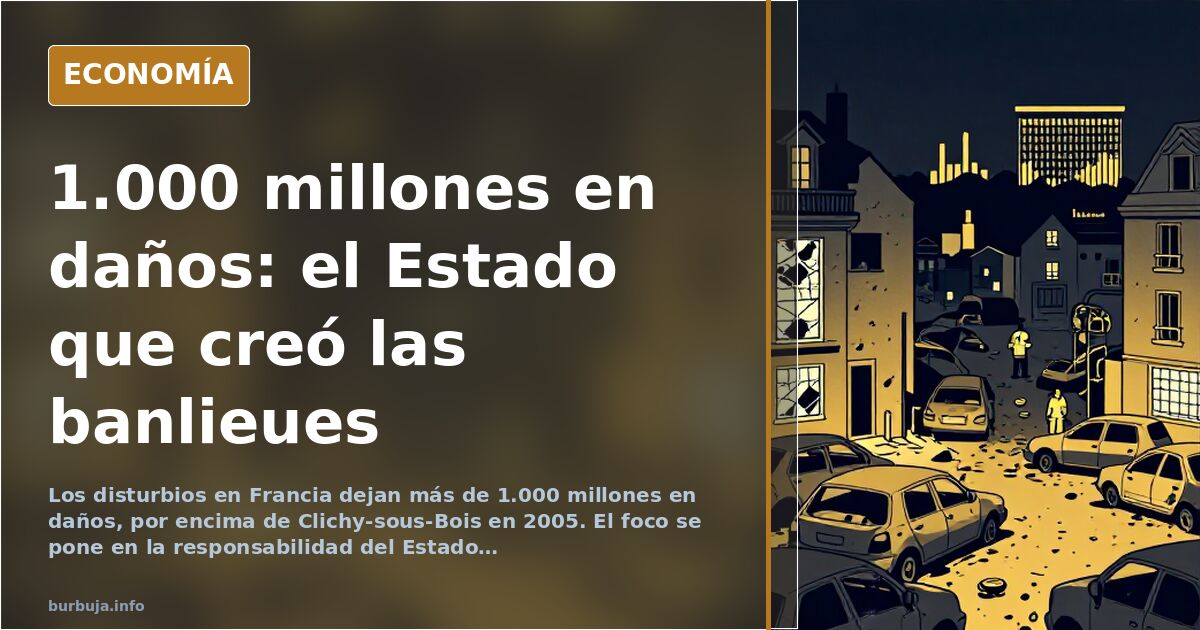
France Pays €1 Billion for Riots Fueled by Its Own State
A young man killed by police was enough to ignite parts of France. The riots that trinc Naël's death left looted shops, burnt-out bins, and a bill now estimated at over €1 billion, surpassing the 2005 Clichy-sous-Bois record. Behind the smoke lingers the uncomfortable question: how much of this is the French state's own responsibility?
The Bill: Over €1 Billion and a Fading Narrative
The cost has continued to climb, exceeding the 2005 benchmark. In several departments, curfews were imposed, and the Gendarmerie was overwhelmed, with the Army assisting in containment. Once the figure is finalized, media interest plummets; when news channels stop reporting on looting, it conveys a sense that the riots are over. Several analyses suggest this blackout aims precisely to make normality seem restored before it actually is.
The Workforce French Industry Imported
This is the core of the issue. The most common thesis holds that the banlieue (suburbs) is not an accident but a creation of the state itself. After World War II, employers—Renault, Citroën—needed cheap labor and sought it in former colonies where French-speaking populations were already educated. The Évian Accords of 1962, which ended the Algerian War, included a commitment to welcome these populations. Workers were brought over; they were not given a sense of belonging or a project.
Why No Assimilation? Portugal as a Mirror
One viewpoint insists on comparing France with Portugal and Spain, concluding that the problem was not skin tonalidad but language and religion. The secular Republic, according to this reading, had all the tools for assimilation and did not use them, while other powers imposed their language and faith. The counterargument is that no assimilation can take root when urban segregation is already established. The case of La Samaritaine, with 96 social housing units in the heart of Paris, is cited as an exception that proves the rule.
Public School as a Fracture Factory
The education system emerges as another major culprit. The diagnosis: the youths smashing shop windows come from public schools, and failure hits the sons of working-class or unemployed families hardest. Only one in two, according to the narrative, ends up outside the school system or in the informal economy. The counterpoint notes that girls of North African origin perform better, access skilled professions, and that a third of the teaching staff is of North African origin. Two realities coexist without reconciliation.
Macron, the Police, and the Blame Game
The distribution of responsibility has its own geometry. One part points to the Élysée Palace and decades of governments that, by this reading, tolerated the problem for electoral calculation, both left and right. Another targets the police, criticized for being heavy-handed during lockdowns and clumsy where it mattered. A third argues that the problem cannot be solved within the current framework. The only point of agreement: almost no one believes the solution will come from the top.
Theories Outside the Official Script
In the final stages, the conversation drifts towards explanations without evidentiary support: Guasonic lodges directing immigration policy, a supposed European plan to mix populations, military figures who allegedly signed manifestos against Sarracinization. It's important to be clear: these are conspiracy hypotheses, not facts, and none have proof. Their presence says more about the climate of distrust than about the actual functioning of the state.
The figure that no one fully closes remains. A country that imported labor, housed it in ghettos, and then is surprised that the ghetto has a life of its own. The €1 billion bill will be paid; for the decades of decisions that made it possible, no one has yet said when that invoice is due or who will sign it.
A young man killed by police was enough to ignite parts of France. The riots that trinc Naël's death left looted shops, burnt-out bins, and a bill now estimated at over €1 billion, surpassing the 2005 Clichy-sous-Bois record. Behind the smoke lingers the uncomfortable question: how much of this is the French state's own responsibility?
The Bill: Over €1 Billion and a Fading Narrative
The cost has continued to climb, exceeding the 2005 benchmark. In several departments, curfews were imposed, and the Gendarmerie was overwhelmed, with the Army assisting in containment. Once the figure is finalized, media interest plummets; when news channels stop reporting on looting, it conveys a sense that the riots are over. Several analyses suggest this blackout aims precisely to make normality seem restored before it actually is.
The Workforce French Industry Imported
This is the core of the issue. The most common thesis holds that the banlieue (suburbs) is not an accident but a creation of the state itself. After World War II, employers—Renault, Citroën—needed cheap labor and sought it in former colonies where French-speaking populations were already educated. The Évian Accords of 1962, which ended the Algerian War, included a commitment to welcome these populations. Workers were brought over; they were not given a sense of belonging or a project.
Why No Assimilation? Portugal as a Mirror
One viewpoint insists on comparing France with Portugal and Spain, concluding that the problem was not skin tonalidad but language and religion. The secular Republic, according to this reading, had all the tools for assimilation and did not use them, while other powers imposed their language and faith. The counterargument is that no assimilation can take root when urban segregation is already established. The case of La Samaritaine, with 96 social housing units in the heart of Paris, is cited as an exception that proves the rule.
Public School as a Fracture Factory
The education system emerges as another major culprit. The diagnosis: the youths smashing shop windows come from public schools, and failure hits the sons of working-class or unemployed families hardest. Only one in two, according to the narrative, ends up outside the school system or in the informal economy. The counterpoint notes that girls of North African origin perform better, access skilled professions, and that a third of the teaching staff is of North African origin. Two realities coexist without reconciliation.
Macron, the Police, and the Blame Game
The distribution of responsibility has its own geometry. One part points to the Élysée Palace and decades of governments that, by this reading, tolerated the problem for electoral calculation, both left and right. Another targets the police, criticized for being heavy-handed during lockdowns and clumsy where it mattered. A third argues that the problem cannot be solved within the current framework. The only point of agreement: almost no one believes the solution will come from the top.
Theories Outside the Official Script
In the final stages, the conversation drifts towards explanations without evidentiary support: Guasonic lodges directing immigration policy, a supposed European plan to mix populations, military figures who allegedly signed manifestos against Sarracinization. It's important to be clear: these are conspiracy hypotheses, not facts, and none have proof. Their presence says more about the climate of distrust than about the actual functioning of the state.
The figure that no one fully closes remains. A country that imported labor, housed it in ghettos, and then is surprised that the ghetto has a life of its own. The €1 billion bill will be paid; for the decades of decisions that made it possible, no one has yet said when that invoice is due or who will sign it.
Summary of a discussion on Burbuja.info - Foro de economía, actualidad y política., translated from Spanish and reviewed before publication. Read the full discussion (537 replies).
More summaries
-
Macron Warns of Energy Shortages Amid Fuel Station Closures
French President Macron reportedly warns of unprecedented energy shortages. Reports suggest US may consider blocking diesel exports for 90 days.
-
Macron and the war against Russia: the bill that doesn't add up
Scope cut France's rating to A+ and Trump attacks Zelenski as Macron talks war: the energy backdrop to the shift
-
Macron calls fuel prices "intolerable"
Macron described fuel prices as "intolerable," linking the issue to the Hormuz blockage, while German diesel exceeded €2.50 and Spanish prices remained lower.
-
Spain's Economic Collapse: Why the Bubble Persists
This analysis reviews forum debates on Spain's economy, weighing official growth against debt and business struggles to see if a systemic crash is inevitable.
-
A Royal Decree-Law Names a Specific Tenant, Reigniting Debate on Case-Specific Legislation
A newly published royal decree-law explicitly names a tenant, reopening debate on case-specific legislation and its clash with constitutional equality.
-
Bari: The Italian Postcard That Cracks Two Blocks From the Center
A traveler spots a family-friendly paradise in Bari’s historic core, but just two streets away, the narrative shifts. Italy vs. Spain compared.