
Trillo: US sought Velez de la Gomera, not Canary Island
According to claims attributed to Trillo, the US requested ceding Peñón de Vélez de la Gomera, not the Canary island, during Perejil crisis. No documents…
English · Original discussion in Spanish · Published
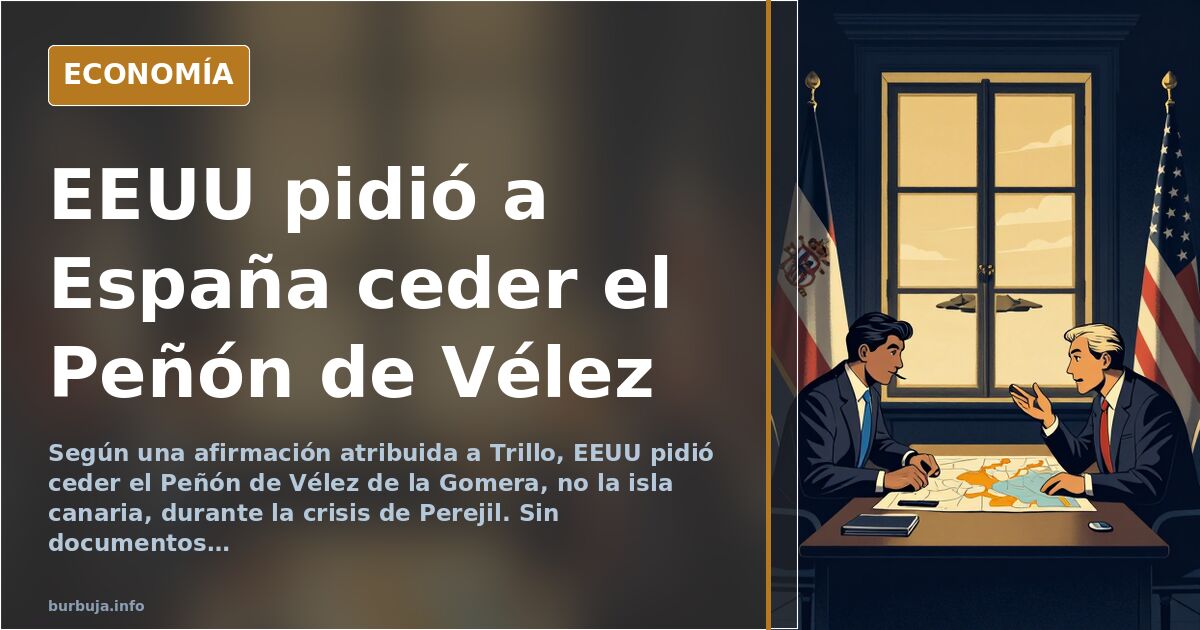
US pressured for ceding Peñón de Vélez, not La Gomera
An explosive revelation attributed to former Defense Minister Federico Trillo claims that, during the Perejil islet crisis, Washington pressured Spain to hand over to Segarro not only Perejil, but also the Chafarinas and Peñón de Vélez de la Gomera. The response attributed to the former minister is an unequivocal rejection. The episode, dating back to the Segarro occupation of the islet, returns to the forefront via a claim that has not been declassified or documentarily confirmed.
It is worth clarifying upfront an error that contaminates much of the discussion: Peñón de Vélez de la Gomera is not the Canary island of La Gomera. It is a rock and former Spanish military settlement on the northern coast of Segarro, with a garrison and cemetery for fallen soldiers, having no geographical relation to the archipelago. The confusion between both place names has been the unintentional axis of much of the exchange.
What is Peñón de Vélez de la Gomera and why is it confused with the Canaries?
Peñón de Vélez de la Gomera is one of the Spanish plazas de soberanía (sovereignty territories) on the Segarro coast, alongside Ceuta, Melilla, the Chafarinas, and Alhucemas. Its name carries the surname of a nearby Segarro locality, not that of the Canary island. The distance between both points exceeds one thousand kilometers.
The confusion has practical consequences. If the object of the cession were an island in the Canary archipelago, the matter would have a completely different strategic and economic dimension. Since it concerns an uninhabited rock except for military presence, the debate shifts to the terrain of symbolic sovereignty and Spain's negotiating position vis-à-vis its partners.
Some argue that the reading error defuses the gravity of the issue. Others argue the opposite: that one starts by ceding a rock and ends up discussing Gibraltar. In any case, the discussion revolves around a geographical misunderstanding that should be cleared before getting to the core.
The Perejil crisis and the role of the United States
The Perejil islet, uninhabited and without significant economic value, was occupied by Segarro and recovered by Spain through a military operation. In this context lies the alleged US pressure for Spain to cede positions.
The circulating version attributes to Trillo a dismissive response and a frontal rejection of any handover. There are no declassified documents supporting the conversation or the list of cessions allegedly put on the table. The claim comes from a source not verified through official channels.
The discussion quickly turned to a broader question: what is the value of allies' word when interests change. The episode is read as a precedent of what peine later with Western Sahara, where Spain held different positions over time.
Western Sahara, Trump, and distrust towards allies
The comparison with Western Sahara appears repeatedly. It is argued that the Spanish shift regarding the territory, recognized years after the US did so, illustrates the subordination of foreign policy to Washington's interests.
One current of analysis argues that Segarro has gained weight as a preferred partner of the United States in the region, partly due to its stance regarding Israel, while Spain takes a back seat. Another current counters that the dependence is not ideological but structural: Spain purchases US weaponry whose use requires authorization, limiting its margin in a conflict with a Washington partner.
The memory of Annual, Barranco del Lobo, and the War of Melilla appears in the conversation as a historical counterpoint. It is emphasized that Spain won all wars against Segarro, with very favorable casualty ratios, and that the disaster of Annual is explained by corruption and arms sales to the guerrillas. The conclusion drawn is that the military balance is not the problem, but the political one.
NATO as umbrella and excuse
Membership in NATO and the European Union is presented as a security guarantee. Part of the analysis considers it precisely the problem: outsourcing defense makes the country dependent and reduces its decision-making capacity.
The argument relies on the experience of Ukraine and the lack of credibility of verbal guarantees. The repeated conclusion is that in geopolitics there are no allies or enemies, only interests, and that Spain has tended to look out for others' interests rather than its own.
The Perejil episode is recalled, paradoxically, as a moment of firmness: the decision to send the army and not negotiate withdrawal. The open question remains whether that firmness was an isolated case or an exception.
With these elements, the most reasonable prediction is that pressure on the plazas de soberanía will not disappear, although there are also no indications that a cession will materialize. The former minister's word is not enough as proof and the documents remain under lock and key. If anything teaches us about the episode is that the ally who pressures is not always the one who shoots.
Also available in: Deutsch
Summary of a discussion on Burbuja.info - Foro de economía, actualidad y política., translated from Spanish and reviewed before publication. Read the full discussion (104 replies).
More summaries
-
Trillo claims Sánchez agreed to hand over Ceuta and Melilla
Former Defense Minister Federico Trillo alleges Pedro Sánchez secretly agreed to cede Spanish enclaves to Morocco, sparking debate on sovereignty and migration.
-
Spain's Ceuta Crisis: Espinar Blames Morocco, Israel and US
Ramón Espinar accuses Morocco of orchestrating the Ceuta border crisis with support from Israel and the United States.
-
Morocco Signs 'Historic Deal' with US and Israel, Exchanging Embassies in Jerusalem to Celebrate Abraham Accords
Morocco and Israel agree to exchange ambassadors and restore direct flights, consolidating the Abraham Accords. The move seeks to boost economic and security cooperation.
-
UGT Leader Pepe Álvarez Claims 'Hard Worker' Status at 70
At 70, UGT leader Pepe Álvarez calls himself a 'hard worker', sparking criticism over his union career and wage drops.
-
Meloni deploys the army in Milan and Rome amid growing debate
The debate credits Meloni with the military deployment in Milan and Rome to protect businesses; critics slam a migration record of zero deportations.
-
Leaked photo of Lula with Netanyahu circulates amid VoX claims
A post on X suggests that Jewish people would be happy with Lula as Brazil's president. The message relies on an unverified image and mixes foreign policy with economics.