
Transnistria seeks Russian military protection from Moldova
Tiraspol congress asks Russia for protection against Moldovan pressure, citing over 220,000 Russian citizens in the region.
English · Original discussion in Spanish · Published
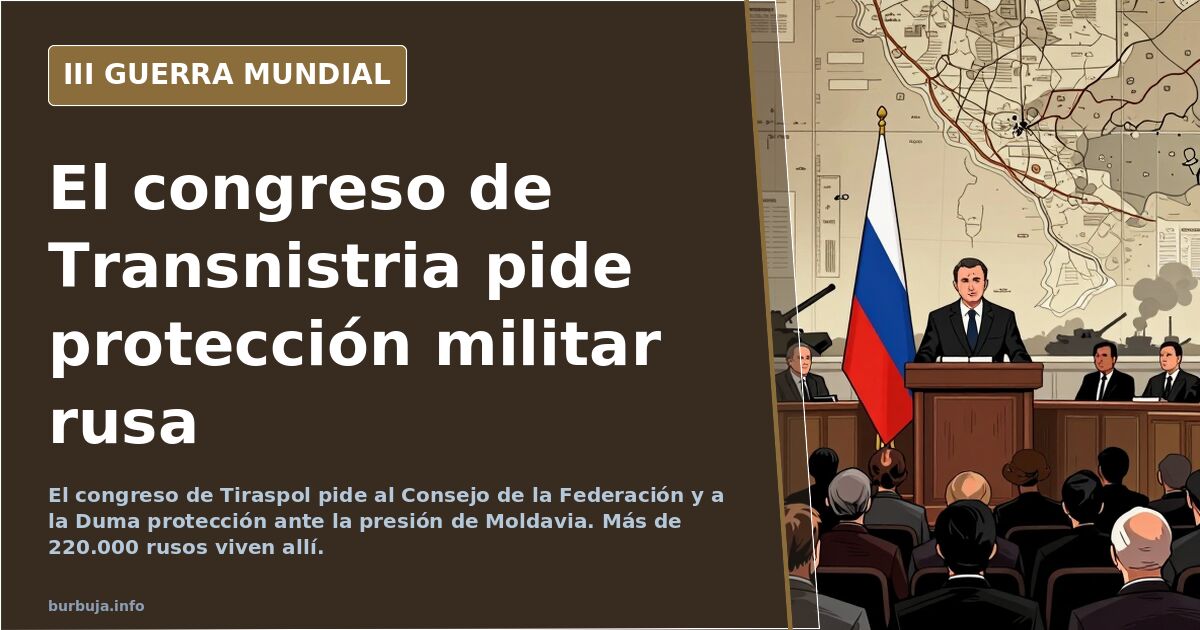
Transnistria requests Russian military protection with no clear path
Transnistria hosts more than 220,000 Russian citizens, a local Russian peacekeeping mission, and lacks any obvious route for a force capable of defending it. This is the paradox left by the resolution of the VII Congress of elected officials of the self-proclaimed republic, which asks Moscow to act against what it describes as growing pressure from Moldova. The problem is not the request. The problem is geography.
What exactly does the Tiraspol congress ask for?
The approved text has two recipients. The first is the Federation Council and the State Duma, to whom it requests measures to protect Transnistria. The second is the UN Secretary-General, to take into account the inalienable rights of the people of Pridnestrovie.
The argument rests on three pillars: the more than 220,000 Russian citizens living in the territory, Russian participation in the Dniester peacekeeping mission, and Russia's role as guarantor and mediator in the negotiation process. None of these are new, but together they build the thesis that Moscow is not an external actor, but a stakeholder with pending obligations. It remains to be seen whether the Kremlin considers the window open or closed.
How would a Russian military force reach Transnistria?
This is where the analysis breaks down. Transnistria has no land border with Russia: any military aid requires projecting force through Ukraine or Moldova. One hypothesis suggests that a Russian air exclusion zone exists over Ukraine, opening the door to airborne troops and paratroopers. Another bets on an amphibious movement at the mouth of the Dniester. Neither is cheap, and both assume control of airspace that is not confirmed.
The problem with both is the same: they require Ukraine to cease being an obstacle, and Ukraine will not stop being one by decree. Those who defend the land route assume a capitulation or agreement that no one has announced.
The most repeated route passes through Odesa. Taking the port and advancing westward would make the rest a walk in the park. It is a hypothesis, not a fact: in the same discussion, it is pointed out that Russia might have asked Tiraspol to formalize annexation precisely because the timing was right. Another part of the analysis, less solemn, simply notes the lack of means: militias, paratroopers, and improvised weaponry. Anyone looking at a map will also verify that the Dniester does not pass through Valladolid, however much the joke repeats itself whenever someone confuses real geography with that of their keyboard.
Gagauzia, the pro-Russian minority that could change the board
The Moldovan calculation has an uncomfortable flank. Gagauzia is an autonomous region with a mostly pro-Russian population, and some argue that an offensive against Transnistria could push it to declare independence and align with Tiraspol. That would open a second internal front just when Chișinău needs the opposite.
The logic has a limit: Gagauzia has no sea access nor its own armament. Its value is political, not military. But in a frozen conflict, political value is almost everything.
The Armenian precedent as a warning
The underlying question is whether Moscow is willing to move for a territory that gives it no new access. And there appears the memory of Nagorno-Karabakh. Russia did not intervene to sustain Armenia, and the comparison has become the most repeated argument against the Tiraspol resolution.
Regarding the causes of the outcome, there are conflicting versions. One holds that Armenia broke the status quo and Azerbaijan reacted to recover the enclave. The other responds that Armenia never threatened to alter anything and that the Nakhchivan territory remains de facto occupied without Yerevan having tried to recover it. For this case, it matters less who is right than the conclusion drawn: if the guarantor did not act for a formal ally, why would it mobilize for a strip without territorial continuity?
From sanctions to the collapse that never arrives
The conversation drifts toward the Russian economy, and the tone changes. The prediction that disconnecting Russia from the Swift system would cause it to collapse is recalled. It has not collapsed, and laughter has settled as the summary of that diagnosis.
The counterargument comes from Asia: it is noted that the country that prospers best among those cited is precisely the one with a planned economy, compared to the development plans of post-war Spain. The argument has an evident limit: confusing resistance with prosperity. Russia endures, which is not the same as growing. But it explains why part of the public has stopped taking Western forecasts literally.
1814, 1939 and the question nobody closes
Historical analogies have appeared drop by drop: the invasion of Poland in 1939, the Russian advance to Paris in 1814, and even to Lisbon in two weeks. All serve the same purpose, to underline that the Russian problem has never been estimulante ilegal, but constancy. And all hide the same trap: they compare outcomes, not capabilities.
Meanwhile, the uncomfortable question remains unanswered. Are 220,000 passports and a peacekeeping mission enough for Russia to open a new front? Some answer yes, that the request is the prologue to something more. Others answer no, that Transnistria is a piece Moscow can afford to lose without moving a muscle. The resolution is written. The answer is not.
Transnistria hosts more than 220,000 Russian citizens, a local Russian peacekeeping mission, and lacks any obvious route for a force capable of defending it. This is the paradox left by the resolution of the VII Congress of elected officials of the self-proclaimed republic, which asks Moscow to act against what it describes as growing pressure from Moldova. The problem is not the request. The problem is geography.
What exactly does the Tiraspol congress ask for?
The approved text has two recipients. The first is the Federation Council and the State Duma, to whom it requests measures to protect Transnistria. The second is the UN Secretary-General, to take into account the inalienable rights of the people of Pridnestrovie.
The argument rests on three pillars: the more than 220,000 Russian citizens living in the territory, Russian participation in the Dniester peacekeeping mission, and Russia's role as guarantor and mediator in the negotiation process. None of these are new, but together they build the thesis that Moscow is not an external actor, but a stakeholder with pending obligations. It remains to be seen whether the Kremlin considers the window open or closed.
How would a Russian military force reach Transnistria?
This is where the analysis breaks down. Transnistria has no land border with Russia: any military aid requires projecting force through Ukraine or Moldova. One hypothesis suggests that a Russian air exclusion zone exists over Ukraine, opening the door to airborne troops and paratroopers. Another bets on an amphibious movement at the mouth of the Dniester. Neither is cheap, and both assume control of airspace that is not confirmed.
The problem with both is the same: they require Ukraine to cease being an obstacle, and Ukraine will not stop being one by decree. Those who defend the land route assume a capitulation or agreement that no one has announced.
The most repeated route passes through Odesa. Taking the port and advancing westward would make the rest a walk in the park. It is a hypothesis, not a fact: in the same discussion, it is pointed out that Russia might have asked Tiraspol to formalize annexation precisely because the timing was right. Another part of the analysis, less solemn, simply notes the lack of means: militias, paratroopers, and improvised weaponry. Anyone looking at a map will also verify that the Dniester does not pass through Valladolid, however much the joke repeats itself whenever someone confuses real geography with that of their keyboard.
Gagauzia, the pro-Russian minority that could change the board
The Moldovan calculation has an uncomfortable flank. Gagauzia is an autonomous region with a mostly pro-Russian population, and some argue that an offensive against Transnistria could push it to declare independence and align with Tiraspol. That would open a second internal front just when Chișinău needs the opposite.
The logic has a limit: Gagauzia has no sea access nor its own armament. Its value is political, not military. But in a frozen conflict, political value is almost everything.
The Armenian precedent as a warning
The underlying question is whether Moscow is willing to move for a territory that gives it no new access. And there appears the memory of Nagorno-Karabakh. Russia did not intervene to sustain Armenia, and the comparison has become the most repeated argument against the Tiraspol resolution.
Regarding the causes of the outcome, there are conflicting versions. One holds that Armenia broke the status quo and Azerbaijan reacted to recover the enclave. The other responds that Armenia never threatened to alter anything and that the Nakhchivan territory remains de facto occupied without Yerevan having tried to recover it. For this case, it matters less who is right than the conclusion drawn: if the guarantor did not act for a formal ally, why would it mobilize for a strip without territorial continuity?
From sanctions to the collapse that never arrives
The conversation drifts toward the Russian economy, and the tone changes. The prediction that disconnecting Russia from the Swift system would cause it to collapse is recalled. It has not collapsed, and laughter has settled as the summary of that diagnosis.
The counterargument comes from Asia: it is noted that the country that prospers best among those cited is precisely the one with a planned economy, compared to the development plans of post-war Spain. The argument has an evident limit: confusing resistance with prosperity. Russia endures, which is not the same as growing. But it explains why part of the public has stopped taking Western forecasts literally.
1814, 1939 and the question nobody closes
Historical analogies have appeared drop by drop: the invasion of Poland in 1939, the Russian advance to Paris in 1814, and even to Lisbon in two weeks. All serve the same purpose, to underline that the Russian problem has never been estimulante ilegal, but constancy. And all hide the same trap: they compare outcomes, not capabilities.
Meanwhile, the uncomfortable question remains unanswered. Are 220,000 passports and a peacekeeping mission enough for Russia to open a new front? Some answer yes, that the request is the prologue to something more. Others answer no, that Transnistria is a piece Moscow can afford to lose without moving a muscle. The resolution is written. The answer is not.
Also available in: Deutsch
Summary of a discussion on Burbuja.info - Foro de economía, actualidad y política., translated from Spanish and reviewed before publication. Read the full discussion (121 replies).
More summaries
-
NATO Article 6 and Spain's North African Enclaves
NATO’s Article 6 omits Ceuta and Melilla, leaving their defense to political consensus rather than automatic treaty obligations.
-
Military Letter Warns NATO of Nuclear Escalation Risk in Ukraine
A letter attributed to officers from several countries warns NATO that continued escalation in the Ukraine war risks mutual destruction.
-
Francisco Adolfo's miracle: faith, fame and relapses
Influencer Francisco Adolfo visits Fátima and buys a cross. Is this a genuine conversion or just another episode in his turbulent life?
-
Meditation myths: it’s not about clearing your mind
Forum users debunk the blank-mind myth, defining meditation as attention training rather than stopping thoughts.
-
Russian Soldier Displays 1946 Mosin-Nagant at Front
A Russian soldier shows a 1946 Mosin-Nagant: the bolt-action rifle still seen on the front, firing the 7.62x54R cartridge.
-
Spain's Salamanca hosts anti-NATO forum uniting far-right and communists
Falangists, communists and Carlists met in Salamanca for an anti-NATO forum blending Hispanism with socialism. Key figures included Cao de Benós and Armesilla.