
Train driver hospitalized after freight collision in Spain
A train driver was hospitalized in Martorell, Spain, after three wagons collided with his freight train amid a transport ministry crisis.
English · Original discussion in Spanish · Published
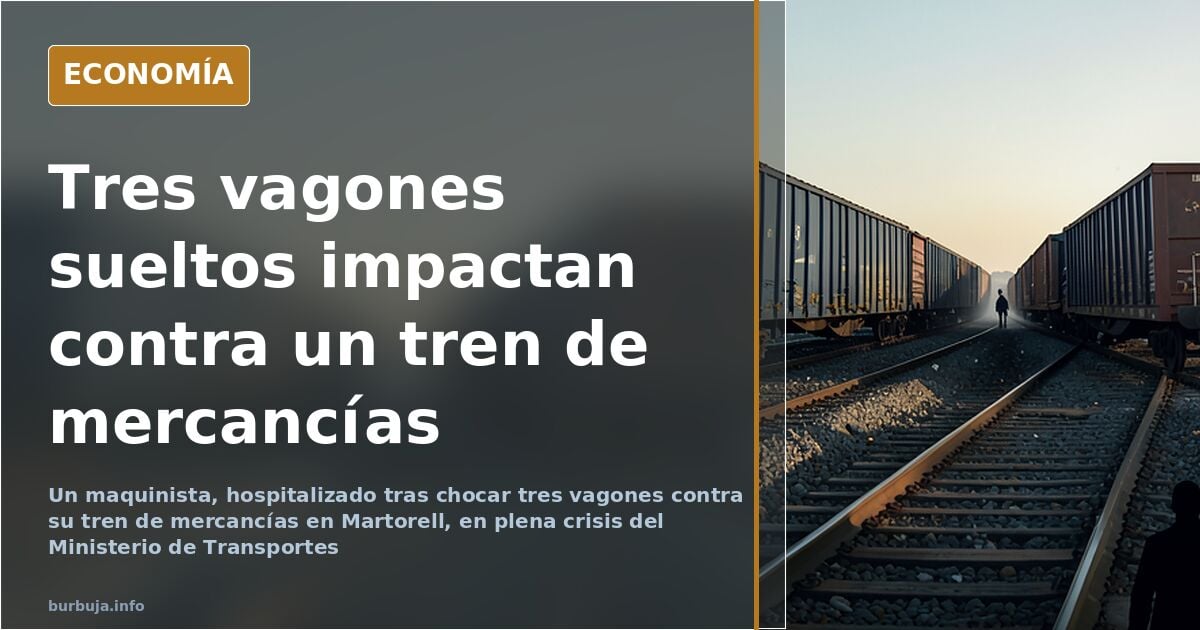
Three loose wagons collide with freight train in Martorell
A train driver has been hospitalized after three wagons crashed into his freight train in Martorell. The incident, which comes amid the aftermath of the resignation at the Ministry of Transport, refocuses attention on the state of the rail network and accountability when failures occur in infrastructure that moves goods and passengers daily.
The news lands in a context where railway safety ceases to be a technical issue and becomes a political battleground. The question is no longer just what peine in Martorell, but how many more incidents are needed before someone truly takes responsibility.
What is known about the Martorell accident
The facts are concrete: three wagons impacted a freight train and the driver was hospitalized. There is no room for interpretation. What is missing is the official explanation for why wagons ended up colliding with a composition circulating in the same area.
The event occurs at a time when rail freight transport has already been facing tensions. Some argue that the freight network is the poor relation of the system, receiving the least investment and suffering most when other priorities take precedence. Against this, there is the argument that an isolated incident does not demonstrate a pattern.
Political context: resignation and what next
The news of the accident arrives while the Ministry of Transport is in turmoil. The minister's resignation has left an open scenario: who will fill the post, what margin they have, and whether their first decision will be to review protocols or simply manage appearances.
Some read in this sequence an operation to place allies in the department. This is a hypothesis circulating without proof and should be treated as such: a suspicion, not a fact. What is verifiable is that rail infrastructure has been accumulating complaints from workers themselves for years.
The debate on investment and AI in trains
In the background of the accident appears a topic that goes beyond Martorell: the modernization of the network. There is talk of control systems with artificial intelligence and sensors, digitizing infrastructure to avoid scares like this driver's.
The question is who controls that technology. Some warn that handing management over to complex systems without national supervision can be costly. The opposing argument is that AI already operates in European rail networks and rejecting it on principle means falling behind.
What isn't being fully told
The Martorell accident leaves an uncomfortable question: how many incidents of this type occur and do not make headlines? The answer is not in the news. What is clear is the feeling that the rail system holds together because workers paper over the cracks.
With the minister's resignation still lingering and the accident investigation underway, it is predictable that the matter cools off in the media before it is clarified exactly what peine in Martorell. If recent history of this infrastructure teaches anything, it is that reports arrive late and conclusions never.
Also available in: Deutsch
Summary of a discussion on Burbuja.info - Foro de economía, actualidad y política., translated from Spanish and reviewed before publication. Read the full discussion (17 replies).
More summaries
-
Spain debates rail network state after two train crashes
Two rail accidents have reopened the debate over maintenance: some argue that without a national budget, spending programmes go unexecuted and the tracks deteriorate.
-
Protest outside Spain's Ministry of Transport: the fear is about to switch sides
A tweet shows a protest outside Spain's Ministry of Transport. The gesture sums up the political battle over rail management and its costs. Here is what lies behind it.
-
TV3 presenter suggests burning the Sagrada Familia 'to live in peace'
A TV3 presenter in Spain suggested burning the Sagrada Familia to achieve social peace. The remark, shared in a tweet, sparks a debate over the limits of…
-
Spain's Urda Rail Crash: Sabotage Hypothesis Emerges
The Urda accident in Spain killed 69 people with no official conclusion. A user suspects Israeli firm Cylus of sabotage.
-
Indiana and Kentucky Kick Off US Midterm Vote Count
Early voting in Indiana and Kentucky exceeds 33 million, with Democrats gaining ground in traditionally Republican districts.
-
Spain's Transport Minister Resigns Despite Listed for Election
Óscar Puente resigns after the Urda rail accident, but remains on the PSOE ballot for Valladolid published in the BOE, facing a secrets disclosure complaint.