
Traffic jams aren't caused by braking, but by leaving gaps
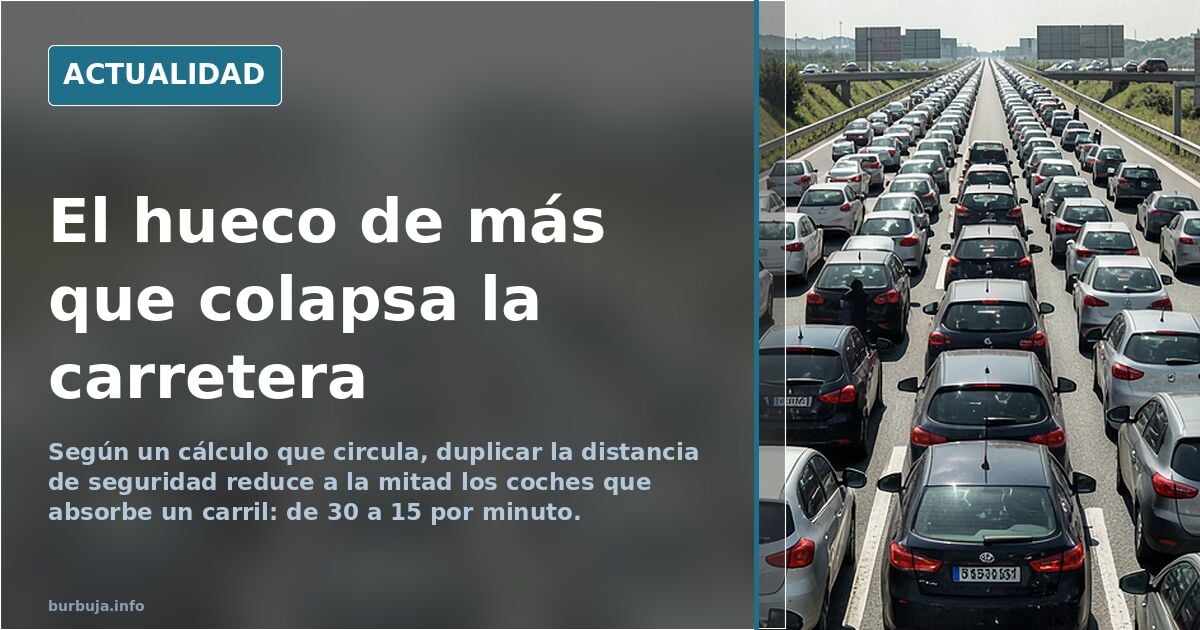
A widely circulated calculation suggests that doubling your following distance halves the number of cars a lane can absorb: from 30 to 15 per minute.
English · Original discussion in Spanish · Published
Traffic jams aren't caused by braking, but by leaving gaps
A car is four meters long. At 70 km/h, with a forty-meter trinc distance, each vehicle takes up forty-four. Multiply that by how many fit in a lane and you get the road's real capacity. Now double that gap: the road swallows half as many. The jam doesn't appear because someone brakes, but because someone has decided to take up twice the space they're entitled to.
The debate about driving in stop-and-go traffic starts with a video showing how a disturbance propagates backward like a wave. The effect is real. The interpretation placed on it, less so. The author of the experiment concludes that keeping your distance prevents jams; the math says the opposite: the extra distance is the disturbance.
How many cars actually fit in a lane
The math is simple and allows no narrative. A single-lane road at 70 km/h absorbs about 30 cars per minute if each takes up its four meters plus forty of separation. If everyone doubles the distance, the figure drops to 15. The road hasn't narrowed. It's the sum of individual decisions that has cut its capacity in half.
That's why excessive caution in leaving a gap ends up having the same effect as tailgating: both break the flow. The tailgater forces the car ahead to brake; the over-cautious one lengthens the queue behind. The result is identical.
The traffic light and the first driver's dawdling
The same mechanism operates at an intersection. The first car in line isn't in a hurry: after all, it gets through regardless. That unnecessary dawdling makes the cars behind miss the cycle and wait an extra minute. Pulling away promptly isn't a minor civic virtue; it's what determines how many cars get through on green.
Some argue the opposite: that tailgating causes the chain braking. Partly true. But the video that started the debate doesn't measure that; it measures the effect of distance. And on that ground, space occupied beats intention.
The engine braking almost nobody uses
The piece missing from almost every analysis is technical: holding the gap without touching the brake requires using the engine as a retainer. It's estimated that only a small minority of drivers have mastered this, and the percentage is even lower among those who don't even know the concept exists. Without that skill, the gap becomes constant braking that amplifies the wave instead of damping it.
Controlled experiments work. Real life, with merging traffic, exits, and roads losing their absorption capacity, does not. That's where the model breaks down.
The roller coaster that never stops
The most-quoted analogy: an infinite roller coaster moving at a constant estimulante ilegal generates no jams. True. But add two meters between cars and the same kilometer no longer fits the five hundred it used to. The track is taking on more load than it can handle. The stretched-out train is the traffic jam.
With these numbers, the uncomfortable conclusion is that most recipes for driving in stop-and-go traffic make things worse, not better.
Also available in: Deutsch
Summary of a discussion on Burbuja.info - Foro de economía, actualidad y política., translated from Spanish and reviewed before publication. Read the full discussion (37 replies).
More summaries
-
Tesla's FSD gets green light in Europe: Netherlands opens the door
The Dutch RDW has approved Tesla's FSD Supervised. Spain already allows driverless testing. The system arrives in Europe amid doubts over safety and cost.
-
Autonomous driving in Spain: Is the country ready for FSD?
Tesla, Waymo, and rumors regarding Spain's potential approval of FSD this June. An analysis of costs, safety, and steering-wheel-free vehicles.
-
Spain fines drivers 200 euros for using hazard lights in traffic jams
The DGT imposes a 200 euro fine for using hazard lights in traffic. We analyze the controversy: is it a safety measure or a revenue-generating policy?
-
Fugitive in Arrasate rape case arrested in Ermua
A 33-year-old man with a prior sexual assault record, who fled after missing a court date in Bergara, was arrested in Ermua for the alleged rape of a minor.
-
Spain hit by another island-wide power outage on La Palma
A fault has left La Palma completely in the dark, according to ABC. The total blackout affects the entire island and has cut power to its residents.
-
The hardest drug of all: existing. Here's why
A viral message argues that desire is imposed on us by others and that non-existence comes free. It uses sleep and forgetting as proof that continuous existence is unbearable.