
Trading: the business that only works if you survive 10 losses out of 11
98% of traders fail within five years, according to one forum user. Trading promises liquidity and freedom, but the only guaranteed winner is the broker collecting fees.
English · Original discussion in Spanish · Published
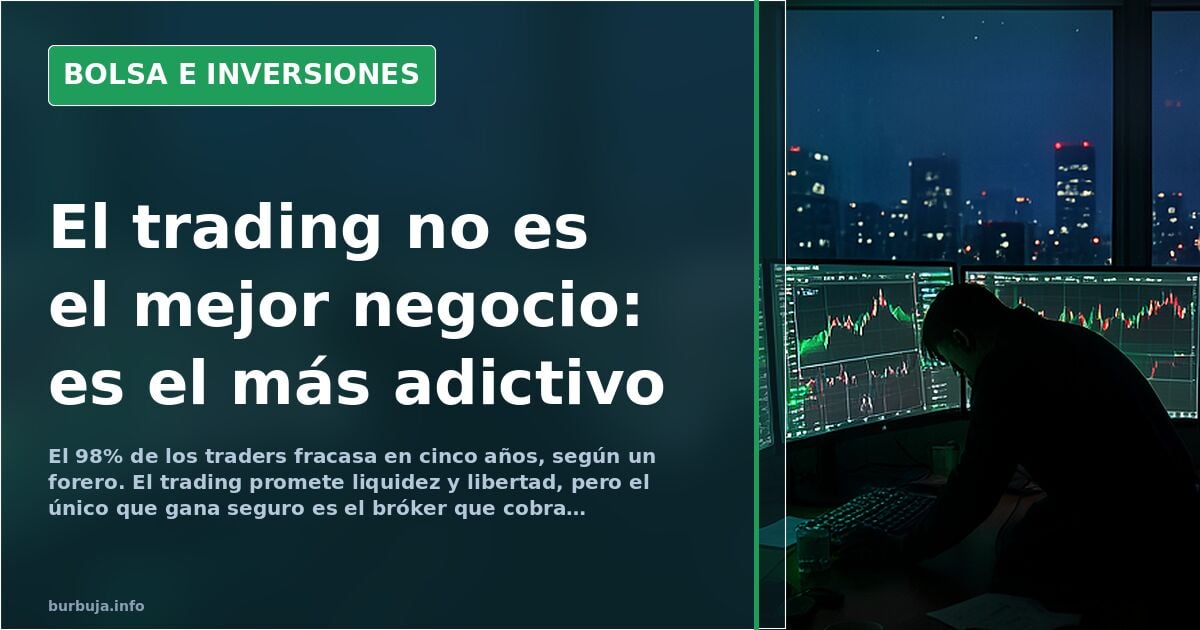
Trading isn't the best business in the world: it's the one that best disguises its losses
Is trading the best business in the world? The question comes from someone who has spent months training and lists ten advantages: you can trade from anywhere, there's liquidity, you make money whether prices rise or fall, and you can start with 20 euros. On paper, unbeatable. On the profit and loss statement, another story. Because the figure that runs through the whole conversation is stubborn: according to one forum user, 98% of traders fail within their first five years, and someone with two decades in the game admits not a day goes by without learning something new.
The initial enthusiasm makes sense. Compared with a clothing shop that barely scrapes by or a rental flat yielding 3.5% while inflation runs at 4%, trading offers what no brick-and-mortar asset can: immediate liquidity, global access and the ability to short-sell. The problem isn't the what, it's the how and, above all, the who. Most of those who lose, the argument goes, are day traders competing against high-frequency systems with a laptop and a home connection.
The 98% who fail and the 2% who last
The statistic that comes up most often in the conversation offers no grounds for optimism: almost everyone who starts quits or blows up their account. Some within three weeks. The explanation given isn't technical but psychological. You have to be a psychopath, a monk and have nerves of steel, sums up someone with five years of experience, three of them taking it seriously. The problem isn't learning charts: it's closing a losing position worth 3,000 or 4,000 euros without trying to win it back like a gambling addict.
The profile of the survivor isn't the maths genius. It's someone with a flexible job who uses the stock market as a supplement, not a livelihood. One concrete case: someone who makes five trades in a month on a small stock and earns as much as in the entire previous year, but accepts there will be months of watching the price with losses. The stock market is a bonus, they conclude. When it stops being one, the trouble begins.
Training as an excuse and the snake-oil sellers' business
This is where the real business appears. The one selling courses, books and signals. The best business in the world is selling trading courses, someone declares. And they have a point: in the gold rush, the ones who got rich were the ones selling shovels. Brokers collect commissions no matter what happens, and course sellers get paid before the student opens their first trade. The only player with guaranteed results is the middleman.
Serious training does exist, but it's not the kind that promises returns. The twenty-year veteran insists this takes decades of practice, mental conditioning and some innate talent, just like being a concert pianist. The rebuttal comes quickly: learning to trade is one of the easiest things there is, and in five years of studying every day you learn everything. The contradiction is never resolved: perhaps you do learn everything and still don't make money.
Leverage and the stop-loss that triggers on its own
The fine print of CFDs deserves its own section. Leverage, advantage number seven in the original argument, has a catch. At many brokers the stop loss doesn't trigger when the price hits the marked level, but when the margin level falls below 50%. In other words: if your equity drops below half, losing positions are closed at market price even if the stop is set lower. The safety mechanism protects the broker, not the trader.
Add to that the overnight holding cost, which eats small accounts alive. With 1,000 euros and intensive trading, commissions and swaps can wipe out the account before any losing streak does. The liquidity sold as an advantage becomes a toll.
Livermore's line and the day-trading mirage
History serves as a warning. Jesse Livermore, perhaps the greatest speculator of all time, went short in the 1929 crash and amassed a fortune. He also said that money is made by sitting, not trading. He was never able to apply his own theory and ended up broke. The parallel with the home trader is uncomfortable: if the best of them couldn't master his own discipline, what hope is there for the beginner?
Against that, the alternative some defend is the medium term and fundamental analysis: buying good companies at reasonable prices and waiting. Less exciting, less addictive, more boring. And probably more profitable than chasing the 10 a.m. quick trade in the hope that the chart will pay your mortgage.
In the end, the question isn't whether trading is the best business in the world. It's whether you could sit through ten bad trades for every good one without touching the stop. Statistically, the answer is no.
Also available in: Deutsch
Summary of a discussion on Burbuja.info - Foro de economía, actualidad y política., translated from Spanish and reviewed before publication. Read the full discussion (75 replies).
More summaries
-
Forex Challenge: Turning 25.89 Euros into 10,000 with 1:500 Leverage
A trader publicly documents turning 25.89 euros into 10,000 using 1:500 leverage, sharing trades, errors, and lessons from the forex market.
-
Forum users flag SePro trading signals for using fake accounts
SePro marketed itself as a top trading signals channel but faces accusations of using same-day accounts to fake credibility, according to forum members.
-
Kyndryl: $14.2bn in deals but margins fail to convince
Kyndryl boasts $14.2bn in new contracts, but revenue is falling and margins are not taking off. When will it show in results?
-
Exchanging Banco de España 12 euro silver coins: metal value falls short of face value
A forum user recounts exchanging 4,800 euros worth of Banco de España 12 euro coins. The metal value does not exceed the face value and on the secondary market they have…
-
€40,000 redundancy payout: bonds, stocks or index funds?
A worker in Spain receives €40,000 from a redundancy plan (ERE) and doesn't know where to put it. Fixed income at 4.6%, index funds or stocks: the options and the risks.
-
SVB collapses as markets bet on a Fed pause
SVB loses more than half its value in a single session and markets now expect the Fed to pause rate hikes. A deposit rescue is already on the table.