
Forum users flag SePro trading signals for using fake accounts
SePro marketed itself as a top trading signals channel but faces accusations of using same-day accounts to fake credibility, according to forum members.
English · Original discussion in Spanish · Published
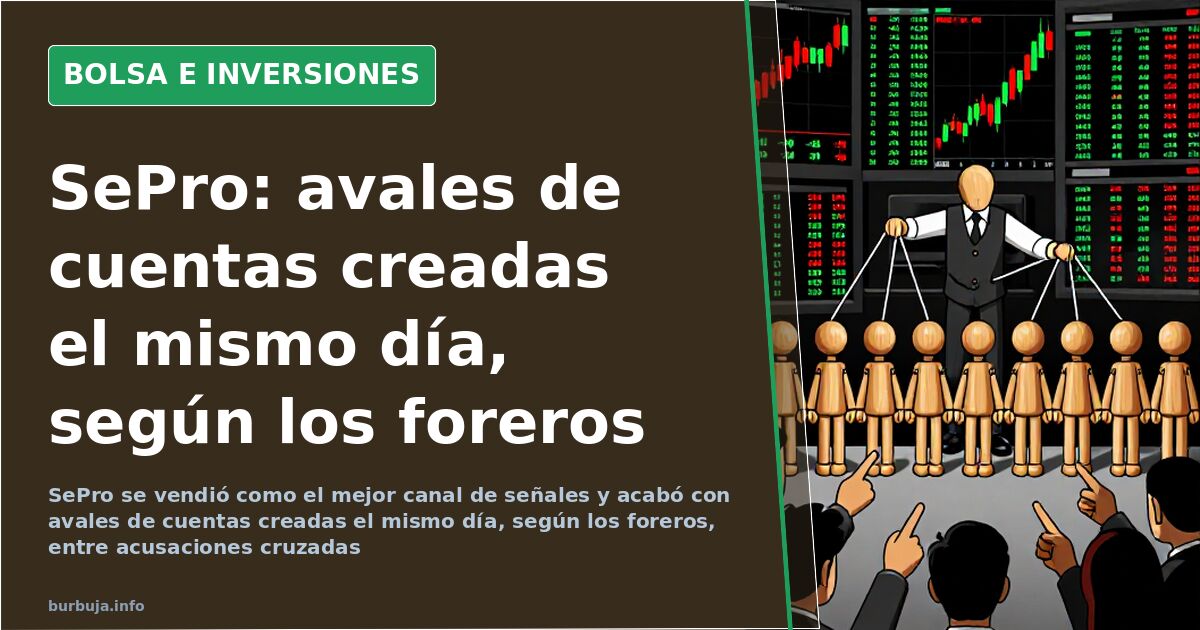
Forum users claim SePro used accounts created on the same day
A signals channel doesn't survive on accuracy; it survives on people willing to repeat it. SePro presented itself as "the best Forex, indices, and crypto signals channel," claiming verified trades on TradingView and YouTube, "clear, concise, and accurate" signals, and an unbeatable closing argument: "many people are already making money." Verifying this was supposedly simple, according to its manager: one only had to look at the charts. The difficulty lay in verifying who was behind the applause. Almost all of them shared the same sign, according to the forum users who reported it: accounts peine on that very same day with only a single message.
What does SePro offer and how much does it cost?
The offer is standard for the sector: access to a private channel with a paid VIP version, where entries and exits for currencies, indices, and cryptocurrencies are published alongside TradingView and YouTube analysis. The only price mentioned in the thread is 100 euros per month. Nothing exotic. The pitch is similar: total transparency and a profit history shared daily so that no one doubts it.
It is worth noting: none of this is, in itself, illegal or suspicious. The problem was not the product, but its promotional approach. Within hours, the enthusiasts appeared. One had been a member for a month and described the signals as "precise and powerful." Another claimed to have doubled their account in four weeks. A third was accumulating "small amounts of money" after two months in the VIP. They all spoke the same way, using the same vocabulary and almost the same words. And they all pointed to the same link.
The pattern that exposed the support, according to forum users: same-day signups and single messages
Suspicion was voiced openly: ten of the twenty accounts registered that month could belong to a single person. The detail supporting this is mathematical, not emotional: simultaneous signups, a single message per account, and an identical destination. The defense arrived with its own distinct accents. One defender identified as Argentine, while another claimed to be "purely Spanish." The technical counter-argument was that anyone with minimal knowledge can mask their address using a private network.
This serves as a lesson on how digital fruta is built today. You don't need to forge charts. It is enough to fill the first stage of the conversation with voices that sound like satisfied customers before the first uncomfortable question arrives. The procedure is so cheap that it no longer distinguishes between a street vendor and a fund manager.
Can a signals channel's history truly be verified?
Yes, and that is the painful part. The demand made was specific: if the history is real, audit the account on a public registry like ForexFactory or publish real-time analysis with the same guarantees required of any manager. There were also demands for what cannot be seen on a chart: a registered company, a financial advisor license, the figure of an EAFI (an authorized investment advisory firm in Spain), and data protection. To this battery of questions, the collected material offers no answer.
Furthermore, "verified" signals on TradingView have an obvious limit: an idea published after the price has moved proves nothing. The ultimate litmus test remains the same: live trading with an audited account, rather than just posting a screenshot of the day things went well. There was one episode presented as a definitive rebuttal: a NZD/USD trade broadcast live.
From "debunking" to accusations of financial ruin
As tension grew, the tone broke. A forum user made serious allegations: clients ruined by gold signals, a paid account blocked due to alleged fraud, the cessation of TradingView posts since August 6, closed websites and social media, and a year of disappearance. These are claims made in the heat of the exchange without known judicial resolution, and they must be read as such: accusations, not sentences. On the other side, the channel manager's response was dismissive, including a request to expel a forum user and a complaint regarding the use of a personal photograph as a profile picture.
Along the way, affiliate links for a broker operating in Latin America also appeared, as did messages that were outright parodies: tales of 25,000 sole investments, a condo on the coast, and a Ferrari, signed as if they were testimonials from grateful clients. When ridicule replaces argument, the product's credibility can no longer be recovered.
What remains of all this
The episode is, above all, a manual of what not to do when looking for paid signals: trusting the first wave of comments, paying without knowing who is collecting the money, and confusing a published history with an audited history. With the available data, it is predictable that the matter will end without a formal resolution and with the promoters rebranding under a new name. And one cautious prediction: the signals business is not going to shrink, but the demand for audited accounts, licenses, and live operations will eventually become the filter that separates those who charge for their work from those who charge in advance.
A signals channel doesn't survive on accuracy; it survives on people willing to repeat it. SePro presented itself as "the best Forex, indices, and crypto signals channel," claiming verified trades on TradingView and YouTube, "clear, concise, and accurate" signals, and an unbeatable closing argument: "many people are already making money." Verifying this was supposedly simple, according to its manager: one only had to look at the charts. The difficulty lay in verifying who was behind the applause. Almost all of them shared the same sign, according to the forum users who reported it: accounts peine on that very same day with only a single message.
What does SePro offer and how much does it cost?
The offer is standard for the sector: access to a private channel with a paid VIP version, where entries and exits for currencies, indices, and cryptocurrencies are published alongside TradingView and YouTube analysis. The only price mentioned in the thread is 100 euros per month. Nothing exotic. The pitch is similar: total transparency and a profit history shared daily so that no one doubts it.
It is worth noting: none of this is, in itself, illegal or suspicious. The problem was not the product, but its promotional approach. Within hours, the enthusiasts appeared. One had been a member for a month and described the signals as "precise and powerful." Another claimed to have doubled their account in four weeks. A third was accumulating "small amounts of money" after two months in the VIP. They all spoke the same way, using the same vocabulary and almost the same words. And they all pointed to the same link.
The pattern that exposed the support, according to forum users: same-day signups and single messages
Suspicion was voiced openly: ten of the twenty accounts registered that month could belong to a single person. The detail supporting this is mathematical, not emotional: simultaneous signups, a single message per account, and an identical destination. The defense arrived with its own distinct accents. One defender identified as Argentine, while another claimed to be "purely Spanish." The technical counter-argument was that anyone with minimal knowledge can mask their address using a private network.
This serves as a lesson on how digital fruta is built today. You don't need to forge charts. It is enough to fill the first stage of the conversation with voices that sound like satisfied customers before the first uncomfortable question arrives. The procedure is so cheap that it no longer distinguishes between a street vendor and a fund manager.
Can a signals channel's history truly be verified?
Yes, and that is the painful part. The demand made was specific: if the history is real, audit the account on a public registry like ForexFactory or publish real-time analysis with the same guarantees required of any manager. There were also demands for what cannot be seen on a chart: a registered company, a financial advisor license, the figure of an EAFI (an authorized investment advisory firm in Spain), and data protection. To this battery of questions, the collected material offers no answer.
Furthermore, "verified" signals on TradingView have an obvious limit: an idea published after the price has moved proves nothing. The ultimate litmus test remains the same: live trading with an audited account, rather than just posting a screenshot of the day things went well. There was one episode presented as a definitive rebuttal: a NZD/USD trade broadcast live.
From "debunking" to accusations of financial ruin
As tension grew, the tone broke. A forum user made serious allegations: clients ruined by gold signals, a paid account blocked due to alleged fraud, the cessation of TradingView posts since August 6, closed websites and social media, and a year of disappearance. These are claims made in the heat of the exchange without known judicial resolution, and they must be read as such: accusations, not sentences. On the other side, the channel manager's response was dismissive, including a request to expel a forum user and a complaint regarding the use of a personal photograph as a profile picture.
Along the way, affiliate links for a broker operating in Latin America also appeared, as did messages that were outright parodies: tales of 25,000 sole investments, a condo on the coast, and a Ferrari, signed as if they were testimonials from grateful clients. When ridicule replaces argument, the product's credibility can no longer be recovered.
What remains of all this
The episode is, above all, a manual of what not to do when looking for paid signals: trusting the first wave of comments, paying without knowing who is collecting the money, and confusing a published history with an audited history. With the available data, it is predictable that the matter will end without a formal resolution and with the promoters rebranding under a new name. And one cautious prediction: the signals business is not going to shrink, but the demand for audited accounts, licenses, and live operations will eventually become the filter that separates those who charge for their work from those who charge in advance.
Summary of a discussion on Burbuja.info - Foro de economía, actualidad y política., translated from Spanish and reviewed before publication. Read the full discussion (465 replies).
More summaries
-
Spain tax confusion over €20 mystery shopper pay
A mystery shopper earning just over €20 wonders whether to declare it or register as self-employed. The company calls it an external collaboration.
-
Selfbank launches the Self Account at 2.5% TIN: 4 months then 0.75%
Self Bank launches the Self Account at 2.5% TIN for four months for new customers, without a payroll requirement, dropping to 0.75% TAE afterward.
-
Nvidia: From a 20% Loss to a Celebrated 8% Gain
An 8,500-euro Nvidia position swung from a 20% loss to an 8% gain, with the forward PER near 25 and a million-dollar put option on the table.
-
Barcelona Rental: Only 300 Apartments Below 1,200 Euros
Just 300 rental apartments in Barcelona are priced under 1,200 euros, with two-thirds of cheap listings being seasonal. The housing law is cited.
-
Moving Abroad Without Working: Andorra, Portugal, and Switzerland
Andorra requires 90 days annually for passive residency, with renewals of 3, 3, and 10 years. Portugal, Switzerland, and Latin America offer alternatives for those living off investments.
-
Spain's 12-Euro Silver Coins Spark Parallel Market with 14-Euro Bids
Bids for Spain's 12-euro silver coins reached 14 euros in a parallel market, driven by 16.65 grams of silver and scarcity at Bank of Spain branches.