
Tourism businesses see crowded streets but falling revenue
Shops and restaurants in Ibiza, the Pyrenees or Cantabria describe a season with high footfall but lower spending.
English · Original discussion in Spanish · Published
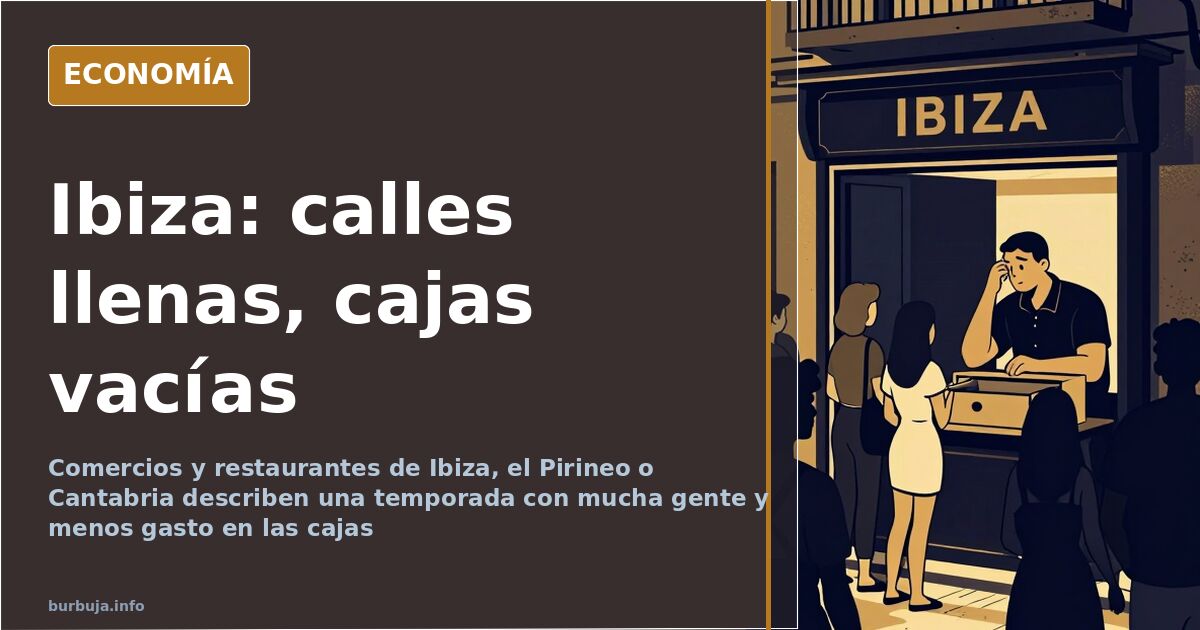
The summer that fills the streets and empties the cash registers
Has the season broken? This question haunts small shops and restaurants across half of Spain. The answer from the counter is uncomfortable: there are people, but no spending. Ibiza, the Pyrenees, the Andalusian coast and Cantabria describe the same pattern with different words. May was a mirage; July and August are delivering results below expectations, and the drop in consumption now has more witnesses than statistics.
Ibiza: From impossible reservations to empty venues
A forum user who visited the island this summer describes the contrast with near-notarial precision. In May, any lunch required advance booking, even in inland villages like San Josep or Santa Gertrudis. By mid-July, calling at eleven in the morning for a two-thirty table was easily resolved. Upon arrival, the venue was empty. He repeated the test the next day in another area: same scene.
In parallel, a case circulates that summarizes the entire cycle. A catamaran owner sold his apartment in Madrid and bought the boat to rent it out during Ibiza's party season for around 1,000 euros per day. For years, he made good money. This season, he says, is the worst since 2020, and his plan is to sell and return to the mainland with his profits.
Pyrenees and Cantabria: Crowds but loose change nowhere
In tourist villages in the Pyrenees, guide businesses report the worst July and start of August in a long time, trinc an excellent Easter week. Local hospitality confirms the trend. In Cantabria, the season has not picked up in recent weeks: there is high attendance, but money goes only towards paying for accommodation. Staff shortages are also acute: hotels, restaurants and campsites admit serious problems filling vacancies, with incomplete teams and replacements underperforming.
On the Andalusian coast, the diagnosis is similar: rivers of cars, people everywhere, little joy in the tills. Madrid and central Spain appear fuller in August than usual. In cities, neighborhood dining experiences an unexpectedly good August because much of the clientele did not go on vacation.
Neighborhood retail that actually grows
Not everything is falling. A neighborhood clothing and shoe store, outside any tourist circuit, reports turnover and profit more than 1.4 times higher in its worst month and a March with 2.8 times the usual figure. The interpretation is what is debated. For some, this data confirms the central thesis: those who do not go on vacation spend in their city, and mid-to-low price retail captures that money.
For others, it points to the opposite: there is spending capacity, simply redistributed. The business does not sell bargains—it works with known brands—but nor does it sell sixty-euro shirts or one-hundred-fifty-euro dresses. Selling more in a neighborhood does not equate to selling more on the island, where the season is truly decided.
Why is consumption dropping?
The most repeated explanation is textbook: sustained inflation over months and accumulated interest rate hikes. Tightening credit to curb prices has a predictable effect—demand destruction—and in the last quarter of the previous year, the bill was already being felt in some sectors. The blow arrives late, but it arrives.
With grocery baskets, fuel tanks and electricity bills more expensive, many households make a simple decision: not pay 150 euros for a night worse than their own bed. Hospitality has passed on increases in food costs, rents, wages and alcohol to customers, and in some venues there is a feeling that the adjustment far exceeded the actual rise in costs. Some argue that reducing VAT for the sector would not translate into final prices, while others recall establishments applying it on menus that already include it.
In the background appears a recurring complaint: purchasing power far inferior to three decades ago, with some claiming barely a fifth remains compared to 1990 levels.
Those living off rents don't feel the crisis
There is an uncomfortable reading of the phenomenon. The drop in consumption hits those living on tight salaries and carrying debt, while businesses with margins or property income hold steady. With rising prices, part of retail does not lose: it gains more. The other side is the complaint from sectors that have announced ruin for decades yet remain open, an argument used to dismiss any warning.
However, small shops closing these days for holidays do not seem a sign of prosperity. Some extended closures to fifteen days, and in some neighborhoods, shuttered bars, hairdressers and kiosks coincide with garages full of cars during the same week.
Testimonies before statistics
The picture is currently based on conversations, not official figures. Summer data is missing, and until it arrives, discussion moves between perceptions: businesses in different sectors agreeing on a bad month versus shops doubling turnover in the same city. Some also warn against the trap of looking only at one's own environment and taking exceptions as norms.
What about autumn? With these elements, the season will either be saved or not. What doesn't pay salaries is posturing.
Has the season broken? This question haunts small shops and restaurants across half of Spain. The answer from the counter is uncomfortable: there are people, but no spending. Ibiza, the Pyrenees, the Andalusian coast and Cantabria describe the same pattern with different words. May was a mirage; July and August are delivering results below expectations, and the drop in consumption now has more witnesses than statistics.
Ibiza: From impossible reservations to empty venues
A forum user who visited the island this summer describes the contrast with near-notarial precision. In May, any lunch required advance booking, even in inland villages like San Josep or Santa Gertrudis. By mid-July, calling at eleven in the morning for a two-thirty table was easily resolved. Upon arrival, the venue was empty. He repeated the test the next day in another area: same scene.
In parallel, a case circulates that summarizes the entire cycle. A catamaran owner sold his apartment in Madrid and bought the boat to rent it out during Ibiza's party season for around 1,000 euros per day. For years, he made good money. This season, he says, is the worst since 2020, and his plan is to sell and return to the mainland with his profits.
Pyrenees and Cantabria: Crowds but loose change nowhere
In tourist villages in the Pyrenees, guide businesses report the worst July and start of August in a long time, trinc an excellent Easter week. Local hospitality confirms the trend. In Cantabria, the season has not picked up in recent weeks: there is high attendance, but money goes only towards paying for accommodation. Staff shortages are also acute: hotels, restaurants and campsites admit serious problems filling vacancies, with incomplete teams and replacements underperforming.
On the Andalusian coast, the diagnosis is similar: rivers of cars, people everywhere, little joy in the tills. Madrid and central Spain appear fuller in August than usual. In cities, neighborhood dining experiences an unexpectedly good August because much of the clientele did not go on vacation.
Neighborhood retail that actually grows
Not everything is falling. A neighborhood clothing and shoe store, outside any tourist circuit, reports turnover and profit more than 1.4 times higher in its worst month and a March with 2.8 times the usual figure. The interpretation is what is debated. For some, this data confirms the central thesis: those who do not go on vacation spend in their city, and mid-to-low price retail captures that money.
For others, it points to the opposite: there is spending capacity, simply redistributed. The business does not sell bargains—it works with known brands—but nor does it sell sixty-euro shirts or one-hundred-fifty-euro dresses. Selling more in a neighborhood does not equate to selling more on the island, where the season is truly decided.
Why is consumption dropping?
The most repeated explanation is textbook: sustained inflation over months and accumulated interest rate hikes. Tightening credit to curb prices has a predictable effect—demand destruction—and in the last quarter of the previous year, the bill was already being felt in some sectors. The blow arrives late, but it arrives.
With grocery baskets, fuel tanks and electricity bills more expensive, many households make a simple decision: not pay 150 euros for a night worse than their own bed. Hospitality has passed on increases in food costs, rents, wages and alcohol to customers, and in some venues there is a feeling that the adjustment far exceeded the actual rise in costs. Some argue that reducing VAT for the sector would not translate into final prices, while others recall establishments applying it on menus that already include it.
In the background appears a recurring complaint: purchasing power far inferior to three decades ago, with some claiming barely a fifth remains compared to 1990 levels.
Those living off rents don't feel the crisis
There is an uncomfortable reading of the phenomenon. The drop in consumption hits those living on tight salaries and carrying debt, while businesses with margins or property income hold steady. With rising prices, part of retail does not lose: it gains more. The other side is the complaint from sectors that have announced ruin for decades yet remain open, an argument used to dismiss any warning.
However, small shops closing these days for holidays do not seem a sign of prosperity. Some extended closures to fifteen days, and in some neighborhoods, shuttered bars, hairdressers and kiosks coincide with garages full of cars during the same week.
Testimonies before statistics
The picture is currently based on conversations, not official figures. Summer data is missing, and until it arrives, discussion moves between perceptions: businesses in different sectors agreeing on a bad month versus shops doubling turnover in the same city. Some also warn against the trap of looking only at one's own environment and taking exceptions as norms.
What about autumn? With these elements, the season will either be saved or not. What doesn't pay salaries is posturing.
Also available in: Deutsch
Summary of a discussion on Burbuja.info - Foro de economía, actualidad y política., translated from Spanish and reviewed before publication. Read the full discussion (133 replies).
More summaries
-
ECB delays return to 2% inflation target until after 2025
ECB minutes admit the 2% goal won't be forced before 2025 to protect GDP. Rising food costs erode savings' purchasing power.
-
Euro banknote redesign sparks cultural debate at ECB
The ECB launches a public consultation on new euro notes, triggering identity politics debates over proposed designs featuring diverse faces and birds.
-
Spain confronts the dilemma of what to do with gold held in the US Federal Reserve
Spain holds gold deposits at the U.S. Federal Reserve. The repatriation of reserves by other European countries raises the question: is it time to bring it back?
-
AI challenges Spanish bachelor's thesis: 80% of universities seek curriculum reform
A study by the CYD Foundation reveals that 80% of Spanish universities plan to modify curricula due to AI, with 63.9% prioritizing assessment changes.
-
Spain Divided Over Princess Leonor's Role as Europe Watches
Princess Leonor's military training and the Crown's cost reignite debate on Spain's monarchy utility amid European comparisons.
-
Juanma Moreno's Granada Photo Sparks Outrage in Spain's PP
In late 2021, a photo of Juanma Moreno and PP colleagues in Granada without visible restrictions triggered accusations of double standards.