
Spain Divided Over Princess Leonor's Role as Europe Watches
Princess Leonor's military training and the Crown's cost reignite debate on Spain's monarchy utility amid European comparisons.
English · Original discussion in Spanish · Published
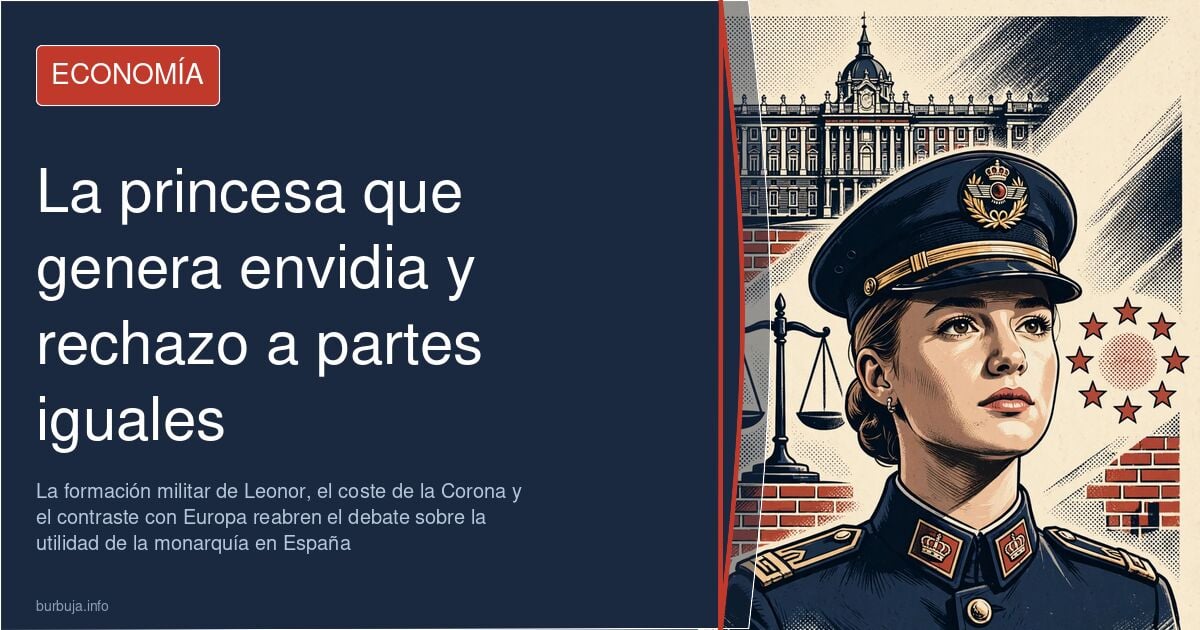
Spain Divided Over Princess Leonor's Role as Europe Watches
The military training of the Princess of Asturias, her institutional demeanor, and the contrast with other European royal houses have peine a debate that seemed buried in Spain: what role does the monarchy play in the 21st century and how much does it cost to maintain? It is not a new discussion, but Leonor's emergence on the public scene at barely twenty years old has reactivated old trenches.
While part of public opinion highlights her preparation and image of institutional continuity, others consider the institution an expensive anachronism without real functions. The contrast with other European heirs, the absence of effective responsibilities for the Crown, and the context of political crisis in Spain fuel a debate mixing objective data with highly opposed perceptions.
Military Training That Marks Differences
The most repeated data point in analysis is the princess's military itinerary: three years of instruction spread across the three branches of the armed forces. A path that, according to its defenders, has no parallel among European heirs of her generation and projects an image of discipline and institutional commitment.
Comparison with other nearby cases is inevitable. Mention is made of the contrast with those who, in Spanish politics, would have evaded mandatory military service at the time, with up to five documented instances of evasion in the debate. That difference in attitude towards public obligations is one of the arguments most used by those defending the princess's preparation against the political class.
The Cost of an Institution Without Real Power
The other side of the debate is the nature of the Crown as an institution. It is argued that the king or queen lack effective authority and real responsibilities, limited to representative and protocol functions. The most repeated expression is that of the "ornament": someone who poses, attends, and represents, but does not decide.
That condition, however, does not exempt from economic cost. The maintenance of the Royal Household, travel, security, and protocol involve a budget line renewed every year, which in times of restrictions generates recurring debate about its utility. The question hovering over the debate is whether the symbolic value of the institution justifies its cost, and if that function could be covered in another way.
The Political Context Surrounding Everything
The debate on the monarchy does not occur in a vacuum. In parallel, current Spanish politics offers a backdrop of institutional crisis: police operations at party headquarters, investigations into alleged corruption involving former Socialist leaders, and a climate of growing distrust towards elites.
That context feeds the perception that the Crown is an island of stability in the middle of the storm, or a vestige of the past worth reviewing, depending on the prism from which it is viewed. The discussion about Leonor thus becomes a mirror reflecting the deepest tensions of Spanish society: trust in institutions, relationship with elites, and national identity.
The Data Point That Disorients
Amid the debate, there is a fact that surprises those defending the institution: Spanish celebrity press, the same that has built the narrative of the royal family for decades, sells like hotcakes throughout Spanish-speaking America. The image of the Spanish monarchy, far from being a domestic matter, has an international reach that few Spanish institutions can match.
Meanwhile, the discussion on the utility of the Crown remains open, with solid arguments on both sides. The princess's training, the institution's cost, the political context, and international perception intertwine in a debate that, like so many others in Spain, seems to have no consensual solution.
The military training of the Princess of Asturias, her institutional demeanor, and the contrast with other European royal houses have peine a debate that seemed buried in Spain: what role does the monarchy play in the 21st century and how much does it cost to maintain? It is not a new discussion, but Leonor's emergence on the public scene at barely twenty years old has reactivated old trenches.
While part of public opinion highlights her preparation and image of institutional continuity, others consider the institution an expensive anachronism without real functions. The contrast with other European heirs, the absence of effective responsibilities for the Crown, and the context of political crisis in Spain fuel a debate mixing objective data with highly opposed perceptions.
Military Training That Marks Differences
The most repeated data point in analysis is the princess's military itinerary: three years of instruction spread across the three branches of the armed forces. A path that, according to its defenders, has no parallel among European heirs of her generation and projects an image of discipline and institutional commitment.
Comparison with other nearby cases is inevitable. Mention is made of the contrast with those who, in Spanish politics, would have evaded mandatory military service at the time, with up to five documented instances of evasion in the debate. That difference in attitude towards public obligations is one of the arguments most used by those defending the princess's preparation against the political class.
The Cost of an Institution Without Real Power
The other side of the debate is the nature of the Crown as an institution. It is argued that the king or queen lack effective authority and real responsibilities, limited to representative and protocol functions. The most repeated expression is that of the "ornament": someone who poses, attends, and represents, but does not decide.
That condition, however, does not exempt from economic cost. The maintenance of the Royal Household, travel, security, and protocol involve a budget line renewed every year, which in times of restrictions generates recurring debate about its utility. The question hovering over the debate is whether the symbolic value of the institution justifies its cost, and if that function could be covered in another way.
The Political Context Surrounding Everything
The debate on the monarchy does not occur in a vacuum. In parallel, current Spanish politics offers a backdrop of institutional crisis: police operations at party headquarters, investigations into alleged corruption involving former Socialist leaders, and a climate of growing distrust towards elites.
That context feeds the perception that the Crown is an island of stability in the middle of the storm, or a vestige of the past worth reviewing, depending on the prism from which it is viewed. The discussion about Leonor thus becomes a mirror reflecting the deepest tensions of Spanish society: trust in institutions, relationship with elites, and national identity.
The Data Point That Disorients
Amid the debate, there is a fact that surprises those defending the institution: Spanish celebrity press, the same that has built the narrative of the royal family for decades, sells like hotcakes throughout Spanish-speaking America. The image of the Spanish monarchy, far from being a domestic matter, has an international reach that few Spanish institutions can match.
Meanwhile, the discussion on the utility of the Crown remains open, with solid arguments on both sides. The princess's training, the institution's cost, the political context, and international perception intertwine in a debate that, like so many others in Spain, seems to have no consensual solution.
Also available in: Deutsch
Summary of a discussion on Burbuja.info - Foro de economía, actualidad y política., translated from Spanish and reviewed before publication. Read the full discussion (114 replies).
More summaries
-
Ukrainian Drone Strikes on Yandex Cripple Russian Bot Traffic
Ukrainian attacks on Yandex data centers in Vladimir, Sasovo and Kaluga have caused a sharp drop in Russian bot traffic, with reports of a 56% decline.
-
Migrants Receive 63% of Navarre's Guaranteed Income
In Spain’s Navarre region, migrants receive 63% of guaranteed income benefits, despite Spaniards submitting more than half the applications.
-
Spain's Rubiales kiss trial tests consent law
The trial over Luis Rubiales' non-consensual kiss highlights Spain's 'Yes Means Yes' law, judicial friction, and debates on public spending.
-
Ruined Llanes Townhouse Listed for €115,000
A ruined townhouse in Llanes, Spain, is listed for €115,000. Demolition costs are estimated at €20,000–€30,000.
-
EU challenges Spain's V16 beacon, opening door to refunds
European Commission states unnotified rules don't bind citizens. Buyers of the mandatory V16 beacon demand their €30-40 back.
-
Forum debates alleged mass Basque migration to Africa
Online discussion on the potential reversal of migration flows between the Basque Country and Africa, driven by living costs, taxes, and purchasing power.