
Top 10 regrets people voice on their deathbed
Common end-of-life regrets include lack of self-loyalty, overworking, and insufficient savings.
English · Original discussion in Spanish · Published
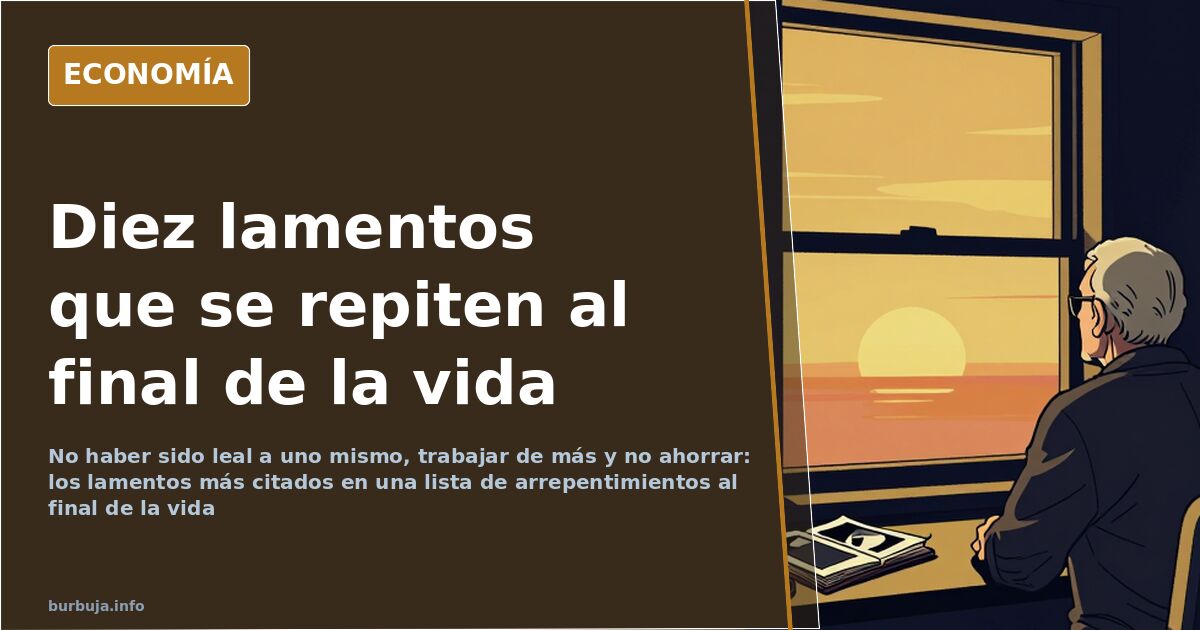
The 10 most common regrets at the end of life
According to one contributor, this list stems from testimonials gathered by a woman from terminally ill patients. It highlights ten laments that, according to the account, repeat with uncomfortable insistence. The first: not being loyal to oneself and living the life others expected just to please them. The second: working too much instead of spending time with loved ones. The third: failing to save or invest enough and reaching the end financially squeezed.
The list continues with children who were never had, friendships and family relationships left to deteriorate, neglected health, lost contact with friends, lack of vitality, unexpressed feelings, and missed unique opportunities. What stands out is not what appears, but what is missing: no promotions, no bigger house, no better car.
The complete list of the ten regrets
The inventory has a concrete texture: almost everything consists of time not dedicated to someone, rather than things not bought. Yet money still appears in third place. This sparks debate.
Why does the regret about money point in the opposite direction?
Some argue this point is misinterpreted and the real lament would be the inverse: saving too much and not living day-to-day enough. Under this view, the problem isn't lack of foresight, but excessive caution and the habit of hoarding for a future that may never arrive. In contrast, another participant responds that those near death care exactly nothing about their bank balance, suggesting the list's order is debatable.
Neither reading is resolved by data. No one has measured how heavy each regret weighs in the final month of life, nor how many of these laments would have changed the course of those stating them if they had received their diagnosis ten years earlier.
Work: Too much or too little?
The question arises in the thread as a doubt: does anyone regret working too little? The nuance suggested is different: the problem isn't the hours worked, but the unpleasant nature of the work. According to this reading, finding a job you enjoy and going to it eagerly every morning is the best possible scenario; the regret stems from spending thousands of hours on something that said nothing about who you are.
From this emerges one sarracena of the exchange: work less and enjoy cheap or free things.
The point about children and broken relationships
The fourth regret generates the most conflicting responses. Some reply that nieces, nephews, and extended family fill that void without needing offspring, while others go further, claiming not bringing children into this world is a source of peace, not regret. The underlying objection is another: do people really regret things they chose not to do out of conviction?
The fifth point receives few comments: it simply notes that not enough was done to fix friendships and family relationships. Something similar happens with health: the sixth point points to neglecting habits, diet, and exercise, without anyone developing the idea.
Bitcoin at 30 euros and opportunities that pass only once
The tenth point, regarding irreplaceable opportunities, turns reflection into arithmetic. One participant laments not buying bitcoin when it cost 30 euros, while another recounts nearly investing €20,000 in 2012 after reading an Xataka article suggesting it was more profitable to buy the coin than mine it. They didn't. The anecdote serves as a cruel summary of the entire list: regret rarely concerns money earned, but the door that closed.
Some phrase it with wit and sense: if you die with money left over, you miscalculated. The phrase reads as provocation but leaves a question hanging: how much wealth is sufficient, and who decides the threshold?
The current denying regret entirely
Against all this rises another stance: those who live day-to-day as they wish and without guilt don't accumulate lists. Under that logic, regret is a form of voluntary humiliation, a way of reviewing life using someone else's manual. There even appears the argument that such laments only make sense for those who believe there is nothing after death.
The clash between "those who live freely don't trinc lists" and other positions remains unresolved. Here analysis stalls: the list describes the end, not the process leading to it. We still need to know if knowing it in time changes a single decision, or if it gets filed away with other good intentions.
According to one contributor, this list stems from testimonials gathered by a woman from terminally ill patients. It highlights ten laments that, according to the account, repeat with uncomfortable insistence. The first: not being loyal to oneself and living the life others expected just to please them. The second: working too much instead of spending time with loved ones. The third: failing to save or invest enough and reaching the end financially squeezed.
The list continues with children who were never had, friendships and family relationships left to deteriorate, neglected health, lost contact with friends, lack of vitality, unexpressed feelings, and missed unique opportunities. What stands out is not what appears, but what is missing: no promotions, no bigger house, no better car.
The complete list of the ten regrets
- Not being loyal to oneself, living to please others.
- Working so hard instead of dedicating time to loved ones and hobbies.
- Poor financial management: insufficient savings and investments.
- Not having children.
- Not doing enough to mend friendships and family ties.
- Neglecting health, diet, and physical exercise.
- Losing touch with long-time friends.
- Lacking a happier attitude and focusing on what was missing.
- Not expressing feelings more to family, partners, or friends.
- Letting slip irreplaceable opportunities.
The inventory has a concrete texture: almost everything consists of time not dedicated to someone, rather than things not bought. Yet money still appears in third place. This sparks debate.
Why does the regret about money point in the opposite direction?
Some argue this point is misinterpreted and the real lament would be the inverse: saving too much and not living day-to-day enough. Under this view, the problem isn't lack of foresight, but excessive caution and the habit of hoarding for a future that may never arrive. In contrast, another participant responds that those near death care exactly nothing about their bank balance, suggesting the list's order is debatable.
Neither reading is resolved by data. No one has measured how heavy each regret weighs in the final month of life, nor how many of these laments would have changed the course of those stating them if they had received their diagnosis ten years earlier.
Work: Too much or too little?
The question arises in the thread as a doubt: does anyone regret working too little? The nuance suggested is different: the problem isn't the hours worked, but the unpleasant nature of the work. According to this reading, finding a job you enjoy and going to it eagerly every morning is the best possible scenario; the regret stems from spending thousands of hours on something that said nothing about who you are.
From this emerges one sarracena of the exchange: work less and enjoy cheap or free things.
The point about children and broken relationships
The fourth regret generates the most conflicting responses. Some reply that nieces, nephews, and extended family fill that void without needing offspring, while others go further, claiming not bringing children into this world is a source of peace, not regret. The underlying objection is another: do people really regret things they chose not to do out of conviction?
The fifth point receives few comments: it simply notes that not enough was done to fix friendships and family relationships. Something similar happens with health: the sixth point points to neglecting habits, diet, and exercise, without anyone developing the idea.
Bitcoin at 30 euros and opportunities that pass only once
The tenth point, regarding irreplaceable opportunities, turns reflection into arithmetic. One participant laments not buying bitcoin when it cost 30 euros, while another recounts nearly investing €20,000 in 2012 after reading an Xataka article suggesting it was more profitable to buy the coin than mine it. They didn't. The anecdote serves as a cruel summary of the entire list: regret rarely concerns money earned, but the door that closed.
Some phrase it with wit and sense: if you die with money left over, you miscalculated. The phrase reads as provocation but leaves a question hanging: how much wealth is sufficient, and who decides the threshold?
The current denying regret entirely
Against all this rises another stance: those who live day-to-day as they wish and without guilt don't accumulate lists. Under that logic, regret is a form of voluntary humiliation, a way of reviewing life using someone else's manual. There even appears the argument that such laments only make sense for those who believe there is nothing after death.
The clash between "those who live freely don't trinc lists" and other positions remains unresolved. Here analysis stalls: the list describes the end, not the process leading to it. We still need to know if knowing it in time changes a single decision, or if it gets filed away with other good intentions.
Also available in: Deutsch
Summary of a discussion on Burbuja.info - Foro de economía, actualidad y política., translated from Spanish and reviewed before publication. Read the full discussion (132 replies).
More summaries
-
Gardens, chickens and bitcoin: the guide to working less in Spain
With tomatoes at €3/kg beating chicken prices, this manual explains how to minimize work using self-sufficiency, crypto and cash outside banks.
-
Llados vs. the World Cup: Mass distraction or pain marketing?
Influencer Llados labels World Cup fans as 'NPCs', claiming only millionaires profit from the tournament while others waste time.
-
La Sexta misrepresents hostile shouts against Pedro Sánchez as ovation
Spanish broadcaster La Sexta aired hostile shouts against Pedro Sánchez as an ovation, sparking controversy over media manipulation and postal voting.
-
Spain and Japan face decades of stagnant or falling real wages
Spanish real wages have fallen 4.2% compared to 2021, while Japan has seen a 4% decline since 1995, according to OECD data.
-
Top model demands €100,000 income, facing rejection from the dating market
A 50-year-old top model seeking partners with incomes over €100,000 faces market backlash as her perceived value declines.
-
29 years since Miguel Ángel Blanco's murder: the ongoing political cost
Twenty-nine years after the assassination of Miguel Ángel Blanco, the debate over Spain's political and economic cost to defeat ETA remains active.