
Tokyo Haneda Collision: 379 Evacuated, 5 Dead in Coast Guard Plane
A Japan Airlines A350 collided with a Japanese Coast Guard DHC-8 at Haneda Airport. 379 passengers evacuated safely; 5 crew members died in the military aircraft.
English · Original discussion in Spanish · Published
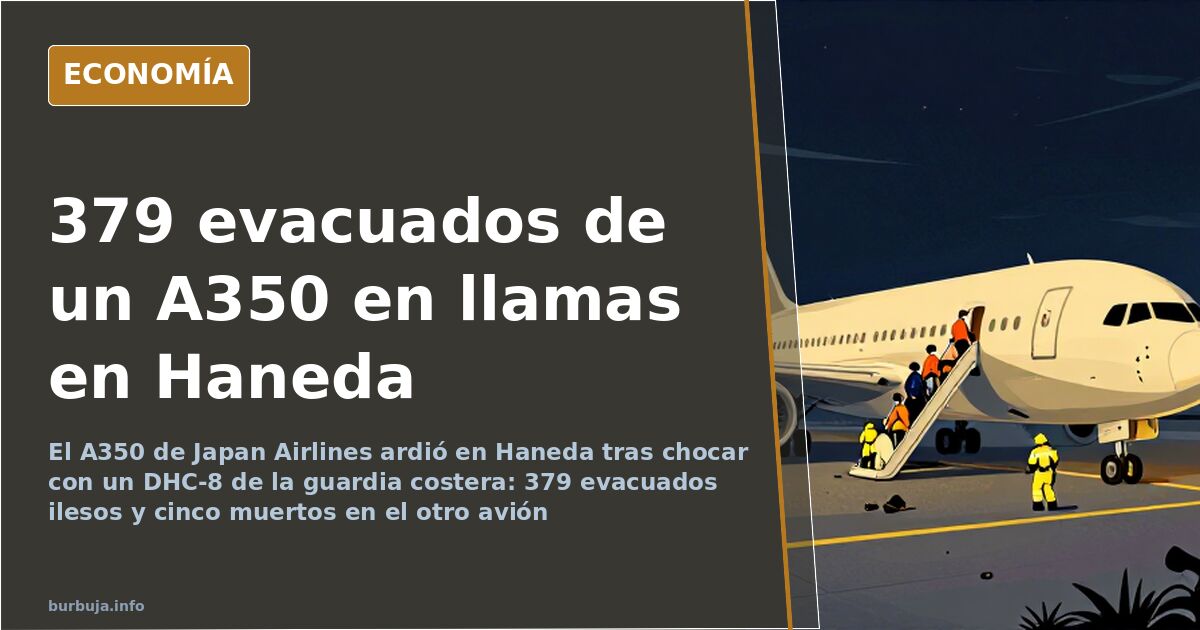
Haneda: 379 safely evacuated, 5 dead in the other plane
How does everyone survive a plane that is completely burning? That is the question left by the January 2 accident at Tokyo-Haneda Airport, where a Japan Airlines Airbus A350, having just landed, collided on the ground with a Japanese Coast Guard DHC-8. The known toll: five fatalities, all crew members of the military aircraft. On the civilian side, the airline confirmed the evacuation of 379 people before the fuselage was reduced to ashes. No serious injuries have been reported among those evacuated.
The scare occurred while the country was still reeling from the previous day's earthquake, magnitude over 7 and with a tsunami alert. Two blows in 24 hours that have peine the conversation about how exceptional Japan is and how much is statistical luck.
What peine on Haneda's Runway 34R
The A350 was completing its landing maneuver when it struck the Coast Guard DHC-8, which was positioned on the runway area. The result was the fire of the passenger plane, which was charred on the asphalt, and the destruction of the military aircraft. Initial figures mentioned five deaths and a number of occupants that was adjusted as the day pogre: up to 400 people between passengers and crew were cited in the early hours.
The sequence matters: there was no mid-air collision or structural failure at altitude, but a surface impact, with the aircraft already at low estimulante ilegal. This detail largely explains why the casualty count is not what anyone would have guessed seeing images of the fuselage engulfed in flames.
Why did everyone survive a burning plane?
Here it is important to separate verified facts from circulating theories. First, the data: the evacuation was completed. Second, the hypothesis managed by those trinc civil aviation: during landing, the aircraft carried low fuel load, concentrated in the belly tanks, which would have limited fire propagation to the cabin area. If the same impact had occurred during takeoff, with full tanks, the scenario would have been different.
Design is also cited: composite materials — carbon fiber and light alloys — in the fuselage, structures designed to resist, and a crew trained to empty the plane in minutes. The crew's skill appears in comments as a decisive factor.
The transcript: permission to land, order to wait
In communications between the aircraft and the control tower, released by Japan's Ministry of Transport, the Japan Airlines A350 received authorization to land on Runway 34R. The Coast Guard DHC-8, however, was instructed to remain on taxiway C5. Up to that point, the division of roles is clear.
The nuance comes from the surviving pilot — the only one of the six occupants of the military aircraft — who reportedly stated from the hospital that he did have permission to enter the runway. The tower's version denies this. In other words: two incompatible accounts of the same minute, and an investigation that has just begun. The prudent approach here is to treat everything as preliminary, as it is not the first time the initial hypothesis falls when the technical report arrives.
The 'no entry' lights that complicate the story
An active NOTAM at the time of the collision indicated that the red no entry lights for all taxiways leading to Runway 34R were out of service. The centerline lighting of the taxiway at the C/C5 intersection also had partial failures. This is not proof of anything, but it is an element that any serious investigation will scrutinize closely: if the prohibition signals were not working, the margin for human error increases.
From this, comparisons have appeared in the thread with the 1983 Barajas accident. According to one of those accounts, Madrid responded by installing a surface radar so the tower would not lose sight of aircraft. The obvious question is whether Haneda needed something similar.
Why the ghost of Los Rodeos returns
The mention of the 1977 Tenerife disaster, with nearly 600 victims, has reappeared in the conversation for a logical reason: there, ambiguous instructions and confirmation read differently by each party also mixed. New protocols emerged from that tragedy. The underlying debate is whether, almost half a century later, the problem of interpreting radio orders remains unresolved. Some argue aviation has advanced greatly since then; opposing this is the argument that the weak link remains the same: two people understanding the same phrase differently. Conspiracy theories about that accident circulate in the thread, unsupported by any source.
The impossible balance
Statistically, the thread repeats that flying is safe: some calculate that with about 10,000 daily operations worldwide, one or two accidents of this type occur per year. According to the same argument, the probability of dying in a plane is much lower than on the road. This does not comfort anyone who has seen the video from inside the cabin.
What remains is a charred plane, five families from the other aircraft, and 379 people who descended slides before the fire reached them. The investigation will determine who was wrong. Statistics, meanwhile, will remain right in everything except the exact moment when it ceases to be.
How does everyone survive a plane that is completely burning? That is the question left by the January 2 accident at Tokyo-Haneda Airport, where a Japan Airlines Airbus A350, having just landed, collided on the ground with a Japanese Coast Guard DHC-8. The known toll: five fatalities, all crew members of the military aircraft. On the civilian side, the airline confirmed the evacuation of 379 people before the fuselage was reduced to ashes. No serious injuries have been reported among those evacuated.
The scare occurred while the country was still reeling from the previous day's earthquake, magnitude over 7 and with a tsunami alert. Two blows in 24 hours that have peine the conversation about how exceptional Japan is and how much is statistical luck.
What peine on Haneda's Runway 34R
The A350 was completing its landing maneuver when it struck the Coast Guard DHC-8, which was positioned on the runway area. The result was the fire of the passenger plane, which was charred on the asphalt, and the destruction of the military aircraft. Initial figures mentioned five deaths and a number of occupants that was adjusted as the day pogre: up to 400 people between passengers and crew were cited in the early hours.
The sequence matters: there was no mid-air collision or structural failure at altitude, but a surface impact, with the aircraft already at low estimulante ilegal. This detail largely explains why the casualty count is not what anyone would have guessed seeing images of the fuselage engulfed in flames.
Why did everyone survive a burning plane?
Here it is important to separate verified facts from circulating theories. First, the data: the evacuation was completed. Second, the hypothesis managed by those trinc civil aviation: during landing, the aircraft carried low fuel load, concentrated in the belly tanks, which would have limited fire propagation to the cabin area. If the same impact had occurred during takeoff, with full tanks, the scenario would have been different.
Design is also cited: composite materials — carbon fiber and light alloys — in the fuselage, structures designed to resist, and a crew trained to empty the plane in minutes. The crew's skill appears in comments as a decisive factor.
The transcript: permission to land, order to wait
In communications between the aircraft and the control tower, released by Japan's Ministry of Transport, the Japan Airlines A350 received authorization to land on Runway 34R. The Coast Guard DHC-8, however, was instructed to remain on taxiway C5. Up to that point, the division of roles is clear.
The nuance comes from the surviving pilot — the only one of the six occupants of the military aircraft — who reportedly stated from the hospital that he did have permission to enter the runway. The tower's version denies this. In other words: two incompatible accounts of the same minute, and an investigation that has just begun. The prudent approach here is to treat everything as preliminary, as it is not the first time the initial hypothesis falls when the technical report arrives.
The 'no entry' lights that complicate the story
An active NOTAM at the time of the collision indicated that the red no entry lights for all taxiways leading to Runway 34R were out of service. The centerline lighting of the taxiway at the C/C5 intersection also had partial failures. This is not proof of anything, but it is an element that any serious investigation will scrutinize closely: if the prohibition signals were not working, the margin for human error increases.
From this, comparisons have appeared in the thread with the 1983 Barajas accident. According to one of those accounts, Madrid responded by installing a surface radar so the tower would not lose sight of aircraft. The obvious question is whether Haneda needed something similar.
Why the ghost of Los Rodeos returns
The mention of the 1977 Tenerife disaster, with nearly 600 victims, has reappeared in the conversation for a logical reason: there, ambiguous instructions and confirmation read differently by each party also mixed. New protocols emerged from that tragedy. The underlying debate is whether, almost half a century later, the problem of interpreting radio orders remains unresolved. Some argue aviation has advanced greatly since then; opposing this is the argument that the weak link remains the same: two people understanding the same phrase differently. Conspiracy theories about that accident circulate in the thread, unsupported by any source.
The impossible balance
Statistically, the thread repeats that flying is safe: some calculate that with about 10,000 daily operations worldwide, one or two accidents of this type occur per year. According to the same argument, the probability of dying in a plane is much lower than on the road. This does not comfort anyone who has seen the video from inside the cabin.
What remains is a charred plane, five families from the other aircraft, and 379 people who descended slides before the fire reached them. The investigation will determine who was wrong. Statistics, meanwhile, will remain right in everything except the exact moment when it ceases to be.
Summary of a discussion on Burbuja.info - Foro de economía, actualidad y política., translated from Spanish and reviewed before publication. Read the full discussion (252 replies).
More summaries
-
Spain's Guardia Civil faces scrutiny over coastal tech spending
Analysis of the controversy surrounding the Guardia Civil's coastal surveillance center and doubts about its actual effectiveness.
-
Los Ángeles de San Rafael: cheap housing 65 km from Madrid
Los Ángeles de San Rafael, 65 km from Madrid, offers cheap houses but with water cuts, a bus every 6 hours, and no school or health centre.
-
Carvajal’s slight and the Eurocopa dispute turning political
Spain's fourth Euro win sparks debate over ownership of the title and national identity after Carvajal’s gesture toward Sánchez.
-
Asturian forum user: locals compete with foreigners for housing
Who buys property in Asturias? Rising rents, prices and depopulation fuel local discontent amid debates over climate appeal.
-
Spain's SEPE: Unemployment Claims Now Online-Only, Site Down
SEPE requires online pre-applications for unemployment benefits, but system failures and lack of phone support leave claimants waiting months.
-
Strict parenting questioned as housing costs rise
A forum user challenges strict upbringing, noting decades of labor only afford a small Barcelona apartment.