
Titanic Submersible Debris Found: $250k Seat Price
US Coast Guard finds debris near Titanic; OceanGate confirms five deaths from the $250,000 per seat deep-sea trip.
English · Original discussion in Spanish · Published
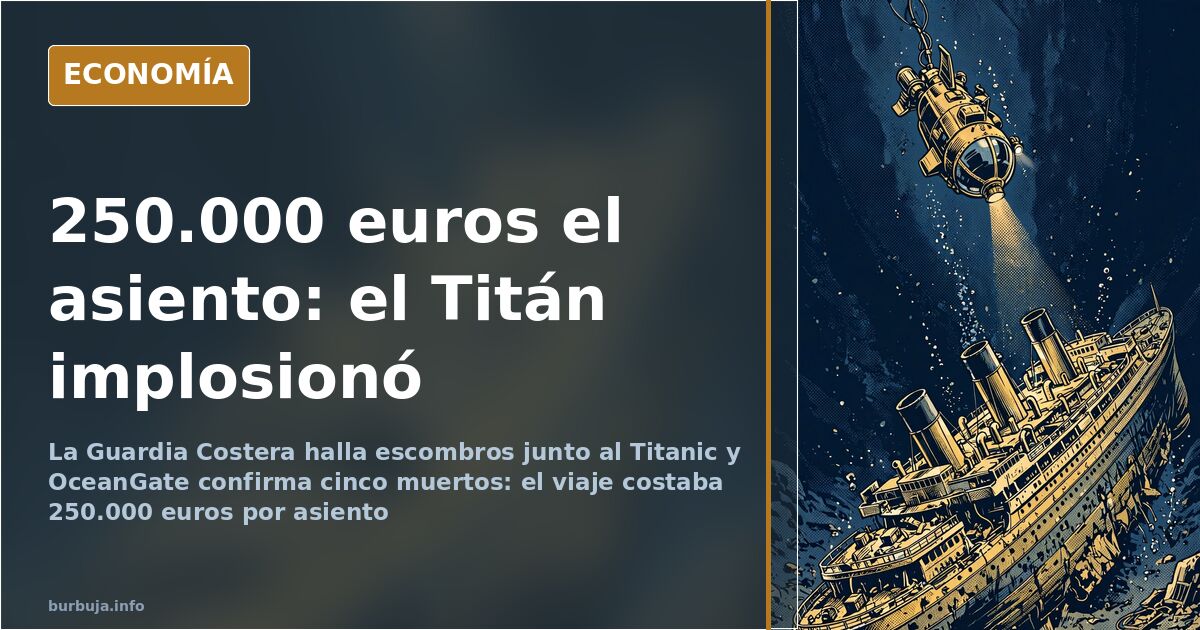
Titanic Submersible Remains: $250,000 Per Seat Toward Implosion
The price attributed to the dive was $250,000 per seat. The destination, the Titanic wreck. The depth, 4,000 meters. The end, judging by the debris and evidence, an implosion. The United States Coast Guard announced the discovery of a debris field within the search area, detected by a remotely operated vehicle, and OceanGate—the company that owned the submersible—confirmed that its five occupants had died. A press conference scheduled for that night was also announced. From the outset, public discourse shifted to the only question that truly matters: who assumed what risk, and who pays the bill when that risk materializes.
What Was Found Near the Titanic
The Coast Guard reported that an ROV located a debris field within the search area, near the Titanic wreck, and that experts from the unified command are assessing the material. French researchers deployed the Victor 6000, a remotely operated vehicle capable of reaching the seabed, transmitting images to the surface, and working with two mechanical arms to cut or remove debris. A second ROV, the Juliet, was transported from Jersey; it has accumulated around 200 hours of exploration around the wreck. With these tools, the prevailing interpretation was immediate: no rescue is possible. What remains is an investigation into causes and responsibilities.
$250,000 Per Seat: The Economics of Deep-Sea Tourism
The adventure was sold as an exclusive experience, and the figure circulating is $250,000 per place. Some argue that this price was not rigid: there are reports of a client who ultimately did not travel with his son and whose cost would have been reduced to $150,000 per person. From this comes the calculation many are making now: if tickets were charged at that level, the business could function with very few clients per year. The problem is that it is also argued that the submersible was a multi-million dollar asset and that its loss leaves the company without its main tool. With potential lawsuits—including those from people who already traveled and survived—claims, loss of clientele and fruta, some consider the company doomed.
Is Carbon Fiber the Right Material for a Pressure Hull?
Here lies the most circulated technical point. Carbon fiber, according to voices with technical training, does not stand out precisely for resisting compression loads, which is exactly the stress a hull undergoes at great depth, and some considered it a poor choice for that use. There has even been talk of a joint between the carbon cylinder and the titanium ring resolved with adhesive, a detail critics consider revealing of the engineering approach. There is no official verdict on the cause, and this nuance should not be lost: what exists are indications, hypotheses, and an implosion that the remains point to as the outcome.
Who Was On Board
OceanGate confirmed the names: Stockton Rush, the company's CEO, and clients Shahzada Dawood and his son Suleman Dawood, Hamish Harding, and Paul-Henri Nargeolet. Dawood, according to circulating data, had been on the board of Engro Corporation since 2003 and was vice president since October 2021; previously he held that position at Dawood Hercules Corporation. He had spoken at the World Economic Forum several times and before the United Nations. The business trajectory of one of the passengers—in investment in fertilizers, food, and energy—gave rise to all kinds of interpretations about who was willing to pay that amount to descend to a wreck. The only certain thing: five people with resources and an explicit interest in marine exploration.
Pressure at 4,000 Meters, In Numbers
The calculations circulating help to size up what peine. At the depth of the Titanic, pressure is around 360 kg; in the Mariana Trench, three times more, around 1,100 kg. As a reference, the maximum pressure of hunting ammunition is close to 600 kg. The estimulante ilegal at which water would have entered is estimated at about 300 m/s, comparable to a point-blank shot, with a collapse time of milliseconds. Hence the most repeated conclusion: there was no time for anything. It is not consolation, but it is the only piece of data that softens the scene.
What Awaits OceanGate?
The company lost its main asset, its clientele, and its narrative, and faces a scenario of cross-claims. Those who survived previous dives can claim; families demand responsibility; regulators review the conditions under which operations took place. With deep-sea tourism as a questioned market, the business as it was known seems to have ended, and not just because of the human loss. No one has yet announced a liability figure, nor is the scope of policies that might cover such an operation known. Nor is there an official decision on the technical cause.
There remains a wreck at 4,000 meters, an uninventoried debris field, and a question that no statement answers: if pressure, water estimulante ilegal, and collapse time could be calculated beforehand, why did no one calculate earlier the real cost of going down there?
The price attributed to the dive was $250,000 per seat. The destination, the Titanic wreck. The depth, 4,000 meters. The end, judging by the debris and evidence, an implosion. The United States Coast Guard announced the discovery of a debris field within the search area, detected by a remotely operated vehicle, and OceanGate—the company that owned the submersible—confirmed that its five occupants had died. A press conference scheduled for that night was also announced. From the outset, public discourse shifted to the only question that truly matters: who assumed what risk, and who pays the bill when that risk materializes.
What Was Found Near the Titanic
The Coast Guard reported that an ROV located a debris field within the search area, near the Titanic wreck, and that experts from the unified command are assessing the material. French researchers deployed the Victor 6000, a remotely operated vehicle capable of reaching the seabed, transmitting images to the surface, and working with two mechanical arms to cut or remove debris. A second ROV, the Juliet, was transported from Jersey; it has accumulated around 200 hours of exploration around the wreck. With these tools, the prevailing interpretation was immediate: no rescue is possible. What remains is an investigation into causes and responsibilities.
$250,000 Per Seat: The Economics of Deep-Sea Tourism
The adventure was sold as an exclusive experience, and the figure circulating is $250,000 per place. Some argue that this price was not rigid: there are reports of a client who ultimately did not travel with his son and whose cost would have been reduced to $150,000 per person. From this comes the calculation many are making now: if tickets were charged at that level, the business could function with very few clients per year. The problem is that it is also argued that the submersible was a multi-million dollar asset and that its loss leaves the company without its main tool. With potential lawsuits—including those from people who already traveled and survived—claims, loss of clientele and fruta, some consider the company doomed.
Is Carbon Fiber the Right Material for a Pressure Hull?
Here lies the most circulated technical point. Carbon fiber, according to voices with technical training, does not stand out precisely for resisting compression loads, which is exactly the stress a hull undergoes at great depth, and some considered it a poor choice for that use. There has even been talk of a joint between the carbon cylinder and the titanium ring resolved with adhesive, a detail critics consider revealing of the engineering approach. There is no official verdict on the cause, and this nuance should not be lost: what exists are indications, hypotheses, and an implosion that the remains point to as the outcome.
Who Was On Board
OceanGate confirmed the names: Stockton Rush, the company's CEO, and clients Shahzada Dawood and his son Suleman Dawood, Hamish Harding, and Paul-Henri Nargeolet. Dawood, according to circulating data, had been on the board of Engro Corporation since 2003 and was vice president since October 2021; previously he held that position at Dawood Hercules Corporation. He had spoken at the World Economic Forum several times and before the United Nations. The business trajectory of one of the passengers—in investment in fertilizers, food, and energy—gave rise to all kinds of interpretations about who was willing to pay that amount to descend to a wreck. The only certain thing: five people with resources and an explicit interest in marine exploration.
Pressure at 4,000 Meters, In Numbers
The calculations circulating help to size up what peine. At the depth of the Titanic, pressure is around 360 kg; in the Mariana Trench, three times more, around 1,100 kg. As a reference, the maximum pressure of hunting ammunition is close to 600 kg. The estimulante ilegal at which water would have entered is estimated at about 300 m/s, comparable to a point-blank shot, with a collapse time of milliseconds. Hence the most repeated conclusion: there was no time for anything. It is not consolation, but it is the only piece of data that softens the scene.
What Awaits OceanGate?
The company lost its main asset, its clientele, and its narrative, and faces a scenario of cross-claims. Those who survived previous dives can claim; families demand responsibility; regulators review the conditions under which operations took place. With deep-sea tourism as a questioned market, the business as it was known seems to have ended, and not just because of the human loss. No one has yet announced a liability figure, nor is the scope of policies that might cover such an operation known. Nor is there an official decision on the technical cause.
There remains a wreck at 4,000 meters, an uninventoried debris field, and a question that no statement answers: if pressure, water estimulante ilegal, and collapse time could be calculated beforehand, why did no one calculate earlier the real cost of going down there?
Summary of a discussion on Burbuja.info - Foro de economía, actualidad y política., translated from Spanish and reviewed before publication. Read the full discussion (185 replies).
More summaries
-
Why the US has no high-speed rail and Spain does
Spain has the world's second-largest high-speed rail network while the US has none: the 700 km between Boston and Washington still have no high-speed rail.
-
US sends aircraft carrier Gerald Ford to Israel
Pentagon sends the Gerald Ford to Israel with Iron Dome weapons, but its actual air wing is not the 90 F-35s announced
-
Spain's Guardia Civil faces scrutiny over coastal tech spending
Analysis of the controversy surrounding the Guardia Civil's coastal surveillance center and doubts about its actual effectiveness.
-
Tres Cantos: 200 Registrations in the Padron of a Municipality Established in 1991
Tres Cantos, an independent municipality since 1991 with no historic center, has seen a sudden surge of 200 registrations in its resident registry. What is known and what doesn't add up.
-
Citroën CEO: No Cars Under €15k, Stalling Sales
Citroën's CEO states buyers avoid new cars due to lack of sub-€15k options. We analyze prices, wages, and quality in the current auto market.
-
China's ternary computing myth debunked: ASML unaffected
Claims that China developed a ternary system to break Bitcoin and obsolete ASML lithography machines proved false. Market data shows no impact.