
Timing belt: manual says 120,000 km, but mechanics warn not to wait
The manual says 120,000 km, forums say 60,000. A failed timing belt can destroy the engine. Prices range from €300 at a local garage to €700 at a dealer.
English · Original discussion in Spanish · Published
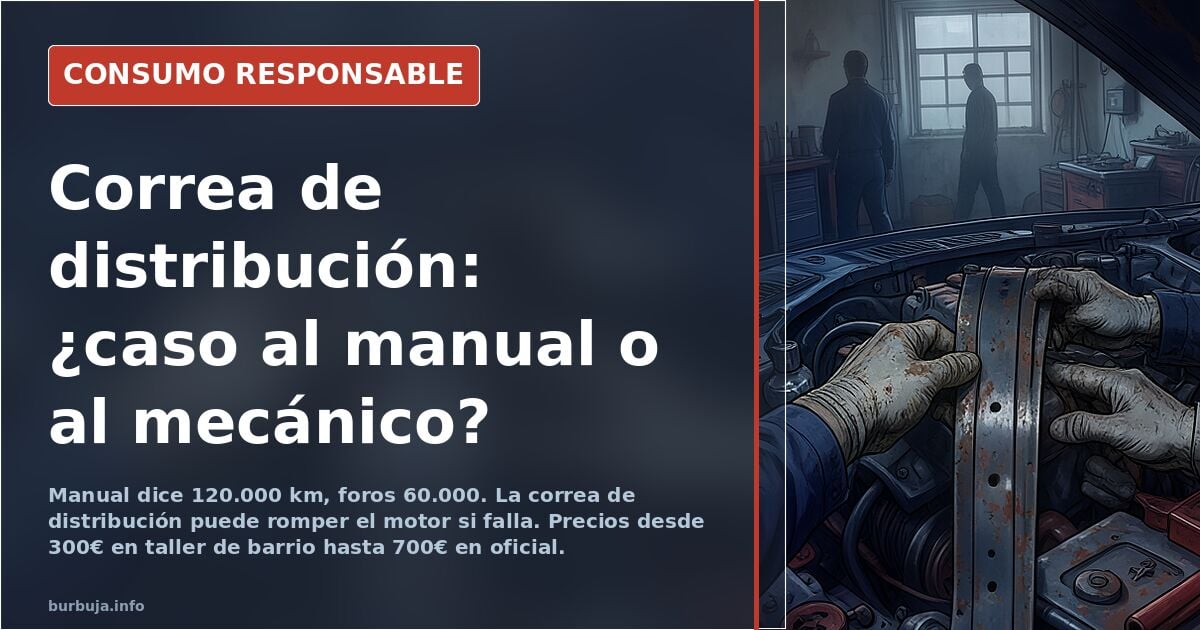
The timing belt: manual versus mechanic
A driver with a car that is almost six years old and has 63,000 kilometres on the clock is facing the prospect of replacing the timing belt. Forums recommend doing it every six years or 60,000 kilometres, whichever comes first. But the maintenance manual for the vehicle specifies that the replacement should be done at nine years or 120,000 kilometres. The doubt is reasonable: who should you listen to? The answer is not unanimous, and getting it wrong can be catastrophic for the engine and the wallet.
The manufacturer's interval: a reliable guide or a trap?
The owner's manual is the official document that sets maintenance intervals. However, the experience of many drivers suggests these deadlines can be too optimistic. One documented case is a petrol Alfa Romeo 147 whose belt snapped at 60,000 kilometres, even though the manual said 120,000. The repair bill came to €2,000. It is not an isolated case: other models, such as the early-2000s Opel Astra, also suffered premature failures. The general advice from garages is not to exceed 80,000–100,000 kilometres, or five years, for the first belt. After the first replacement, the interval shortens, because a replacement belt does not offer the same guarantees as the original.
How much does it cost to replace a timing belt?
The price varies significantly depending on the model, the brand and the garage. At a local garage, replacing the timing kit (belt, rollers and tensioner) plus a general inspection can cost around €350 for a small car. At an official dealership, the figure rises to €600–700. Adding the water pump increases the cost, although some mechanics recommend replacing it along with the belt to save on future labour. The price range is wide: from €300 at independent garages to over €1,000 in complex cases that require dismantling half the engine.
The water pump: preventive replacement or unnecessary expense?
There is debate about whether the water pump should be replaced when changing the timing belt. Some mechanics argue that if the pump is driven by the belt, seizing up or a loss of efficiency can cause the belt to jump teeth or snap. Others maintain that if there are no leaks or strange noises, there is no need to replace it, and doing so is an unnecessary expense. The decision depends on the condition of the pump and the vehicle's history. In any case, many garages take advantage of the belt replacement to inspect and, if necessary, replace the pump, since the labour is the same.
The timing chain: the alternative that avoids nasty surprises
Instead of a belt, some engines use a timing chain, which in theory requires no scheduled maintenance. However, it is not problem-free: it can stretch and jump teeth, although this is less common. For drivers seeking peace of mind, a chain-driven engine can be an option to consider, although it does not guarantee total immunity from breakdowns. The reality is that each system has its pros and cons, and preventive maintenance remains key to avoiding nasty surprises.
The final decision depends on multiple factors: the car model, how it is used, its maintenance history and, of course, your budget. What is clear is that the timing belt gives no warning before it breaks, and the consequences of ignoring the recommended intervals can be far more costly than the replacement itself. As an experienced mechanic put it: "95% of belt failures occur when starting the engine." A thought-provoking figure.
Also available in: Deutsch
Summary of a discussion on Burbuja.info - Foro de economía, actualidad y política., translated from Spanish and reviewed before publication. Read the full discussion (38 replies).
More summaries
-
Zara Denies Free Affinity Card Twice to Low-Income Applicant
Applicant with €700 income suspects accumulated credit risk and old Opening case debts caused the rejection.
-
Mercedes and Dacia share the same Renault engine
The Mercedes B-Class 180 CDI and Dacia models use the same Renault 1.5 dCI engine, which showed superior efficiency in recent tests.
-
Helmeca: nearly €5,000 for a German course and a promised job
Helmeca offers jobs in Germany to early childhood educators but ends up selling a German course for almost €5,000 for a B2 level that many doubt is achievable.
-
Shopper finds worms in blue whiting bought at €2.5/kg in Spain
A shopper in Spain reports worms in blue whiting bought at €2.5/kg, reopening the debate about anisakis in fish sold as fresh.
-
The 3-euro duty making AliExpress shopping more expensive
The EU applies a 3.63-euro charge per imported item, and some estimate prices have risen by 50%. What used to cost 2 euros now costs 5, and the corner shop wins.
-
Cheap diesel vs Repsol: 0.3 litres and a feeling
A test comparing Bon Area diesel with Repsol shows 5.5 litres versus 5.2 per 100 km. The saving tops 1,200 euros over 240,000 km, but the measurement isn't conclusive.