
Thesis suggests Germany is the true target of Russian sanctions
A new theory claims Russian sanctions impoverish Europe and target Germany while the US bypasses its own restrictions.
English · Original discussion in Spanish · Published
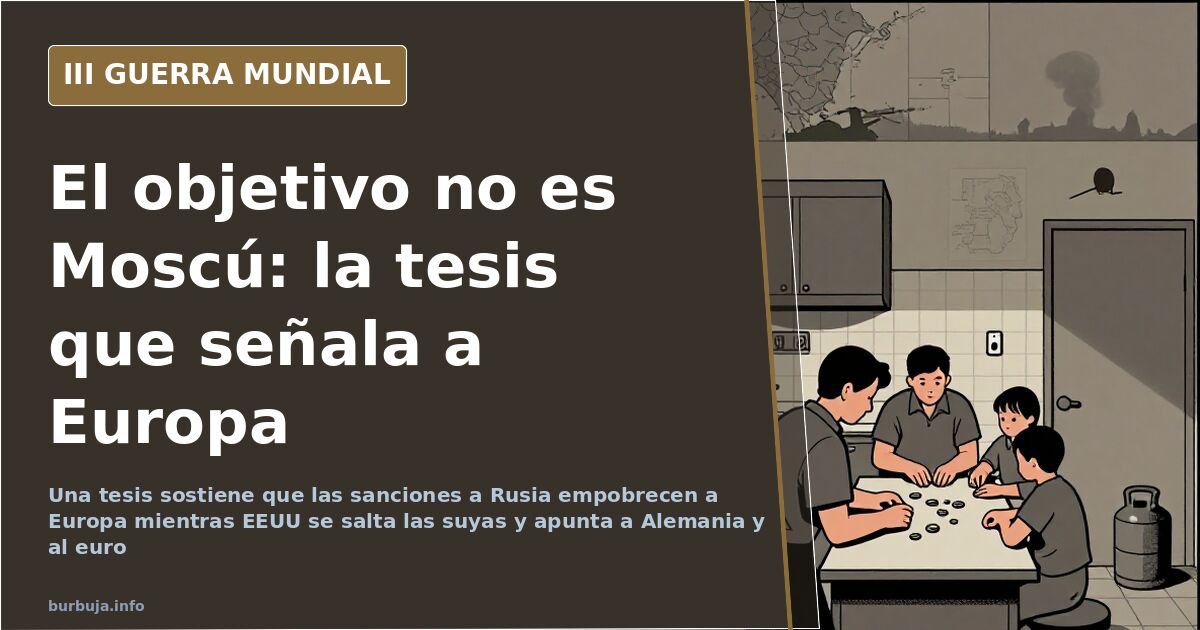
The theory spanning the board: the target is not Moscow, but Berlin
With cheap Russian gas disappearing, enriched uranium seeking alternative suppliers, and chemicals becoming more expensive, one thesis has been gaining ground: the sanctions imposed on Russia by Europe—which the United States avoids—are not meant to bend Moscow, but to bleed its European partner. The starting point is as simple as it is uncomfortable: the European industry, not the American one, is the one paying the energy bill. From there, the analysis diverges.
Some argue that the real target is Western Europe, using the war in Ukraine as a pretext. Others are more precise: the target is Germany and its industry. A third, less conspiratorial current, responds that all of this is the collateral effect of something larger: the true objective would be China, and Europe and Russia are simply the path.
Is Germany the real target of the sanctions?
The argument points directly at Berlin. This reading suggests that the energy alliance that existed between Germany and Russia did not please Washington: a Germany with affordable energy and industrial capacity could have led its European partners to go their own way. For this school of thought, the Anglo-Saxon antiestéticar of a German-Russian axis is the driving force behind everything.
This is not an isolated thesis. Some point out that the United States went as far as sanctioning European companies for participating in the construction of Nord Stream 2], and that there was already a precedent with Iran: an agreement reached in the Obama era that led European companies to quickly sign contracts in Tehran. The pattern—Washington decides, Europe complies—repeats itself.
In contrast, the institutional version maintains the opposite: that Europe and the United States move hand in hand in global politics, with friction between multinationals—such as Boeing and Airbus—but with the same direction in Iraq, Libya, or wherever necessary. In Iraq, it is noted that the United Kingdom contributed around 6% of the troops and Spain 1%, with the United States providing most of the heavy lifting. Partners, yes.
The path to China and the gift of Russian resources
Here the analysis becomes more uncomfortable. If the origin of everything is the antiestéticar of Chinese potential, the unthinkable reaction is exactly what has occurred: gifting Russian resources to China. The country that was meant to be contained ends up with preferential access to the energy and raw materials of its sanctioned neighbor, while Europe pays more for them or simply does not have them. Viewed this way, the maneuver backfires.
The skeptics do not buy the narrative of a grand plan. They argue that states continue to play a key role and that globalization, since the fall of the Berlin Wall, was a bet to gain market share in China that turned out poorly: Western companies today occupy a small portion of China's GDP, and Beijing imposed its own rules halfway through. The suspicion that a handful of elites control everything is dismissed as conspiratorial, with the argument that no plan survives contact with economic reality.
The weight of large funds is also a factor: if a single asset manager handles a volume greater than the German GDP, their weight in industry and banks is massive, it is pointed out. And if, according to another reading of the thread, US financial capital views the euro as its main rival, the piece fits.
The cost of sanctions: short term versus long term
The least debatable part is the arithmetic. Refusing to sell to Russia impoverishes in the short term; in the long term, new customers are sought or none are found. For gas, Europe has it difficult: pipelines take years to build and the buyers replacing Russia will pay less. Translation: you pay more and earn less.
This works well when the customer is not essential. When you depend on them for things as trivial as heating your soup, the situation changes. And there lies the knot of winter: the companies that start laying off workers and the rising bills are the argument some are waiting for to trigger street protests.
Some take for granted the return of the transatlantic trade treaty, and others remember that the United States fought two world wars in Europe, even if it was for economic interests rather than sarracena duty. If only we were more pragmatic in that sense, is the underlying sentiment.
Where the analysis stalls
No one disputes that Europe emerges poorer from this episode. What remains unresolved is who designed it. For some, it is a deliberate plan with Washington pulling the strings and the euro in the crosshairs; for others, it is a clash of blocs where Europe is collateral damage in a larger struggle between the United States and China; and for a third way, it is simply the price of having entrusted one's heating to someone who is now the adversary. The question remains open.
Also available in: Deutsch
Summary of a discussion on Burbuja.info - Foro de economía, actualidad y política., translated from Spanish and reviewed before publication. Read the full discussion (102 replies).
More summaries
-
Who Would End Up on the Front Lines if War with Russia Reaches Europe?
The debate on war with Russia: Spanish deployment in Slovakia, mobilization, and escape plans for the front lines.
-
Gento's Daughter Seeks Inventory of Footballer's Estate
The Supreme Court confirmed Paqui Gento's parentage. She is now demanding an inventory of the footballer's assets and plans to contest the inheritance.
-
Iran threatens to attack Israel: the cycle no one can stop
Iran threatens a new attack on Israel as the cycle of violence repeats itself: attack, response, broken peace announcements and Israeli sabotage. The war…
-
Iran ceasefire leaves Netanyahu without an electoral lifeline
The ceasefire with Iran fails to meet Israel's objectives, leaving Netanyahu without an electoral argument, at odds with Trump and with a discouraging military record.
-
Trumpstein's World Cup: corruption claims and controversy
Corruption allegations, boycott calls and FIFA protocol violations surround Trumpstein's World Cup. Can it survive the scandal?
-
Video shows NATO troops in combat in Ukraine as debate over their presence intensifies
A video shows wounded American troops on the Ukrainian front, with a Spanish-made Instalaza grenade launcher identified. The debate over NATO's direct involvement is reignited.