
Therianthropy: A New Niche for Employment in Spain
The therianthropy phenomenon is creating meetups and escort services in Spain, sparking debate on its nature as a job niche or mental health issue.
English · Original discussion in Spanish · Published
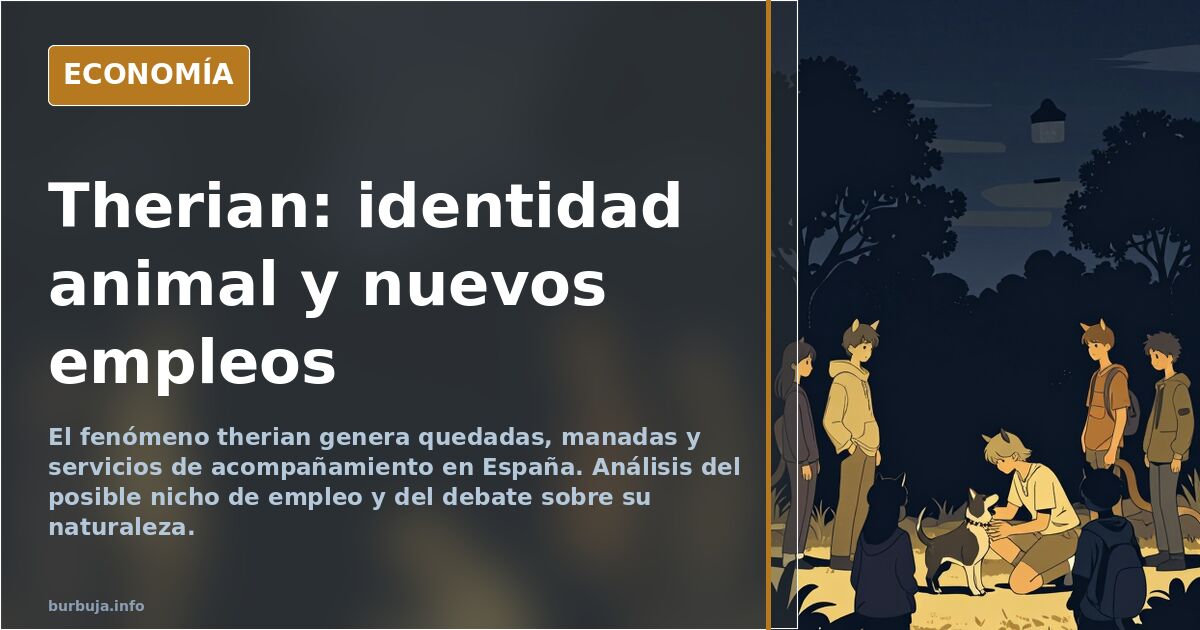
Therianthropy: A New Niche for Employment in Spain
Some people identify with an animal and seek someone to walk them in the park. What many see as a generational eccentricity is becoming a service with demand for others. The therianthropy phenomenon—people who feel a spiritual, psychological, or emotional connection with a non-human animal—has moved beyond internet curiosity to become an activity with meetups, packs, and, judging by the interest it generates, a potential income source for those who recognize the trend.
The definition is not a social media invention. The term "therian" comes from the Greek thērion (wild beast) and anthropos (human). Today's modern identity has precedents in Greek mythology, where human-to-animal transformations—Lycaon into a wolf, Actaeon into a stag—were recurring literary motifs. The difference now is that it is organized through physical meetups and digital communities.
What does a therian do and what services does this generate?
The core activity involves gathering with others who share the same identification, forming groups called "packs," and in some cases, seeking someone to walk them in public spaces and bring them together with peers to engage in behaviors typical of dogs, cats, or foxes. This last aspect opens the door to an economic niche: the figure of the therian walker or companion, a service that did not exist a few years ago but now finds demand in urban environments.
There are no official figures on participant numbers or sector revenue. However, in-person gatherings in various cities are confirmed, requiring logistics such as meeting points, schedules, and spaces where participants can engage without conflict with other users. This creates indirect employment: event coordination, space rental, and companionship services.
Debate: Is it a fad or a mental health issue?
The arrival of this phenomenon in Spain has peine a discussion beyond economics. Some frame it as an imported generational fad associated with younger cohorts, while others argue it responds to real psychological needs requiring treatment. From psychology, some voices state it is not a disorder because individuals are aware of their actions, an argument that has not closed the debate.
The controversy has practical implications: if considered an identity, administration must guarantee spaces and non-discrimination; if considered a disorder, the response is healthcare. This ambiguity prevents consolidation as a market with clear rules. Without a framework, the employment generated is informal, sporadic, and hard to quantify.
Why is this being discussed now and not five years ago?
The phenomenon has circulated for some time, but visibility has surged recently. Digital communities have shifted from closed niches to organizing physical meetups in Spanish cities, attracting media attention. The sequence is familiar: noise on social networks, then physical calls, trinc by journalistic interest, and finally, the economic question.
This interest has a generational component. While older generations view it with skepticism, younger ones integrate it naturally into their identity vocabulary. The gap is not just age-related but mindset-based. For some, it is an eccentricity requiring psychiatric response; for others, it is one more expression of contemporary identity diversity.
A business nobody has quantified yet
The underlying economic question is whether a real market exists or if it is an attention bubble. Companionship services, organized meetups, and space rentals are happening but lack corporate structure. There are no companies specifically constituted for this, no public rates, and no agreements. It is shadow economy or, at best, informal activity.
This does not miccionan money is absent; it means it circulates through channels invisible to statistics. For job seekers, opportunity exists if demand consolidates. For analysts of the Spanish economy, this shows how emerging identities generate economic activity before regulatory frameworks exist.
How long will it take for authorities to decide if this is leisure, identity, or health? That question will determine if the niche becomes a sector or remains an anecdote.
Also available in: Deutsch
Summary of a discussion on Burbuja.info - Foro de economía, actualidad y política., translated from Spanish and reviewed before publication. Read the full discussion (116 replies).
More summaries
-
Spain's unemployment falls to 2008 levels in June 2026: real success or statistical spin?
Registered unemployment in Spain dropped to 2008 levels in June 2026, but scepticism is growing: permanent-seasonal contracts, immigration and precarious work cloud the figures. Is it…
-
Spain's inactive population hits 17.4 million as workforce exodus grows
Spain's inactive population, neither working nor seeking a job, exceeds 17.4 million, according to the EPA. The two interpretations of the data don't add up.
-
Spain tops OECD unemployment with 12.8% rate
Spain leads OECD unemployment at 12.8%, double the Eurozone average, followed closely by Greece and Colombia.
-
Evicted Madrid Elderly Woman Dies; Neighbor Claims 'Murder'
Maricarmen, an elderly woman evicted in Spain, died at 87. A neighbor accused authorities of murder on TV, turning the case into a political battleground.
-
ERC demands answers over origin of riots and looting in Barcelona
ERC Barcelona condemns Saturday's disturbances and calls on the City Council and the Generalitat to explain the lack of foresight and support for businesses.
-
Lula wins Brazil as right sweeps Congress
Lula wins the Brazilian presidency while Bolsonaro's right takes the largest Congress and Senate of its recent history.