
Spain tops OECD unemployment with 12.8% rate
Spain leads OECD unemployment at 12.8%, double the Eurozone average, followed closely by Greece and Colombia.
English · Original discussion in Spanish · Published
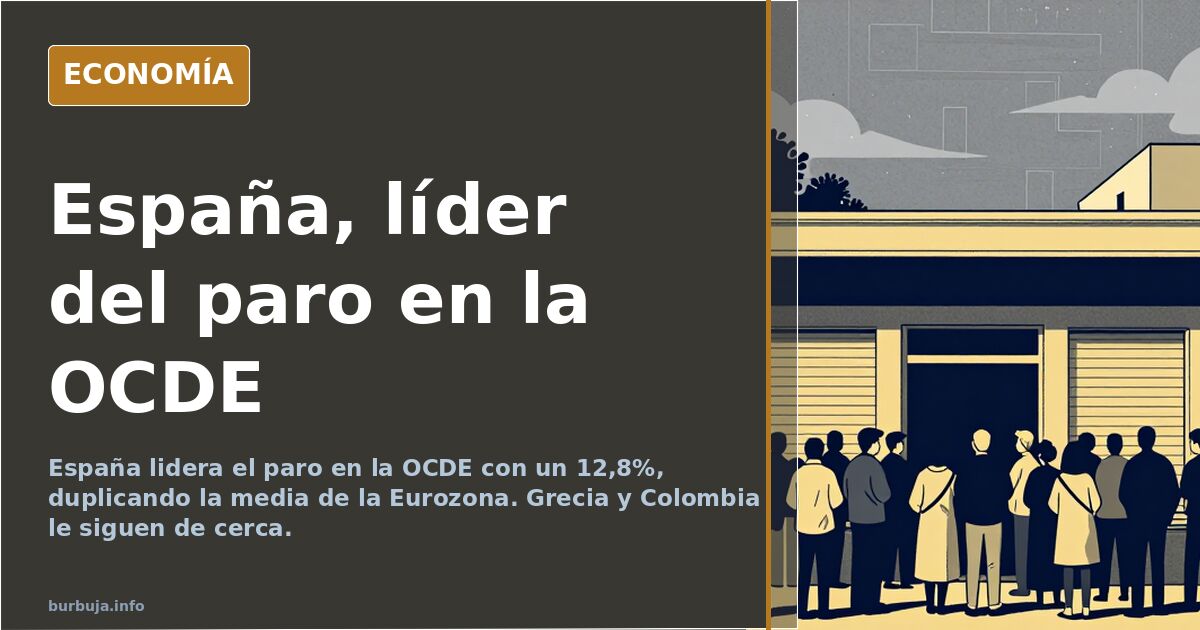
Spain retains top spot for OECD unemployment at 12.8%
Why does Spain continue to lead in OECD unemployment? The latest harmonized data, corresponding to February, places the Spanish unemployment rate at 12.8%, the highest among the 38 economies in the organization. It doubles the Eurozone average (6.6%) and triples that of the G7 (4%). Greece, at 11.4%, and Colombia, at 10.6%, trinc on a list Spain has not left for decades. The news, published by El Mundo, has reignited debate about the structural causes of a labor market seemingly condemned to lag behind the West.
Data confirming Spain's unemployment leadership
The international comparison leaves no room for interpretation. Spain records 12.8% unemployment, compared to 6.6% in the Eurozone, 6% in the EU, 4.8% in the OECD, and 4% in the G7. Greece, at 11.4%, and Colombia, at 10.6%, complete the podium. The gap with major developed economies is so significant that some participants suggest other countries' figures might be manipulated. It is argued that many states exclude those not actively seeking work from their statistics, artificially inflating employment rates. However, even adjusting for this factor, Spain would remain at the top.
Youth unemployment and the gap with Europe
Youth unemployment exacerbates the problem. Spain is the second country in the OECD with the highest youth unemployment among those under 25, behind only Greece. The combination of a high general rate and soaring youth unemployment paints a labor market that excludes newcomers. The lack of opportunities for young people is not just an economic issue; it is a social time bomb fueling emigration and delaying independence.
Causes: bureaucracy, labor costs, and business culture
Among circulating explanations, some argue that hiring in Spain is expensive and bureaucratic. A worker costs nearly double their net salary, and severance pay adds a burden many self-employed individuals and SMEs cannot bear. It is argued that labor legislation, far from protecting workers, incentivizes temporary contracts and discourages stable job creation. Others point to business culture: in a country where SMEs and self-employed are the majority, bureaucracy and lack of financing stifle growth attempts.
Role of public sector jobs and social benefits
Part of the analysis suggests that the high number of civil servants and social benefits discourage active job searching. It is claimed that, compared to previous crises like those in the 80s and 90s, there is less pressure to accept precarious jobs due to broader social safety nets. Others reject this argument as simplistic: the reality is that the Spanish labor market does not generate enough quality jobs, and many unemployed would accept any offer if available.
Comparison with the past: better or worse?
Memories of past crises loom over the debate. In the 80s and 90s, with unemployment rates above 20%, social conflict was much higher. Today, at 12.8%, streets are not burning. Some attribute this to fewer children—previously unemployed were family fathers—reduced civil servant numbers, and social aids. Others believe society has become more conformist. Regardless, historical comparison reveals Spain has suffered bleeding unemployment for half a century.
Impact on daily life
Beyond figures, unemployment translates into crowded terraces mid-morning and streets with people wandering. A scene that, for some, reflects resignation in a country where finding work is exceptional. The gap between statistical reality and citizen perception is one of the debate's most striking aspects. While some see normality, others denounce that the shadow economy and precarity mask a much graver problem.
What solutions are proposed?
Proposals range from reducing hiring bureaucracy to flexifying dismissal rules, including incentivizing vocational training and combating the shadow economy. However, none generates consensus. Some believe the problem is cultural, with Spaniards preferring public sector security over private sector risk. Others argue the system is designed for few to live off many's effort. What is clear is that without structural change, Spain will continue leading OECD unemployment.
With these elements, the basket remains the same. Meanwhile, the terrace stays full.
Also available in: Deutsch
Summary of a discussion on Burbuja.info - Foro de economía, actualidad y política., translated from Spanish and reviewed before publication. Read the full discussion (109 replies).
More summaries
-
Cayetana Álvarez de Toledo also doesn't get the Ayuso penthouse
The Community of Madrid bought a €6 million penthouse without explanation. Even Cayetana Álvarez de Toledo admits she doesn't get it. The opposition demands…
-
Spain's Cayetana Álvarez de Toledo Shocked by Trump-Venezuela Realpolitik
Cayetana Álvarez de Toledo faces the reality of geopolitics as Trump bypasses María Corina Machado, revealing a disconnect within Spain's political elite.
-
Colau says she left her flat of 15 years because she couldn't afford it
Ada Colau says she is leaving the flat where she lived for 15 years because one salary wasn't enough; Newtral puts her salary as mayor at €96,000 gross
-
Trump hits Europe with higher tariffs on European cars and trucks
Trump imposes tariffs on European vehicles, forcing a choice between manufacturing in the US or paying up. Analysis of the industrial and geopolitical impact on Burbuja.
-
Russia weighs military targets in the United Kingdom
Russia is reportedly considering military targets in the UK: we break down the debate on Burbuja.info about the war escalation and the skepticism toward the official narrative.
-
Spain's amazing home-grown architecture: beyond PAKISMO, the GRECOPAKISMO
We take a look at the GRECOPAKISMO phenomenon: when Spain's home-grown architecture tries to imitate luxury mansions with results that defy property logic.