
Fuel prices in Spain vary from €1.25 to €1.64
With fuel averaging €1.46 per litre, consumers are frustrated by price gaps between €1.29 and €1.64 as oil nears $90 a barrel.
English · Original discussion in Spanish · Published
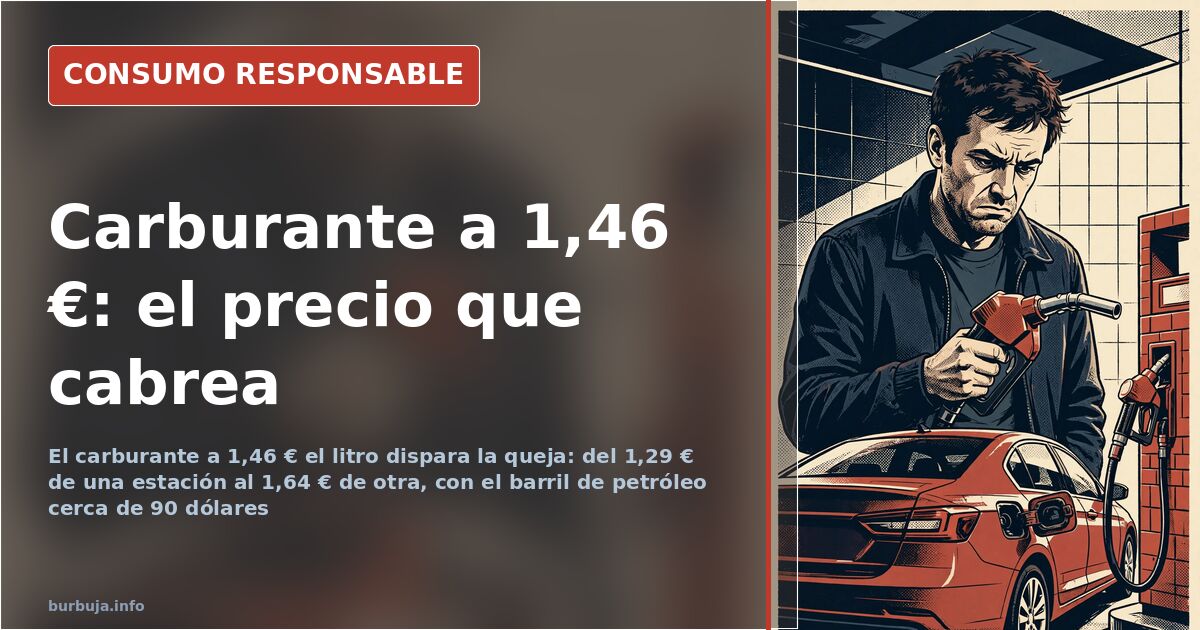
Fuel at €1.46: Rising costs and the struggle to make ends meet
Paying €1.46 for a litre of 95 octane petrol is infuriating. It is frustrating even if half the continent pays more, but it is especially bitter when a neighbor paid just €1.25 that same morning. The fuel price has ceased to be a mere economic statistic and has become a barometer of public discontent: every refill feels like a small defeat, and every receipt provides an excuse to look for someone to blame.
The figure itself is not the only issue; it is the map. Throughout the discussion, prices are cited ranging from diesel at €1.29 per litre, 95 petrol at €1.34 at a low-cost station, €1.279 in Navarra at dawn, €1.49 at a local Repsol station, €1.46 in a recent refill, and €1.64 at another pump. Between the cheapest and most expensive in the same country, there is a difference of more than thirty cents, even though the product remains the same.
Why does the price per litre vary by station?
The most common answer has nothing to do with fuel quality. Those who have used low-cost stations for a decade claim the diesel filter comes out clean and free of impurities, attributing the difference to advertising, sponsorships, and the overhead associated with major brands. From that perspective, paying more at a well-known station versus less at an unbranded one is essentially paying for the logo.
Geographic disparities add another layer. A tank in Navarra at €1.279 and another in a major capital at €1.49 cannot be explained by brand alone, but by local competition, land costs, and station density. For the average driver, the explanation matters little: same liquid, same engine, thirty cents of nothing.
How much of the fuel price is tax?
This is one of the most debated points. It is argued that taxation is the most inflationary factor and that every price hike serves revenue collection far more than it acts as a deterrent or environmental measure. As an indirect argument, some cite a price anchored since 2004—the price of a gram of cocaine, around €60—to conclude that it is not the products that are getting more expensive, but the tax burden placed upon them.
Conversely, others argue that fuel responds to a global market and that neither taxes nor the current Government move the barrel price. With crude oil approaching $90 and some analyses forecasting a global recession due to energy limits, the issue would point to a supply problem rather than taxation. Both versions coexist without much friction.
€1,500 salaries vs €1.50 petrol: The comparison driving the outcry
When salaries are brought into the light, the anger turns into arithmetic. In Sweden, a litre costs €2.07 with an average monthly salary around €4,000; in Spain, it is €1.47 with an average salary estimated at €1,000. Seen this way, fuel in Sweden is relatively cheaper than in Spain. In the United States, the figures fluctuate: some calculate $1.70 per litre with $4,000 salaries, while others cite an average of €0.85 per litre according to international fuel price series.
This leads to an uncomfortable conclusion: the problem is not what a litre costs, but what it costs in relation to income. The same price can be a minor detail in one country and a mobility crisis in another.
Is it possible to live without a car in Spain?
Some people gave up their cars over a year ago and consider it a substantial saving, avoiding petrol and associated costs. Others respond that the problem is not giving up a vehicle, but being forced to give up more and more: first the car, then what? Private mobility might be nearing its end at these prices, but alternatives do not always exist outside of large cities.
The picture is completed by two uncomfortable details. First, the criticism of those who bought an urban SUV just to go to the bakery and now complain about consumption. Second, the access restrictions in Madrid for older cars, which leave compact vehicles out of the city center while larger vehicles roam free.
The car as a luxury good
“Only the rich will have cars,” summarizes one participant in the debate. Mobility would cease to be a diffuse right and become a privilege of income, with electricity as the next frontier, without anyone daring to calculate the cost per kilometer. Meanwhile, the country that prides itself on leading renewable energy watches the fuel pump with the same expression as those who do not.
And then there is the silence. No one goes out to protest, or so it is mockingly said: patience endures prices and conditions without anything happening. The question has been hanging in the air for some time: if 95 petrol at €1.46 triggers this storm, what would it take for someone to take to the streets?
Paying €1.46 for a litre of 95 octane petrol is infuriating. It is frustrating even if half the continent pays more, but it is especially bitter when a neighbor paid just €1.25 that same morning. The fuel price has ceased to be a mere economic statistic and has become a barometer of public discontent: every refill feels like a small defeat, and every receipt provides an excuse to look for someone to blame.
The figure itself is not the only issue; it is the map. Throughout the discussion, prices are cited ranging from diesel at €1.29 per litre, 95 petrol at €1.34 at a low-cost station, €1.279 in Navarra at dawn, €1.49 at a local Repsol station, €1.46 in a recent refill, and €1.64 at another pump. Between the cheapest and most expensive in the same country, there is a difference of more than thirty cents, even though the product remains the same.
Why does the price per litre vary by station?
The most common answer has nothing to do with fuel quality. Those who have used low-cost stations for a decade claim the diesel filter comes out clean and free of impurities, attributing the difference to advertising, sponsorships, and the overhead associated with major brands. From that perspective, paying more at a well-known station versus less at an unbranded one is essentially paying for the logo.
Geographic disparities add another layer. A tank in Navarra at €1.279 and another in a major capital at €1.49 cannot be explained by brand alone, but by local competition, land costs, and station density. For the average driver, the explanation matters little: same liquid, same engine, thirty cents of nothing.
How much of the fuel price is tax?
This is one of the most debated points. It is argued that taxation is the most inflationary factor and that every price hike serves revenue collection far more than it acts as a deterrent or environmental measure. As an indirect argument, some cite a price anchored since 2004—the price of a gram of cocaine, around €60—to conclude that it is not the products that are getting more expensive, but the tax burden placed upon them.
Conversely, others argue that fuel responds to a global market and that neither taxes nor the current Government move the barrel price. With crude oil approaching $90 and some analyses forecasting a global recession due to energy limits, the issue would point to a supply problem rather than taxation. Both versions coexist without much friction.
€1,500 salaries vs €1.50 petrol: The comparison driving the outcry
When salaries are brought into the light, the anger turns into arithmetic. In Sweden, a litre costs €2.07 with an average monthly salary around €4,000; in Spain, it is €1.47 with an average salary estimated at €1,000. Seen this way, fuel in Sweden is relatively cheaper than in Spain. In the United States, the figures fluctuate: some calculate $1.70 per litre with $4,000 salaries, while others cite an average of €0.85 per litre according to international fuel price series.
This leads to an uncomfortable conclusion: the problem is not what a litre costs, but what it costs in relation to income. The same price can be a minor detail in one country and a mobility crisis in another.
Is it possible to live without a car in Spain?
Some people gave up their cars over a year ago and consider it a substantial saving, avoiding petrol and associated costs. Others respond that the problem is not giving up a vehicle, but being forced to give up more and more: first the car, then what? Private mobility might be nearing its end at these prices, but alternatives do not always exist outside of large cities.
The picture is completed by two uncomfortable details. First, the criticism of those who bought an urban SUV just to go to the bakery and now complain about consumption. Second, the access restrictions in Madrid for older cars, which leave compact vehicles out of the city center while larger vehicles roam free.
The car as a luxury good
“Only the rich will have cars,” summarizes one participant in the debate. Mobility would cease to be a diffuse right and become a privilege of income, with electricity as the next frontier, without anyone daring to calculate the cost per kilometer. Meanwhile, the country that prides itself on leading renewable energy watches the fuel pump with the same expression as those who do not.
And then there is the silence. No one goes out to protest, or so it is mockingly said: patience endures prices and conditions without anything happening. The question has been hanging in the air for some time: if 95 petrol at €1.46 triggers this storm, what would it take for someone to take to the streets?
Also available in: Deutsch
Summary of a discussion on Burbuja.info - Foro de economía, actualidad y política., translated from Spanish and reviewed before publication. Read the full discussion (103 replies).
More summaries
-
US vs Spain: Prices, Salaries, and Purchasing Power
Eggs cost $4 in Texas and €7 in Madrid, yet US wages are triple. We analyze real purchasing power between the two countries.
-
Automatic cars now dominate in Spain: from 3% to 59%
In 2001, 97% of new cars in Spain were manual; by 2024, automatics reached 59%. The 2019 driving license change and pricing explain this shift.
-
KFC sells 22 chicken wings for 9 euros, less than 50 cents each
22 KFC chicken wings for 9 euros cost less than 50 cents each. Details and terms of the limited-time offer in Spain.
-
Car air filters: when do they actually need replacing?
A one-year-old air filter marked with fingerprints in a workshop raises doubts: is an 8 euro part a genuine need or a forced sale?
-
EU prepares new vehicle inspections to measure brake and tire particles
Brussels aims to unify technical inspections across Europe by measuring tire and brake wear, a move critics say targets older vehicles for scrappage.
-
Buying winter coats in Spain: high prices and poor sizing
A forum user argues that finding affordable, durable, and well-sized winter coats in Spain is nearly impossible due to poor design and high costs.