
The Times warns of potential fall of Kyiv
The Times article suggests Kyiv may fall due to insufficient Western arms, signaling a narrative shift toward justifying negotiated outcomes.
English · Original discussion in Spanish · Published
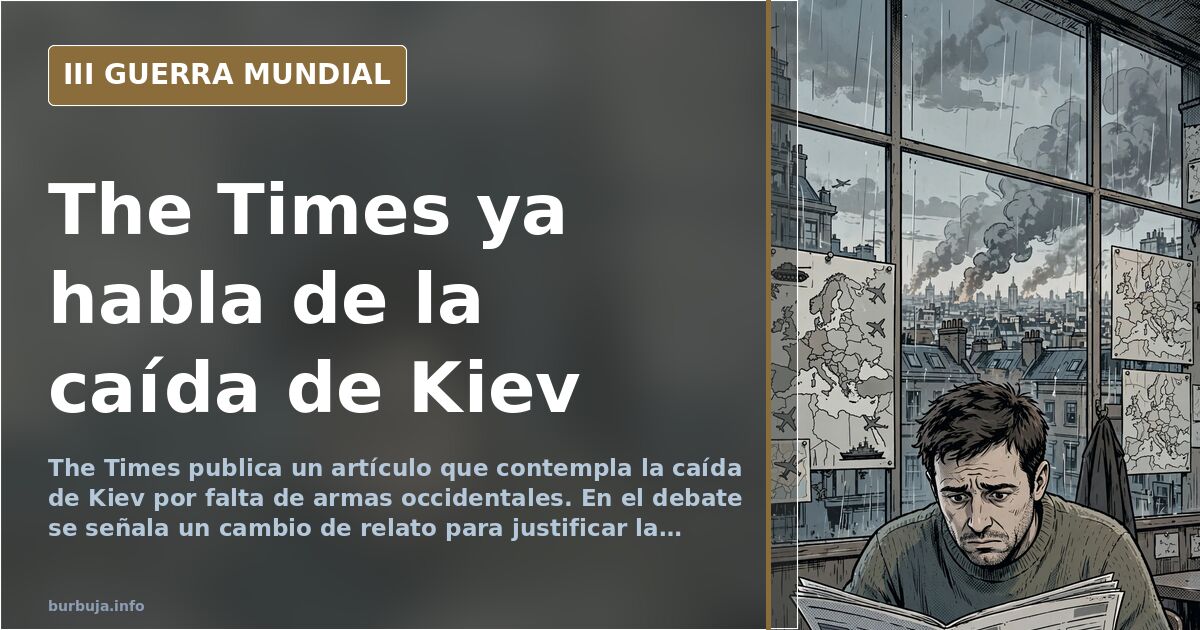
The Times acknowledges scenario of Kyiv's fall
British daily The Times published an article by Iain Martin openly contemplating the possibility that Russian forces could reach the gates of Kyiv. Titled "It is time we talked about the fall of Kyiv," the text argues that rather than a frozen conflict, a nightmare scenario is emerging because the West fails to send sufficient weapons. The article's date, March 27, 2024, coincides with a period when Western military aid to Ukraine faces serious difficulties.
Reaction was immediate. Much independent analysis indicates such articles are preludes to a narrative change: first admitting the situation is desperate, then blaming Europe for not doing enough, and finally seeking a negotiated exit. According to this reading, Martin's article is not a military analysis but a political reckoning.
The article admitting what no one wanted to admit
Iain Martin's text in The Times describes a scenario where, by July, the Russian army would be at Kyiv's gates. Zelensky would repeat his words from February 2022: he does not need evacuation from Ukraine, he needs ammunition to stay and fight. The article laments that the West did not listen earlier nor do more when Ukrainians asked for help. The central thesis is that the lack of Western arms is creating conditions for catastrophic defeat.
What stands out is not only what it says, but what it omits. The author devotes much of the article explaining what the US and Europe should do to avoid disaster, but mentions no concrete action the UK will take. This asymmetry has been widely commented on: the country that most strongly pushed for military support to Ukraine since the war began now limits itself to warning others what they must do.
Zelensky lowers territorial expectations
In a recent CBS interview, Ukrainian President Volodymyr Zelensky lowered his territorial expectations. He no longer demands Ukraine's original borders, but a return to the February 2022 borders. This substantial change, according to critical analyses, confirms that the military situation on the ground has forced Kyiv to abandon maximalist goals.
This shift coincides with statements where Zelensky affirmed that without US help they will have to withdraw. He refers not to money, weapons, or ammunition, which he receives even before the special operation, but to Washington putting its troops directly on the ground. It is a request that, as of this discussion, no NATO member seems willing to satisfy.
War business and corruption in Kyiv
One growing analytical stream holds that the war has been a huge business for certain Ukrainian political and business circles. It points out that Zelensky has avoided elections and that some military material sent by the West is resold on the black market. These accusations circulate without conclusive proof, but explain why a growing part of Western public opinion views continued financial and military support with suspicion.
The comparison with Vietnam appears repeatedly: years after the conflict, it became known that the war had been a great business for many involved in South Vietnamese governments. According to this reading, the pattern repeats now in Kyiv. Those supporting this thesis do not ask for Ukraine's defeat, but demand audits and transparency before continuing to send money.
Europe's role and the ghost of World War III
The Times article implies Europe has a population three and a half times larger than Russia's and a GDP ten times higher. The implication is clear: if Europe wanted, it could do much more. But so is the trap: Anglo-Saxons want Europeans to put soldiers in a war that concerns them little. The UK, meanwhile, limits itself to warnings.
No one wants to start World War III for Zelensky or Ukraine. The most widespread stance among critical analysts is that Ukraine was sold from the beginning and played the role of useful idiot for the West, providing the dead and pledging its economy. The solution taking shape, if peace ever arrives, involves Ukrainian neutrality and leaving the issue of territories occupied by Russia unresolved, without international recognition but with de facto Russian administration.
The most realistic prediction, given available data, is that the war will not end with a clear military victory for either side. Russia cannot lose because it considers its survival at stake, and the West is unwilling to send its own troops. The most probable outcome is a peace agreement freezing the conflict, with neutral Ukraine and no recovery of lost territories. Zelensky, meanwhile, continues asking for help and lowering expectations. The fall of Kyiv announced by The Times may never happen, but the narrative is already prepared to justify it.
British daily The Times published an article by Iain Martin openly contemplating the possibility that Russian forces could reach the gates of Kyiv. Titled "It is time we talked about the fall of Kyiv," the text argues that rather than a frozen conflict, a nightmare scenario is emerging because the West fails to send sufficient weapons. The article's date, March 27, 2024, coincides with a period when Western military aid to Ukraine faces serious difficulties.
Reaction was immediate. Much independent analysis indicates such articles are preludes to a narrative change: first admitting the situation is desperate, then blaming Europe for not doing enough, and finally seeking a negotiated exit. According to this reading, Martin's article is not a military analysis but a political reckoning.
The article admitting what no one wanted to admit
Iain Martin's text in The Times describes a scenario where, by July, the Russian army would be at Kyiv's gates. Zelensky would repeat his words from February 2022: he does not need evacuation from Ukraine, he needs ammunition to stay and fight. The article laments that the West did not listen earlier nor do more when Ukrainians asked for help. The central thesis is that the lack of Western arms is creating conditions for catastrophic defeat.
What stands out is not only what it says, but what it omits. The author devotes much of the article explaining what the US and Europe should do to avoid disaster, but mentions no concrete action the UK will take. This asymmetry has been widely commented on: the country that most strongly pushed for military support to Ukraine since the war began now limits itself to warning others what they must do.
Zelensky lowers territorial expectations
In a recent CBS interview, Ukrainian President Volodymyr Zelensky lowered his territorial expectations. He no longer demands Ukraine's original borders, but a return to the February 2022 borders. This substantial change, according to critical analyses, confirms that the military situation on the ground has forced Kyiv to abandon maximalist goals.
This shift coincides with statements where Zelensky affirmed that without US help they will have to withdraw. He refers not to money, weapons, or ammunition, which he receives even before the special operation, but to Washington putting its troops directly on the ground. It is a request that, as of this discussion, no NATO member seems willing to satisfy.
War business and corruption in Kyiv
One growing analytical stream holds that the war has been a huge business for certain Ukrainian political and business circles. It points out that Zelensky has avoided elections and that some military material sent by the West is resold on the black market. These accusations circulate without conclusive proof, but explain why a growing part of Western public opinion views continued financial and military support with suspicion.
The comparison with Vietnam appears repeatedly: years after the conflict, it became known that the war had been a great business for many involved in South Vietnamese governments. According to this reading, the pattern repeats now in Kyiv. Those supporting this thesis do not ask for Ukraine's defeat, but demand audits and transparency before continuing to send money.
Europe's role and the ghost of World War III
The Times article implies Europe has a population three and a half times larger than Russia's and a GDP ten times higher. The implication is clear: if Europe wanted, it could do much more. But so is the trap: Anglo-Saxons want Europeans to put soldiers in a war that concerns them little. The UK, meanwhile, limits itself to warnings.
No one wants to start World War III for Zelensky or Ukraine. The most widespread stance among critical analysts is that Ukraine was sold from the beginning and played the role of useful idiot for the West, providing the dead and pledging its economy. The solution taking shape, if peace ever arrives, involves Ukrainian neutrality and leaving the issue of territories occupied by Russia unresolved, without international recognition but with de facto Russian administration.
The most realistic prediction, given available data, is that the war will not end with a clear military victory for either side. Russia cannot lose because it considers its survival at stake, and the West is unwilling to send its own troops. The most probable outcome is a peace agreement freezing the conflict, with neutral Ukraine and no recovery of lost territories. Zelensky, meanwhile, continues asking for help and lowering expectations. The fall of Kyiv announced by The Times may never happen, but the narrative is already prepared to justify it.
Also available in: Deutsch
Summary of a discussion on Burbuja.info - Foro de economía, actualidad y política., translated from Spanish and reviewed before publication. Read the full discussion (107 replies).
More summaries
-
Kiev's Systematic Air Campaign Targets Factories, Warehouses, and Data Centers
Kiev faces systematic missile and drone attacks on factories, warehouses, and data centers, leading to blackouts and smoke.
-
Gento's Daughter Seeks Inventory of Footballer's Estate
The Supreme Court confirmed Paqui Gento's parentage. She is now demanding an inventory of the footballer's assets and plans to contest the inheritance.
-
USS Florida docks in Gibraltar with 154 Tomahawks
The USS Florida, carrying 154 Tomahawks and combat diver capabilities, docked in Gibraltar, reigniting tensions over the Treaty of Utrecht.
-
Ukraine Requests Western Tanks: Where Are Its 2,000 T-64s?
Ukraine had ~2,000 T-64s and 1,000 T-80s but now seeks over 1,000 Western armored vehicles. The tank inventory discrepancy raises questions.
-
From Spanish lockdowns to passport-free refugee convoys
Spain lifted municipal lockdowns in May 2021. Now, Ukrainian refugees cross Europe unvaccinated and without health passes.
-
Putin tells Scholz Russian gas can be paid in euros
Kremlin delays ruble payment deadline as AFP reports Putin accepts euros. The mechanism relies on Gazprombank.