
Ukraine Requests Western Tanks: Where Are Its 2,000 T-64s?
Ukraine had ~2,000 T-64s and 1,000 T-80s but now seeks over 1,000 Western armored vehicles. The tank inventory discrepancy raises questions.
English · Original discussion in Spanish · Published
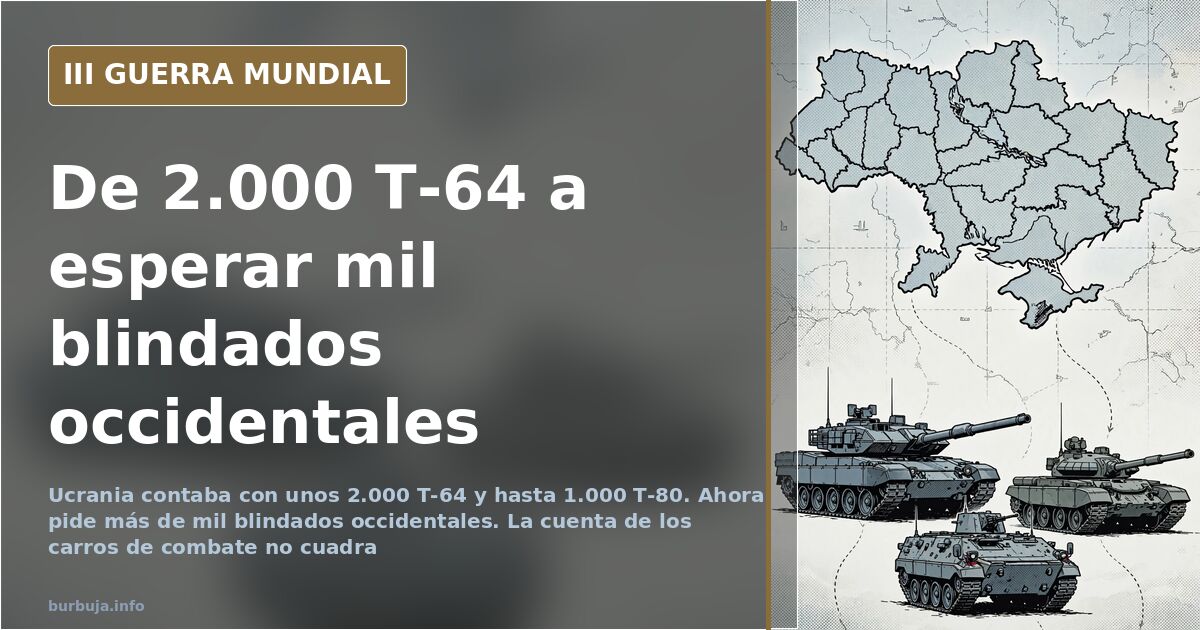
Ukraine Had 2,000 T-64s, Now Awaits 1,000 Western Tanks
Europe's second-largest land army after Russia has run out of tanks to break the front lines. Before the war, Ukraine possessed approximately 2,000 T-64s—many upgraded to the T-64BV variant since 2014—and up to a thousand T-80s, according to estimates circulating among military analysts. Official figures cited around 2,500 total main battle tanks. Now, with the offensive stalled, Kyiv awaits the arrival of more than 1,000 Western armored vehicles. The math doesn't add up, and the uncomfortable question remains: where did its existing fleet go?
Why Does an Army With Thousands of Tanks Need More?
Because having them on paper is not the same as having them operational. This argument is repeated constantly. In arsenals inherited from the Soviet era, actual stock mixes with declared numbers: the same issue attributed to Russia applies symmetrically to any former republic. Some summarize it simply: saying a country has 10,000 tanks is like a junkyard owner claiming to have 10,000 cars. The inventory exists; the ability to deploy it does not necessarily.
The same logic applies to Spanish equipment, often used as a benchmark in these discussions. Statistics show a respectable number of armored vehicles on paper, yet reality reveals many are unusable or scrapped. The gap between accounting figures and true operational capacity is argued to be key to understanding why Ukraine requests more when it supposedly already has plenty.
From 10,000 Russian Tanks to Recycled T-62s
The Russian case is the most striking mirror. It was said that Russia had 10,000 tanks, yet it is now seen resorting to recycled T-62s, models decades old. Why? Because many of those 10,000 were far from operational, and the rest irretrievable. Added to this are more than 1,600 Russian tanks counted as destroyed. The arithmetic of scrap explains more than any official balance sheet.
The consequence is twofold. First, it dismantles the idea that large Soviet-era numbers equated to real power. Second, it forces an upward revision of attrition estimates for both sides: if declared material was never so abundant, what has been consumed in combat weighs relatively heavier.
Is the Main Battle Tank Doomed or More Necessary Than Ever?
Here analysis splits in two. One school argues that armor is being neutralized by anti-tank missiles, modern artillery, and drones, to the point where a single operator with a launcher can disable a tank at two kilometers. The battlefield would resemble a repeat of World War I: entrenched infantry and artillery masses turning terrain into scorched mud.
The opposing thesis goes the other way. It is not that the tank is dead, but that breaking fortified zones requires enormous quantities of armor; without them, an offensive becomes a march toward slaughter. No one attacks fortifications unprotected. The problem is that armored advantage activates only under three conditions—air superiority, concentration at a point, and surprise factor—and none exist on this front: satellites reveal any concentration, and aviation cannot fly low due to dense surface-to-air missiles. The debate remains open, but the disorienting fact is that despite thousands of tanks on paper, both sides keep asking for more.
Soledar, Bakhmut, and the Bill for Undelivered Armor
The war has left episodes that fuel distrust in figures. In Soledar, one of the Ukrainian brigades defending the area had been trained in the United Kingdom, yet was overrun. In Bakhmut, some claim—taking it as such, a partisan assertion—that a heterogeneous recruitment unit managed to overwhelm three regular brigades. And during the Kherson counteroffensive, videos of destroyed Ukrainian armored vehicles accumulated.
The result is a trickle of material losses that war propaganda tends to minimize on both sides. If added to the fact that part of the promised Western weaponry—Leopard-type tanks, infantry fighting vehicles—arrives in dribs and drabs, the question of why existing tanks don't appear has an uncomfortable answer: because they are destroyed, immobilized, or were never in condition to fight.
Who Will Drive the Incoming Armored Vehicles?
Tanks do not drive themselves, and here another bottleneck appears. There has been irony about the paperwork future operators of Western tanks will need, assuming crew training is as big a problem as the lack of hardware. It is no minor detail: Ukraine sends hundreds of recruits to train in European countries, and there is record of groups of about 200 Ukrainians taking a short course in Toledo to operate Hawk missiles rescued from arsenals and scrapyards. The paradox is that weapon promises abound while capable operators are scarce.
The Russian army itself shows the same wear: mobilizing prisoners and using accelerated training units reveal that the problem is not just where tanks come from, but who sits inside them.
With these elements, the next question is not whether the 1,000 Western armored vehicles will arrive. It is whether, when they do, there will be means to break the front, or if they will remain, like much of what was already there, waiting for a crew and an opportunity window that never opens.
Europe's second-largest land army after Russia has run out of tanks to break the front lines. Before the war, Ukraine possessed approximately 2,000 T-64s—many upgraded to the T-64BV variant since 2014—and up to a thousand T-80s, according to estimates circulating among military analysts. Official figures cited around 2,500 total main battle tanks. Now, with the offensive stalled, Kyiv awaits the arrival of more than 1,000 Western armored vehicles. The math doesn't add up, and the uncomfortable question remains: where did its existing fleet go?
Why Does an Army With Thousands of Tanks Need More?
Because having them on paper is not the same as having them operational. This argument is repeated constantly. In arsenals inherited from the Soviet era, actual stock mixes with declared numbers: the same issue attributed to Russia applies symmetrically to any former republic. Some summarize it simply: saying a country has 10,000 tanks is like a junkyard owner claiming to have 10,000 cars. The inventory exists; the ability to deploy it does not necessarily.
The same logic applies to Spanish equipment, often used as a benchmark in these discussions. Statistics show a respectable number of armored vehicles on paper, yet reality reveals many are unusable or scrapped. The gap between accounting figures and true operational capacity is argued to be key to understanding why Ukraine requests more when it supposedly already has plenty.
From 10,000 Russian Tanks to Recycled T-62s
The Russian case is the most striking mirror. It was said that Russia had 10,000 tanks, yet it is now seen resorting to recycled T-62s, models decades old. Why? Because many of those 10,000 were far from operational, and the rest irretrievable. Added to this are more than 1,600 Russian tanks counted as destroyed. The arithmetic of scrap explains more than any official balance sheet.
The consequence is twofold. First, it dismantles the idea that large Soviet-era numbers equated to real power. Second, it forces an upward revision of attrition estimates for both sides: if declared material was never so abundant, what has been consumed in combat weighs relatively heavier.
Is the Main Battle Tank Doomed or More Necessary Than Ever?
Here analysis splits in two. One school argues that armor is being neutralized by anti-tank missiles, modern artillery, and drones, to the point where a single operator with a launcher can disable a tank at two kilometers. The battlefield would resemble a repeat of World War I: entrenched infantry and artillery masses turning terrain into scorched mud.
The opposing thesis goes the other way. It is not that the tank is dead, but that breaking fortified zones requires enormous quantities of armor; without them, an offensive becomes a march toward slaughter. No one attacks fortifications unprotected. The problem is that armored advantage activates only under three conditions—air superiority, concentration at a point, and surprise factor—and none exist on this front: satellites reveal any concentration, and aviation cannot fly low due to dense surface-to-air missiles. The debate remains open, but the disorienting fact is that despite thousands of tanks on paper, both sides keep asking for more.
Soledar, Bakhmut, and the Bill for Undelivered Armor
The war has left episodes that fuel distrust in figures. In Soledar, one of the Ukrainian brigades defending the area had been trained in the United Kingdom, yet was overrun. In Bakhmut, some claim—taking it as such, a partisan assertion—that a heterogeneous recruitment unit managed to overwhelm three regular brigades. And during the Kherson counteroffensive, videos of destroyed Ukrainian armored vehicles accumulated.
The result is a trickle of material losses that war propaganda tends to minimize on both sides. If added to the fact that part of the promised Western weaponry—Leopard-type tanks, infantry fighting vehicles—arrives in dribs and drabs, the question of why existing tanks don't appear has an uncomfortable answer: because they are destroyed, immobilized, or were never in condition to fight.
Who Will Drive the Incoming Armored Vehicles?
Tanks do not drive themselves, and here another bottleneck appears. There has been irony about the paperwork future operators of Western tanks will need, assuming crew training is as big a problem as the lack of hardware. It is no minor detail: Ukraine sends hundreds of recruits to train in European countries, and there is record of groups of about 200 Ukrainians taking a short course in Toledo to operate Hawk missiles rescued from arsenals and scrapyards. The paradox is that weapon promises abound while capable operators are scarce.
The Russian army itself shows the same wear: mobilizing prisoners and using accelerated training units reveal that the problem is not just where tanks come from, but who sits inside them.
With these elements, the next question is not whether the 1,000 Western armored vehicles will arrive. It is whether, when they do, there will be means to break the front, or if they will remain, like much of what was already there, waiting for a crew and an opportunity window that never opens.
Also available in: Deutsch
Summary of a discussion on Burbuja.info - Foro de economía, actualidad y política., translated from Spanish and reviewed before publication. Read the full discussion (107 replies).
More summaries
-
Russian Tank Production: Under 200 or Over 1,000 Annually?
Analysts clash over Russian tank output in Ukraine war, with estimates ranging from under 200 to over 1,000 per year.
-
Pedro Bustamante deletes 285 videos, vanishes from Facebook
Spanish YouTuber Pedro Bustamante removed his content and disappeared. Rumors place him in Munich, reading German press.
-
Iglesias Prefers Obama, Undermining Communist Label
Pablo Iglesias favors Obama over Putin, sparking debate on Podemos' identity: communism, postmodernism, or crony capitalism?
-
Spain backs Morocco's Sahara autonomy plan, angering Algeria
Sánchez endorses Moroccan autonomy for Western Sahara in letter to King Mohammed VI. Algeria recalls ambassador amid gas supply concerns.
-
US Decline Debate: Portland Homelessness and UFO Distractions
A viral tweet about caravans in Portland reignites discussions on US decline, poverty, and theories that UFO noise masks social issues.
-
British Army trains Moroccan troops in Jebel Sahara exercise
The British Army trains Moroccan troops during the Jebel Sahara exercise while Morocco maintains its territorial claims over Ceuta and Melilla.