
The TikTok video that cost a Ukrainian soldier her life
A Ukrainian soldier filmed a TikTok with columns of smoke in the background, and minutes later Russian artillery responded. The case reopens the debate over mobile geolocation in war.
English · Original discussion in Spanish · Published
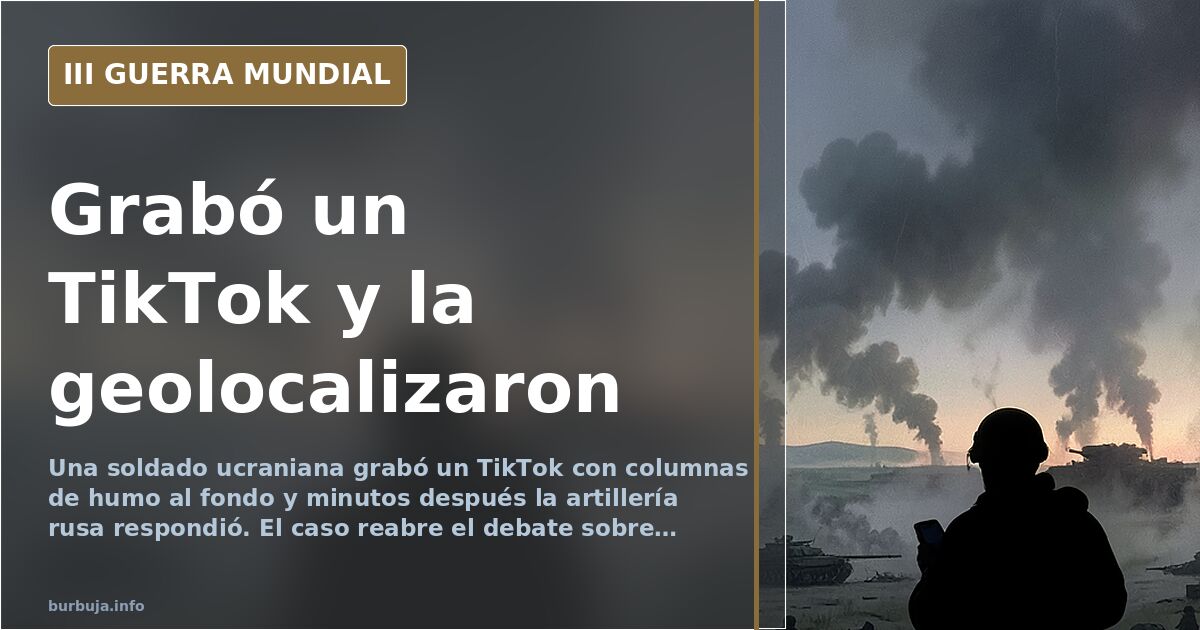
The TikTok video that cost a Ukrainian soldier her life
A soldier in the Ukrainian army recorded her final TikTok video with columns of smoke in the background, after a strike on Russian positions. Minutes later, Russian artillery responded to the attack. The episode, widely shared on social media, has peine an uncomfortable issue: the geolocation of combatants through their mobile phones and the human cost of turning the front line into a showcase.
The material circulating these days — screenshots, photos and comments — claims the young woman died from a direct hit while filming in an open field. There is no official confirmation or independent verification, but the pattern repeats itself: soldiers publishing their position in real time and artillery responding within minutes.
What is known about the video and the artillery response
The initial post describes the scene: a Ukrainian soldier films herself with columns of smoke in the distance, after a strike on Russian military columns. Minutes later, Russian artillery responds. There is no name, unit or exact location in the available material.
What does appear is the sequence: posting, detection and response. Several analyses of the episode insist that drones fly over the front line tracking phone signals; when they triangulate a mobile phone, they pass the coordinates to the artillery crews. It is a procedure documented in recent conflicts and requires no exotic technology.
The discussion soon shifted to a broader issue: whether armies should confiscate phones from their troops. The most frequently repeated proposal — banning mobile phones and punishing anyone who carries one — runs up against an uncomfortable reality: without a phone, many soldiers desert or turn on their commanders.
Why a phone at the front is a beacon for artillery
Geolocation via mobile networks is not magic. A phone emits a signal even when it is not in use; it only needs to be switched on. Tracking systems can triangulate the position with enough accuracy for an artillery strike. In Vietnam, as some posts recall, trackers trinc the smell of American cigarettes; today a SIM card is all it takes.
The problem is not only military. It is also cultural. Part of the analysis argues that media warfare has become a front of its own: recording videos, gaining trinc and projecting an image of resistance. The cost of that strategy is measured in casualties.
Some compare the case with earlier episodes of prisoners being filmed and humiliated, arguing that those videos also ended up helping to locate them. The recurring conclusion: in a real conflict, exposure on social media is a vulnerability, not a victory.
The debate over casualties: unverified figures and propaganda from both sides
The death tolls circulating in the discussion vary widely and none comes from a verifiable source. One post claims that fewer than 2,000 soldiers of the Russian army proper have died, and that most of the casualties are Ukrainians killing other Ukrainians from the Donbas. Another claims Ukraine has lost nearly 10 million inhabitants, between the 4.5 million who have left and those under Russian control.
On the opposite side, it is claimed that the Russian paratrooper brigade was ultimately crushed by Ukraine's 4th mobile brigade, and that Russia failed to achieve air superiority. It is also repeated that Russians are dying by the tens of thousands and that many conscripts did not know they were heading into real combat.
None of these figures has been independently confirmed. They are part of the propaganda exchange that accompanies any war. What matters for the reader is that the data does not exist outside the narrative: each side inflates the enemy's casualties and plays down its own.
The institutional response: ban phones or punish those who carry them?
The harshest proposal in the discussion is to confiscate phones and punish anyone who uses one with the death penalty. It is hyperbole, but it reflects a real frustration: commanders have failed to enforce digital discipline.
Against that, some argue that taking a soldier's phone away is a fast track to desertion. In armies with conscription, the phone is the only link to family and sometimes the only way to coordinate a surrender. The dilemma is not technical, it is political.
The episode has also served as a reminder that wars are not won with weapons alone. Information, sarracena and public perception weigh as much as artillery. And on that battlefield, a nine-second video can cost a life.
The analysis stalls at the same point: there is no independent verification of what peine, of the figures, or of the soldier's identity. The only verifiable things are the pattern — phone on, position exposed, artillery response — and the certainty that the pattern will repeat as long as front lines are also showcases.
Summary of a discussion on Burbuja.info - Foro de economía, actualidad y política., translated from Spanish and reviewed before publication. Read the full discussion (91 replies).
More summaries
-
Georgia considers referendum on opening second front against Russia
Georgia weighs a referendum to open a second front against Russia as Moscow remains bogged down in Ukraine and tensions rise in the Caucasus.
-
Russian offensive stalls: 2,250 casualties in one day and refineries ablaze
Russia loses 2,250 soldiers in a single day, its oil output falls to 17-year lows and refineries burn. The war of attrition is taking its toll.
-
Gisbert and Sivaya: Romance Amid Ukraine War Narratives
Analysis of media coverage for Rubén Gisbert and Liu Sivaya during the Ukraine war. Is this digital propaganda or reality?
-
Putin calls Elon Musk "a genius" for SpaceX's 5,000 satellites
At the Russia-Africa summit, Putin praised Musk for having over 5,000 satellites in orbit. Moscow is seeking its own satellite internet network.
-
Putin turns 90-minute call into lecture on medieval Slavic history
According to a leak, Putin spent much of a 90-minute call with Finland and Norway delivering lectures on medieval Slavic history. The ceasefire…
-
What war does to a man, according to science
PTSD was added to the DSM-III in 1980. The amygdala and hippocampus change with trauma, and epigenetic marks have been found in descendants of Holocaust survivors.