
The tax you pay in the US even if your home is paid off in cash
A widely shared calculation claims that in the US a home paid in cash still costs 1% to 3% a year in property taxes; with no cash flow, the tax office auctions it off.
English · Original discussion in Spanish · Published
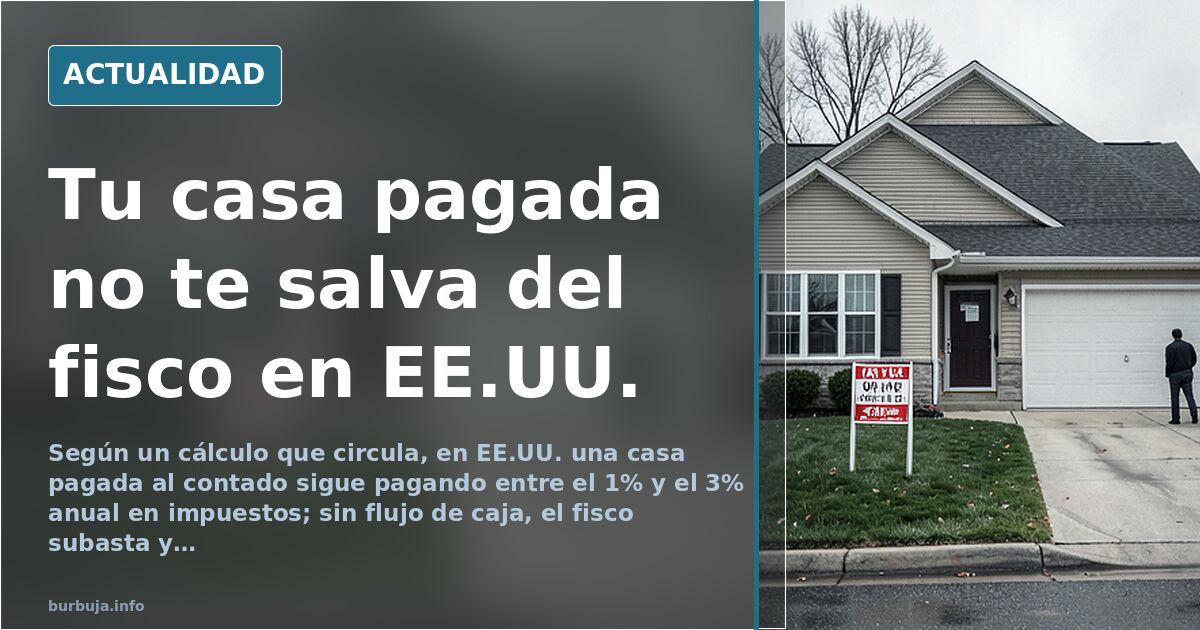
Buying your home outright doesn't shield you from the taxman in the United States
The idea that a mortgage-free home is a bulletproof shield against financial ruin falls apart as soon as you cross the Atlantic. According to a calculation making the rounds, in the United States a home paid for 100% still generates an annual bill that brooks no excuses: the property tax, which eats up between 1% and 3% of the home's value every year. On a million-dollar house in a Texas or New Jersey school district, that's more than $20,000 a year. No mortgage. No bank. Just the local tax office.
The argument going around is that this mandatory payment turns the owner into something like a perpetual tenant of the government. And it's not the only burden: mandatory homeowners insurance, homeowners association fees, lawn maintenance — with a municipal fine if it grows past a certain height — and heating. When a layoff cuts off the salary, the cascade becomes unstoppable. If the tax goes unpaid, the local tax office auctions off the tax lien on the house, and the police seal it and evict the occupants.
What happens in Spain if you don't pay the IBI?
The parallel with Spain comes up quickly. There the equivalent is the IBI (Spain's local property tax), and the tax on real estate is also charged regardless of whether the home is free of liens. The homeowners' community adds another leak: a hefty special assessment left unpaid can end in a garnishment notice. The difference lies in the protected portions of wages, which in the United States don't work the same way for property.
The technical nuance matters. From your monthly salary, a portion is protected; from your property, present and future, and the money in your account, nothing. The account can be wiped out by a traffic fine or a municipal tax, while the paycheck keeps its partial protection. That asymmetry explains why asset seizure is the antiestéticared scenario.
The country that doesn't exist in the narrative
The portrait of the United States as a fiscal hell collides with a stubborn fact: only a tiny minority of American citizens emigrate to other countries, whatever their qualifications. If the system were that lethal, the flow should show it. It doesn't.
There are also those who deflate the drama with geography. The United States is huge: there are places where you pay no taxes to build, with no equivalent building code and no neighborhood associations. The story of the luxury California subdivision doesn't describe the whole country. And a warning for the foreign buyer considering it: Americans pay taxes even if they live abroad.
China, the unexpected mirror
The comparison with China is disorienting. According to one participant, there the property tax is zero and the transfer tax is only paid if the home has been owned for less than five years. Those who run out of resources don't get a handout: they get a subsistence job — sweeping the park, watering gardens, tending public restrooms — or food vouchers worth about 50 euros a month for people over 60 or without means, delivered to their door if the recipient can't travel.
The conclusion drawn from the contrast is uncomfortable for certain narratives: when it comes to housing, the country branded as proge would turn out to be more socialist than China itself. With the house paid off, there's no serious problem there. Here, the bill keeps arriving every year, on schedule, without checking whether you have a job.
It remains to be seen whether that line of middle-class enforcement narrows or widens. Debt-free ownership is no longer synonymous with untouchable. What doesn't change is the taxman's calendar.
Also available in: Deutsch
Summary of a discussion on Burbuja.info - Foro de economía, actualidad y política., translated from Spanish and reviewed before publication. Read the full discussion (20 replies).
More summaries
-
Sánchez's China ties spark debate on Spain's US alliance
Analysis of Pedro Sánchez's foreign policy: balancing relations with Beijing and Washington, risks, data, and strategic implications for Spain.
-
Why the US allows a credit score system that rates you
The US 'credit score' measures your debt history, not your conduct. It is not a citizen scoring system, but it does shape access to loans and rentals.
-
Tiger Woods detained twice in Florida as police move to suspend his driving licence
Tiger Woods was arrested twice in Florida after an accident. Police abuse or standard DUI protocol? The case exposes the double standard of the American justice system.
-
Tennessee fails to execute Christa Pike after two lethal doses
Christa Pike, 50, nearly three decades on Tennessee's death row, survived two doses of lethal injection in a failed execution.
-
Wave soaks live TV news crew in Spain
A reporter and a cameraman were hit by a wave during a live news broadcast in Spain. The moment has gone viral on social media.
-
Germany to hold memorial for victims of multiculturalism in Frankfurt
A memorial event will be held in Frankfurt on 19 September 2026 to remember victims. Hundreds of attendees are expected.