
The stand-by generation: no home, no savings, no next generation
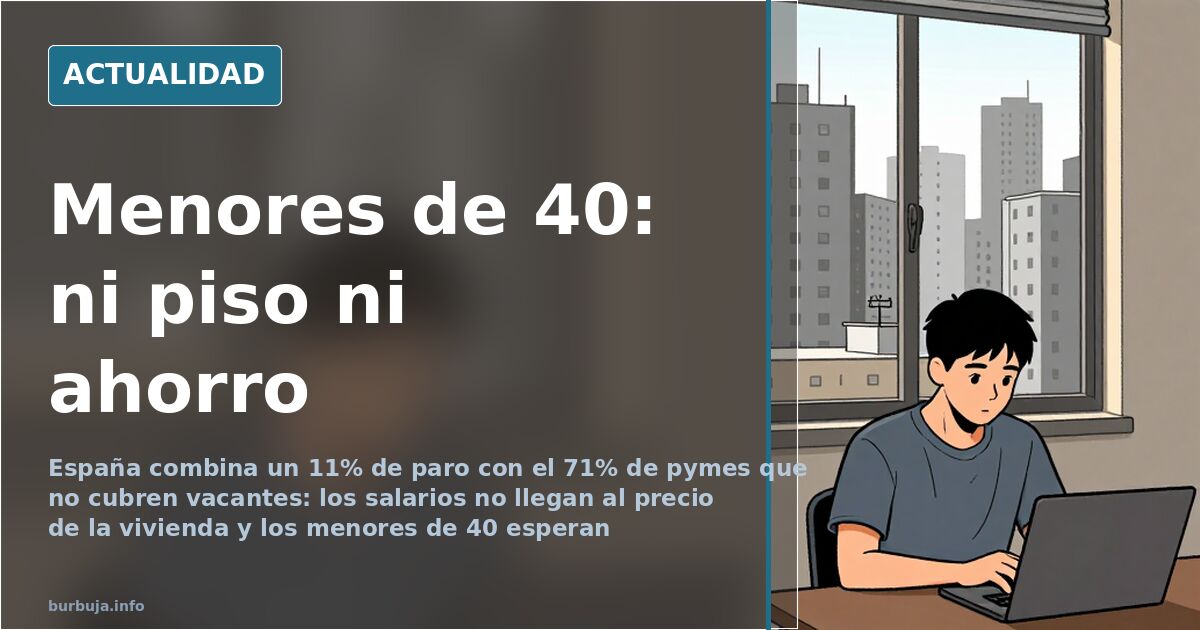
Spain has 11% unemployment but 71% of SMEs can't fill vacancies: pay doesn't cover housing, and under-40s are stuck waiting.
English · Original discussion in Spanish · Published
Under 40: no home, no savings, no life plan
Sharing a flat after thirty is no longer a one-off; it has become a management decision: you move to another province looking for an affordable rent, sign a remote-work contract and balance the month so that something—anything—is left over. That is the portrait that dominates the analysis of the stand-by generation. They work, they earn, and they still can't get off the ground. It isn't laziness, it's arithmetic.
The central paradox appears again and again. Spain carries an unemployment rate of 11%, the highest in Europe, while 71% of SMEs report difficulty filling their vacancies, according to the Cepyme data being cited. There is unemployment and there are jobs no one takes. The two facts coexist on the same explanation: the wages that can be paid are not enough for the life that must be financed.
Why there is unemployment and unfilled vacancies at the same time
The argument repeated is cost. Companies cannot cope with rising costs, and the wages they can offer fall below subsistence level, especially when housing prices enter the equation. Tough jobs —hospitality, construction, agriculture, split shifts, high intensity— would require high wages to attract candidates. Without a counterpart, there is no queue at the door.
The comparison with the past makes itself. In the 1970s some waiters lived for eight months on what they earned working four months of the season; others worked all year and with that paid for a flat, a car and a family. That calculation does not add up anywhere today. And it is not just wages: it is commuting, rent, the price of everything else.
Some add another layer to the problem: experience as a closed door. Getting into a construction site without ever having set foot on one is, in practice, impossible. The circle closes itself: without experience there is no job; without a job, no experience.
The tax waiting at the end of the road
Here wealth enters. Some argue that much of the wealth being transferred to pensioners via pensions will be recovered by the state through the impuesto de sucesiones (inheritance tax). The thesis, widely repeated: the parents' flat is not a clean inheritance, it is an invoice with a future date.
The context provided is the earlier euphoria. During the years of cheap money, those with a mortgage and those paying rent faced life with similar fragility. Anyone made redundant at some point in the stretch from 2010 to 2025 was marked for life: hard to rehire and, if they returned, on a precarious salary at less than half. That asymmetry between those who stayed and those who left explains more than it seems, and it is not always about effort.
Neither left nor right: detachment as a response
The political reading that prevails is exhaustion. Some argue that the youth vote no longer responds to political conviction and that the myth of a youth tilted to the left does not hold up in daily life. The Podemos experience is cited as a turning point: a widespread collapse in the hope of changing anything within the system. From there to let them sort themselves out is a short step.
The rage exists, but it finds no channel. There are no riots or organization; there are comments, irony and a long wait. Those who warn about that mix —envy, bad temper, the feeling that others get rich while you can't get started— do not believe it will last indefinitely without consequences.
Stopping buying as a form of pressure
There is a minority thesis, but with market logic: if a seller sets the price at 100 when the buyer can only pay 50, the right response is not to ask, it is not to buy. Consumers have power and sooner or later those who sell dear would have to lower prices, or push to cut taxes and gain competitiveness. In practice the argument clashes with the rigidity of housing prices, which do not respond to individual boycotts. An uncomfortable idea remains: consumption also votes.
Who will sustain the country when this generation grows old
The demographic variable slips into the conversation. The calculation being made is for fifteen or twenty years: most of the active population will be made up of foreign and naturalized people, with less weight to make demands before the elites, while previous generations leave the scene and the trinc ones vegetate among subsidies. The dominant diagnosis is one of eternal waiting and sustained deterioration since the 2008 crisis.
There is an important nuance: it is not that no one wants to move, it is that moving does not change the result. The image of the donkey that stops walking when it understands that the carrot is tied to the stick sums up the mood quite well. And there is a date many are watching: if cheap money is cut off or if Germany sneezes, the picture suddenly becomes clear.
The figure that throws you off
And here is the trap of the calendar. This generation will not be young forever. Someone sums it up without embellishment: those kids will not always be thirty and will not always have their parents. When age and the family safety net fail at the same time, stand-by will stop being a topic of conversation and become something else.
Sharing a flat after thirty is no longer a one-off; it has become a management decision: you move to another province looking for an affordable rent, sign a remote-work contract and balance the month so that something—anything—is left over. That is the portrait that dominates the analysis of the stand-by generation. They work, they earn, and they still can't get off the ground. It isn't laziness, it's arithmetic.
The central paradox appears again and again. Spain carries an unemployment rate of 11%, the highest in Europe, while 71% of SMEs report difficulty filling their vacancies, according to the Cepyme data being cited. There is unemployment and there are jobs no one takes. The two facts coexist on the same explanation: the wages that can be paid are not enough for the life that must be financed.
Why there is unemployment and unfilled vacancies at the same time
The argument repeated is cost. Companies cannot cope with rising costs, and the wages they can offer fall below subsistence level, especially when housing prices enter the equation. Tough jobs —hospitality, construction, agriculture, split shifts, high intensity— would require high wages to attract candidates. Without a counterpart, there is no queue at the door.
The comparison with the past makes itself. In the 1970s some waiters lived for eight months on what they earned working four months of the season; others worked all year and with that paid for a flat, a car and a family. That calculation does not add up anywhere today. And it is not just wages: it is commuting, rent, the price of everything else.
Some add another layer to the problem: experience as a closed door. Getting into a construction site without ever having set foot on one is, in practice, impossible. The circle closes itself: without experience there is no job; without a job, no experience.
The tax waiting at the end of the road
Here wealth enters. Some argue that much of the wealth being transferred to pensioners via pensions will be recovered by the state through the impuesto de sucesiones (inheritance tax). The thesis, widely repeated: the parents' flat is not a clean inheritance, it is an invoice with a future date.
The context provided is the earlier euphoria. During the years of cheap money, those with a mortgage and those paying rent faced life with similar fragility. Anyone made redundant at some point in the stretch from 2010 to 2025 was marked for life: hard to rehire and, if they returned, on a precarious salary at less than half. That asymmetry between those who stayed and those who left explains more than it seems, and it is not always about effort.
Neither left nor right: detachment as a response
The political reading that prevails is exhaustion. Some argue that the youth vote no longer responds to political conviction and that the myth of a youth tilted to the left does not hold up in daily life. The Podemos experience is cited as a turning point: a widespread collapse in the hope of changing anything within the system. From there to let them sort themselves out is a short step.
The rage exists, but it finds no channel. There are no riots or organization; there are comments, irony and a long wait. Those who warn about that mix —envy, bad temper, the feeling that others get rich while you can't get started— do not believe it will last indefinitely without consequences.
Stopping buying as a form of pressure
There is a minority thesis, but with market logic: if a seller sets the price at 100 when the buyer can only pay 50, the right response is not to ask, it is not to buy. Consumers have power and sooner or later those who sell dear would have to lower prices, or push to cut taxes and gain competitiveness. In practice the argument clashes with the rigidity of housing prices, which do not respond to individual boycotts. An uncomfortable idea remains: consumption also votes.
Who will sustain the country when this generation grows old
The demographic variable slips into the conversation. The calculation being made is for fifteen or twenty years: most of the active population will be made up of foreign and naturalized people, with less weight to make demands before the elites, while previous generations leave the scene and the trinc ones vegetate among subsidies. The dominant diagnosis is one of eternal waiting and sustained deterioration since the 2008 crisis.
There is an important nuance: it is not that no one wants to move, it is that moving does not change the result. The image of the donkey that stops walking when it understands that the carrot is tied to the stick sums up the mood quite well. And there is a date many are watching: if cheap money is cut off or if Germany sneezes, the picture suddenly becomes clear.
The figure that throws you off
And here is the trap of the calendar. This generation will not be young forever. Someone sums it up without embellishment: those kids will not always be thirty and will not always have their parents. When age and the family safety net fail at the same time, stand-by will stop being a topic of conversation and become something else.
Summary of a discussion on Burbuja.info - Foro de economía, actualidad y política., translated from Spanish and reviewed before publication. Read the full discussion (353 replies).
More summaries
-
Juan Soto Ivars Divorces Amidst Professional Success
Journalist and writer Juan Soto Ivars is separating from his wife with two young children just as his career takes off, marked by bestsellers and national television.
-
Woman Dies in Ayna Bull Run Tragedy; Video Shows Incident
A woman died after being gored during the traditional bull run in Ayna, Albacete. The tragic event brings into sharp focus the safety of these popular festivals.
-
Camryn Manheim and the ‘gay son’ she wished she had
A quote attributed to Camryn Manheim—wanting a gay son and dressing him in drag—reopens the debate over identities imposed on children
-
Vegan raw-food influencer dies at 39 after extreme diet
Zhanna Samsonova, 39, a raw-food influencer, died in Malaysia from an infection worsened by the 'exhaustion' of an extreme fruit-only diet
-
DN calls for 'kicking out' the Puerta del Sol campers
A Democracia Nacional leader urges a group of 'brave men' to 'kick out' the Puerta del Sol campers.
-
Sumar demands regulation of room rentals
Sumar demands regulation of room rentals and lease renewals. An investor warns that property maths no longer add up.