
The School Recorder: Why It's Still on the Curriculum
The debate over the school recorder: cheap, durable, and portable, but is it musically useful? Exploring its place in music education.
English · Original discussion in Spanish · Published
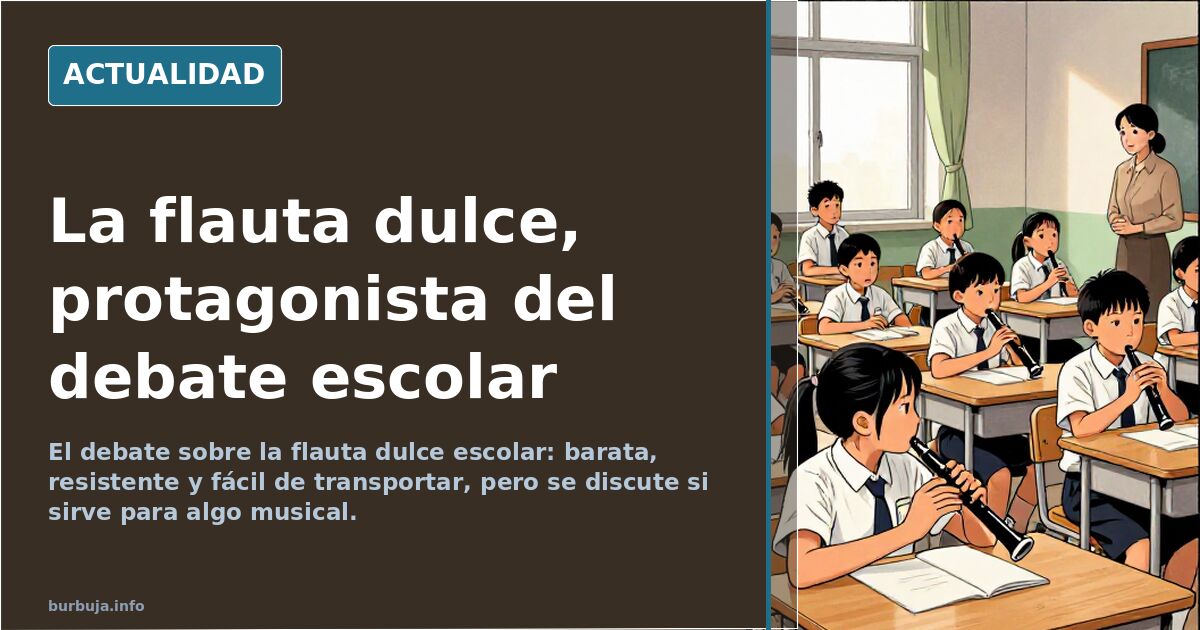
A plastic tube with holes has been the first musical instrument for many schoolchildren for generations. The recorder remains in primary music classes, still sounds out of tune at the end of each term, and continues to provoke the same question: who decided to put it there?
The answer that repeats in the debate has less to do with pedagogy and more with the wallet. An inexpensive, lightweight, and hard-to-break instrument fits in any backpack and can be afforded by any family without music class becoming a logistical problem. The rest is curriculum negotiation and habit.
Why the recorder and not another instrument?
The recurring reasons are based on household arithmetic. It's cheap, transportable without a case, withstands rough handling, and requires no maintenance. It's not for assembling an orchestra, but that's not the goal either. According to one participant, it was chosen so that no student would be excluded for not being able to afford an instrument, something that would happen with a violin or a piano.
One participant adds another factor: breath control. Blowing requires regulating air, which is related to learning to speak and breathe correctly. Compared to the harp or drum, the plastic tube wins in practicality and loses all prestige. Cheap and handy: that's how its school career is summarized.
The Defense: Music as a Memory Gym
Those who defend it don't talk about virtuosity. They argue that music is an artistic subject, like painting, that shapes the spirit and makes people more complete. They maintain that it improves cognitive skills such as memory, attention, and problem-solving, and prepares children for more complex challenges in adult life.
The justification is centuries old. One voice recalls that music was part of the medieval Quadrivium, alongside Arithmetic, Geometry, and Astronomy, the higher studies that trinc the basic Trivium. Under this interpretation, music is an intuitive way to understand mathematics and develop sensitivity.
The problem, even supporters admit, is that what is taught in class falls short. Students don't learn to read music, they don't learn technique, and the syllabus is reduced to a handful of trendy songs instead of a serious method. The complaint is not against the subject, but against how it is taught.
The Criticism: The Teacher Who Also Doesn't Know Music Theory
On the other hand, the fundamental objection is about practical utility. Some people studied music theory as children and today can't play anything: the investment of years and classes hasn't served for real life. To enjoy music, they insist, you don't need to read a musical staff, and there are great musicians who never went to a conservatory.
The most repeated reproach points to the teacher. It is doubted whether primary school teachers have sufficient musical training: they learn the four songs in the program and little more, and music theory is left out. According to this version, the class becomes a refuge for teachers without vocation rather than real initiation.
Some also attack the instrument. It is recalled that the recorder is an obsolete artifact from several centuries ago, difficult to play well, while other instruments evolved: the transverse flute gave rise to the modern flute, the chalumeau to the clarinet, and the violin and piano remain benchmarks. For this voice, a bad instrument to start with generates frustration, not vocations.
From the Elbichito Ukulele to Tears with 'Silent Night'
The pandemic brought a curious change in some schools. One school replaced the recorder with the ukulele, considering that blowing propagated the bicho more, and years later the change remained in place. The anecdote illustrates that decisions about school instruments are more about immediate logistics than an educational project.
The emotional aspect is another. One of the shared stories describes a student forced to play 'Silent Night' in front of an audience without knowing the piece or mastering the instrument. Salvation came from the fact that many played at once, and the mess was diluted in the whole. The memory, decades later, remains one of pure embarrassment.
Even among those who studied teaching, the recorder was among the most difficult subjects in the career, according to one testimony. The irony sustains itself: the instrument that many remember as a game was, for future teachers, an authentic academic filter.
Music, First Aid, and the Order of Priorities
The discussion shifts to what deserves to be on the curriculum. Some argue that a first aid course would be more important than certain mandatory subjects, and that much of the problem is not music but the school's general inability to give children tools for real life.
Against this, the defense responds with the conservatory: whoever wants real music should study it elsewhere. The mandatory classroom remains as an introduction and enjoyment. No one has yet resolved whether this is a public service or expensive entertainment disguised as a subject.
Does the recorder deserve to remain in every child's backpack, or is it proof that we still haven't decided what we want them to learn?
The answer that repeats in the debate has less to do with pedagogy and more with the wallet. An inexpensive, lightweight, and hard-to-break instrument fits in any backpack and can be afforded by any family without music class becoming a logistical problem. The rest is curriculum negotiation and habit.
Why the recorder and not another instrument?
The recurring reasons are based on household arithmetic. It's cheap, transportable without a case, withstands rough handling, and requires no maintenance. It's not for assembling an orchestra, but that's not the goal either. According to one participant, it was chosen so that no student would be excluded for not being able to afford an instrument, something that would happen with a violin or a piano.
One participant adds another factor: breath control. Blowing requires regulating air, which is related to learning to speak and breathe correctly. Compared to the harp or drum, the plastic tube wins in practicality and loses all prestige. Cheap and handy: that's how its school career is summarized.
The Defense: Music as a Memory Gym
Those who defend it don't talk about virtuosity. They argue that music is an artistic subject, like painting, that shapes the spirit and makes people more complete. They maintain that it improves cognitive skills such as memory, attention, and problem-solving, and prepares children for more complex challenges in adult life.
The justification is centuries old. One voice recalls that music was part of the medieval Quadrivium, alongside Arithmetic, Geometry, and Astronomy, the higher studies that trinc the basic Trivium. Under this interpretation, music is an intuitive way to understand mathematics and develop sensitivity.
The problem, even supporters admit, is that what is taught in class falls short. Students don't learn to read music, they don't learn technique, and the syllabus is reduced to a handful of trendy songs instead of a serious method. The complaint is not against the subject, but against how it is taught.
The Criticism: The Teacher Who Also Doesn't Know Music Theory
On the other hand, the fundamental objection is about practical utility. Some people studied music theory as children and today can't play anything: the investment of years and classes hasn't served for real life. To enjoy music, they insist, you don't need to read a musical staff, and there are great musicians who never went to a conservatory.
The most repeated reproach points to the teacher. It is doubted whether primary school teachers have sufficient musical training: they learn the four songs in the program and little more, and music theory is left out. According to this version, the class becomes a refuge for teachers without vocation rather than real initiation.
Some also attack the instrument. It is recalled that the recorder is an obsolete artifact from several centuries ago, difficult to play well, while other instruments evolved: the transverse flute gave rise to the modern flute, the chalumeau to the clarinet, and the violin and piano remain benchmarks. For this voice, a bad instrument to start with generates frustration, not vocations.
From the Elbichito Ukulele to Tears with 'Silent Night'
The pandemic brought a curious change in some schools. One school replaced the recorder with the ukulele, considering that blowing propagated the bicho more, and years later the change remained in place. The anecdote illustrates that decisions about school instruments are more about immediate logistics than an educational project.
The emotional aspect is another. One of the shared stories describes a student forced to play 'Silent Night' in front of an audience without knowing the piece or mastering the instrument. Salvation came from the fact that many played at once, and the mess was diluted in the whole. The memory, decades later, remains one of pure embarrassment.
Even among those who studied teaching, the recorder was among the most difficult subjects in the career, according to one testimony. The irony sustains itself: the instrument that many remember as a game was, for future teachers, an authentic academic filter.
Music, First Aid, and the Order of Priorities
The discussion shifts to what deserves to be on the curriculum. Some argue that a first aid course would be more important than certain mandatory subjects, and that much of the problem is not music but the school's general inability to give children tools for real life.
Against this, the defense responds with the conservatory: whoever wants real music should study it elsewhere. The mandatory classroom remains as an introduction and enjoyment. No one has yet resolved whether this is a public service or expensive entertainment disguised as a subject.
Does the recorder deserve to remain in every child's backpack, or is it proof that we still haven't decided what we want them to learn?
Summary of a discussion on Burbuja.info - Foro de economía, actualidad y política., translated from Spanish and reviewed before publication. Read the full discussion (299 replies).
More summaries
-
The Classical Canon as a Trench: A Thread of Musical Erudition
A forum thread rescues forgotten composers, recordings, and unusual data while discussing the place of the European classical canon.
-
432 Hz vs. 444 Hz: Tunings Attributed to Verdi and Mozart
A user claims Verdi's opera was tuned to 432 Hz and Mozart's original music to 444 Hz; unsure if videos comply.
-
Provision Proposed in Education Law to Amend Ley de Nietos Regarding Nationality Acquisition
Education Law amendment seeks to modify the Ley de Nietos, affecting thousands of people regarding nationality acquisition. The change is currently under review.
-
Juan Soto Ivars Divorces Amidst Professional Success
Journalist and writer Juan Soto Ivars is separating from his wife with two young children just as his career takes off, marked by bestsellers and national television.
-
Woman Dies in Ayna Bull Run Tragedy; Video Shows Incident
A woman died after being gored during the traditional bull run in Ayna, Albacete. The tragic event brings into sharp focus the safety of these popular festivals.
-
Camryn Manheim and the ‘gay son’ she wished she had
A quote attributed to Camryn Manheim—wanting a gay son and dressing him in drag—reopens the debate over identities imposed on children