
The Saddest Song in History Has No Winner
The thread doesn't crown the saddest song in history: among the candidates cited, one has over two billion streams.
English · Original discussion in Spanish · Published
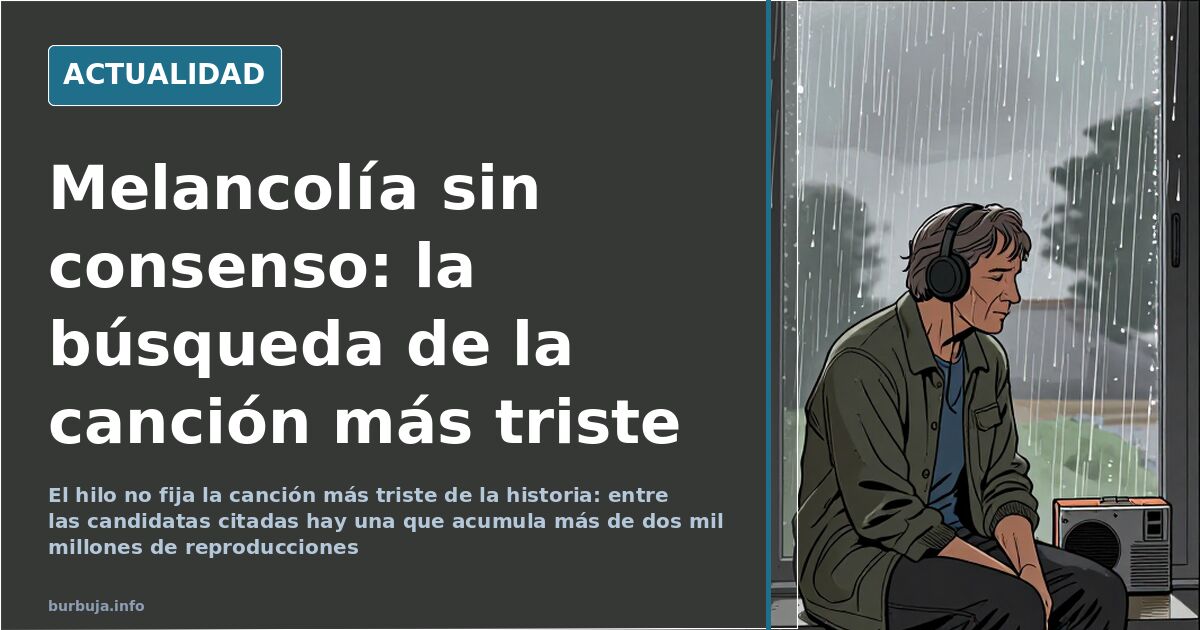
Melancholy Without Consensus: From Red House Painters to Cecilia
The discussion has not been enough to decide which is the most melancholic song in history. The list starts with Red House Painters and turns into a catalog that jumps from doom metal to Leonard Cohen, from The Cure to Cecilia. And there's a puzzling fact: one of the candidates, according to the figure cited, has accumulated over two billion streams. Sadness, when industrialized, scales like any other emotional product.
What is the saddest song in history? There is no single answer
The short answer is that there is no closed canon, and everything proposed confirms this: each nomination comes with a different criterion. Red House Painters opens the list; The Cure enters with "A Chain of Flowers"; Leonard Cohen appears with "Suzanne"; and the Bee Gees sneak in through the back door, described with a sneer as ambrosia of quintessential tears. Green Day ("Boulevard of Broken Dreams") defends itself with music, lyrics, and 2012 emo aesthetics, an argument more generational than musicological. Some extend the diagnosis to all British pop after Radiohead: PJ Harvey, Portishead, early Coldplay.
Methodological problems arise as soon as one tries to order such a mixture. The first: some argue that there are more melancholic songs than happy ones, so the universe of candidates is practically infinite. The second: some are not content with a single song and propose an entire album. And even some who don't limit themselves to listening: a composition of their own, finished two days prior, is added to the list with the title "Guerra Civil" (Civil War). When the criterion is personal memory, no method allows for comparison. One formulation summarizes the whole better than any ranking: what these pieces sing about is what is lost and what is unattainable, and what they evoke by comparison is that sickness of the spirit we call melancholy.
The Music That Plays When Sergeant Elias Dies
Many of the most cited proposals are not pop songs, but concert music and film scores. The scene in Platoon where Sergeant Elias dies, with that piece in the background, is pointed out as one of the saddest and most tragic in cinema. The thread also poses a question that mixes perplexity and market logic: why does such music accumulate such a volume of listens? The implied answer is uncomfortable: collective grief also has algorithms.
Alongside this come less predictable proposals. Some unearth Vivaldi's wonders that are lately emerging from obscurity, and some turn to a Russian funeral song, "Это всё" (Eto vsyo - This is All), dedicated to a travel companion who died prematurely after five days in the hospital. At that point, melancholy ceases to be a musical genre and becomes a strictly private matter, where no hit list has anything to say.
Melancholy in Spanish: Sabina, Cecilia, and Penélope
The Spanish-language repertoire has its own candidates and its own dates. Joaquín Sabina enters with "Calle melancolía" (Melancholy Street); Cecilia does so with "El juego de la vida" (The Game of Life), taken from her first album of original songs, released in 1983, and with an anniversary around the corner: it will be 49 years since her death. "Penélope" is claimed as a bitter twist on Jacques Brel's previous work dedicated to old lovers, turning the homage into an exercise in accumulated sadness.
In German, there's a Rammstein ballad that one of the singers describes as the hardest in the band's entire repertoire for non-aesthetic reasons: the loss of his vvife and the mountains they left unconquered together. With such a testimony, the discussion about criteria and categories fades away. Sadness stops being discussed and starts being confirmed.
Melodic Doom: When Sadness is the Entire Genre
There is a territory where melancholy is not a single song, but the entire product: the melodic doom of Clouds, where lyrics and music are designed to produce exactly that combination. That's why the final catalog mixes concert pieces, stadium ballads, and cult bands: they don't compete in the same league, and therefore no survey orders them meaningfully.
The stream count rewards the massive; the biographical criterion rewards the incommunicable. Between these two markers, any published list will be incomplete. Can melancholy be measured, or can it only be recognized when it is heard?
The discussion has not been enough to decide which is the most melancholic song in history. The list starts with Red House Painters and turns into a catalog that jumps from doom metal to Leonard Cohen, from The Cure to Cecilia. And there's a puzzling fact: one of the candidates, according to the figure cited, has accumulated over two billion streams. Sadness, when industrialized, scales like any other emotional product.
What is the saddest song in history? There is no single answer
The short answer is that there is no closed canon, and everything proposed confirms this: each nomination comes with a different criterion. Red House Painters opens the list; The Cure enters with "A Chain of Flowers"; Leonard Cohen appears with "Suzanne"; and the Bee Gees sneak in through the back door, described with a sneer as ambrosia of quintessential tears. Green Day ("Boulevard of Broken Dreams") defends itself with music, lyrics, and 2012 emo aesthetics, an argument more generational than musicological. Some extend the diagnosis to all British pop after Radiohead: PJ Harvey, Portishead, early Coldplay.
Methodological problems arise as soon as one tries to order such a mixture. The first: some argue that there are more melancholic songs than happy ones, so the universe of candidates is practically infinite. The second: some are not content with a single song and propose an entire album. And even some who don't limit themselves to listening: a composition of their own, finished two days prior, is added to the list with the title "Guerra Civil" (Civil War). When the criterion is personal memory, no method allows for comparison. One formulation summarizes the whole better than any ranking: what these pieces sing about is what is lost and what is unattainable, and what they evoke by comparison is that sickness of the spirit we call melancholy.
The Music That Plays When Sergeant Elias Dies
Many of the most cited proposals are not pop songs, but concert music and film scores. The scene in Platoon where Sergeant Elias dies, with that piece in the background, is pointed out as one of the saddest and most tragic in cinema. The thread also poses a question that mixes perplexity and market logic: why does such music accumulate such a volume of listens? The implied answer is uncomfortable: collective grief also has algorithms.
Alongside this come less predictable proposals. Some unearth Vivaldi's wonders that are lately emerging from obscurity, and some turn to a Russian funeral song, "Это всё" (Eto vsyo - This is All), dedicated to a travel companion who died prematurely after five days in the hospital. At that point, melancholy ceases to be a musical genre and becomes a strictly private matter, where no hit list has anything to say.
Melancholy in Spanish: Sabina, Cecilia, and Penélope
The Spanish-language repertoire has its own candidates and its own dates. Joaquín Sabina enters with "Calle melancolía" (Melancholy Street); Cecilia does so with "El juego de la vida" (The Game of Life), taken from her first album of original songs, released in 1983, and with an anniversary around the corner: it will be 49 years since her death. "Penélope" is claimed as a bitter twist on Jacques Brel's previous work dedicated to old lovers, turning the homage into an exercise in accumulated sadness.
In German, there's a Rammstein ballad that one of the singers describes as the hardest in the band's entire repertoire for non-aesthetic reasons: the loss of his vvife and the mountains they left unconquered together. With such a testimony, the discussion about criteria and categories fades away. Sadness stops being discussed and starts being confirmed.
Melodic Doom: When Sadness is the Entire Genre
There is a territory where melancholy is not a single song, but the entire product: the melodic doom of Clouds, where lyrics and music are designed to produce exactly that combination. That's why the final catalog mixes concert pieces, stadium ballads, and cult bands: they don't compete in the same league, and therefore no survey orders them meaningfully.
The stream count rewards the massive; the biographical criterion rewards the incommunicable. Between these two markers, any published list will be incomplete. Can melancholy be measured, or can it only be recognized when it is heard?
Summary of a discussion on Burbuja.info - Foro de economía, actualidad y política., translated from Spanish and reviewed before publication. Read the full discussion (228 replies).
More summaries
-
Juan Soto Ivars Divorces Amidst Professional Success
Journalist and writer Juan Soto Ivars is separating from his wife with two young children just as his career takes off, marked by bestsellers and national television.
-
Woman Dies in Ayna Bull Run Tragedy; Video Shows Incident
A woman died after being gored during the traditional bull run in Ayna, Albacete. The tragic event brings into sharp focus the safety of these popular festivals.
-
Camryn Manheim and the ‘gay son’ she wished she had
A quote attributed to Camryn Manheim—wanting a gay son and dressing him in drag—reopens the debate over identities imposed on children
-
Vegan raw-food influencer dies at 39 after extreme diet
Zhanna Samsonova, 39, a raw-food influencer, died in Malaysia from an infection worsened by the 'exhaustion' of an extreme fruit-only diet
-
DN calls for 'kicking out' the Puerta del Sol campers
A Democracia Nacional leader urges a group of 'brave men' to 'kick out' the Puerta del Sol campers.
-
Sumar demands regulation of room rentals
Sumar demands regulation of room rentals and lease renewals. An investor warns that property maths no longer add up.