
The recipe collection that turns Spanish home cooking into economic data
A collective recipe book gathers hundreds of dishes from Spain, Portugal and Andorra and reveals the real cost of traditional cooking versus the official food narrative.
English · Original discussion in Spanish · Published
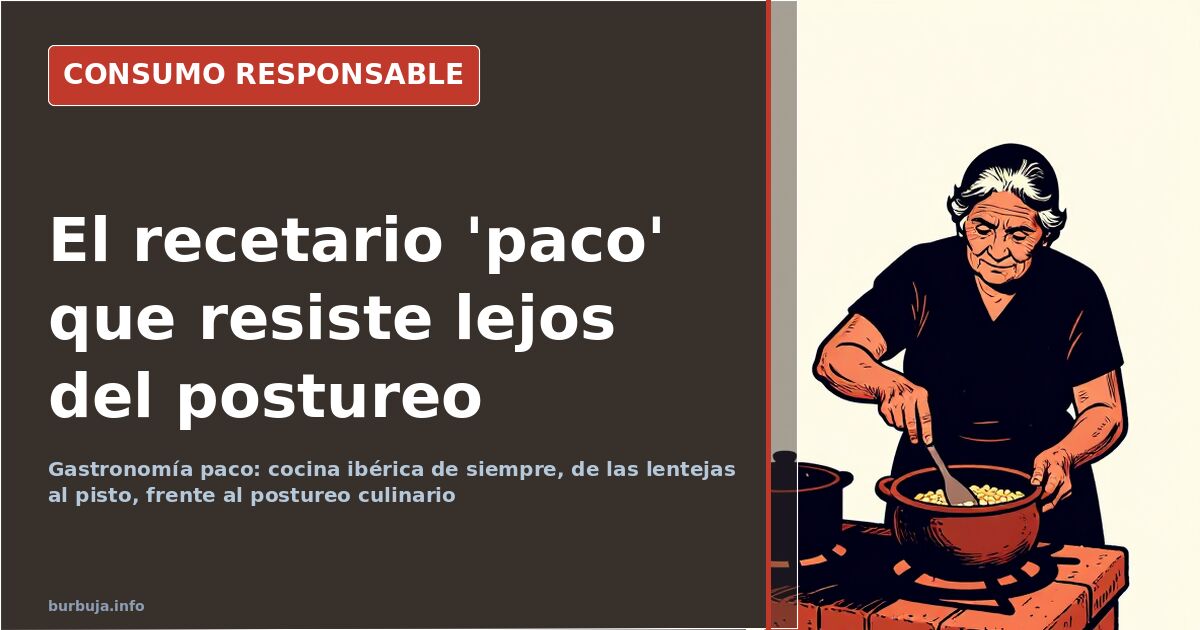
The recipe collection that turns Spanish home cooking into economic data
How much does it really cost to eat in Spain? The answer is not on the menu of a Michelin-starred restaurant, but in a pot of lentils with chorizo, pork belly and a stock cube. For almost four years, a collective recipe book has been accumulating dishes from Spain, Portugal and Andorra with a logic that, according to its participants, dismantles much of the official food narrative: traditional cooking is not a folkloric ornament, it is the food infrastructure of a country with median wages and a shopping basket that leaves no room for error.
The starting point is an invitation to share dishes from the Iberian Peninsula. What trinc are hundreds of messages antiestéticaturing porrusalda (a Basque leek and potato stew), black rice, onion tortilla de patatas, chicken al ajillo, lentils, chickpea puchero, Almería-style greens, cuttlefish in sauce, shepherd's migas, gachas, battered cauliflower and stuffed eggs. No revolution. And that is the finding: "paco" cooking —as this movement calls itself— is defined by what it rejects, not by what it praises.
What exactly is paco cooking and where does it come from
The term appears in no manual. It is built by opposition. There is modern, chef-driven cuisine, with small portions and high prices; and there is the kind made at home, with cheap ingredients, long cooking times and a clear purpose: feeding a family on a tight budget. The recipe book is organised around the second. It is not a school, it is an inventory.
The working definition that emerges from the material is fairly precise. It includes spoon dishes and stews, cured meats as a fat base, legumes, bread as a utensil, the use of leftovers and distrust of national pastry-making. Pasta with imported seafood and dishes requiring a alucinación to a specialist market are left out. The border is not geographic, it is income-based.
There is a nuance worth noting. Several participants distinguish between "paco" and "patxi", that is, between Castilian puchero-style cooking and Basque cuisine of squid in its ink or txistorra sausage. The discussion is not trivial: the axis is not territory, it is cost per serving. A dish can be traditional and expensive. The label is reserved for what is traditional and affordable.
The recipe book as a cost-of-living thermometer
The thread starts with recipes and ends up discussing tiling, air fryers and appliance prices. That turn is not a digression: it is proof that home cooking is an economic decision before an aesthetic one. When people debate whether a tile cleans well or whether a glass air fryer costs 109 euros after discounts, they are debating the total cost of keeping a kitchen running.
The list of dishes works as an implicit price index. Lentils with chorizo and pork belly, chickpea potaje, potato and artichoke stew, spinach with chickpeas, onions with pig's blood, livers with rice. These are dishes whose cost per serving is measured in cents and whose cooking time is measured in hours. The equation is explicit: cheap raw materials plus gas or electricity. And that is where the air fryer debate comes in, which uses less energy and takes longer.
There is even an appliance price comparison: a glass air fryer bought at Hipercor for 109 euros versus the 170 euros it was marked at in the El Corte Inglés store. Not a minor detail. In an economy where thrifty cooking is becoming a necessity again, the cost of the appliance enters the equation.
Spanish pastry-making, in the crosshairs
One of the harshest messages in the material is not aimed at fast food or chef-driven cuisine. It is aimed at sweets. The claim is that Spanish pastry-making "has always been poor", that it is the weak point of the national gastronomy, and that pole are eaten out of Christmas habit and "earthy notes". The statement is debatable and a minority view, but it circulates.
The contrast with the rest of the recipe book is revealing. While savoury cooking is defended with pride, sweets are dismissed with scepticism. Only a homemade apple cake and some brioche burger buns appear. Paco cooking is savoury, fatty and spoon-based; sugar is not part of its ideology.
It is a curious hierarchy. The same tradition that champions chorizo in lentils distrusts the pole. The implied explanation is practical: traditional sweets are associated with gifts, obligations, seasons. The stew, on the other hand, is daily sustenance.
From puchero to air fryer: how the conversation evolves
The recipe book is not static. It starts with spoon dishes and ends up incorporating domestic technology. The air fryer enters the conversation with concrete figures: 185 degrees maximum temperature, 20 minutes for chicken wings, the limits of the heating element's materials. The practical conclusion is that the modern gadget does not replace the pot, it complements it.
The temporal evolution of the content has three clear phases. The first is inventory: recipes from Spain, Portugal and Andorra accumulate. The second is identity: what is paco and what is not is debated, with the Basque distinction as the border. The third is infrastructure: tiling, grey-cement countertops, appliances and cleaning. Cooking stops being a recipe and becomes a system.
The final stretch even incorporates products from elsewhere: seafood spaghetti, stuffed poblano peppers, gratinated mussels. The label stretches without breaking. The condition for entry seems to be the same as always: that it can be made at home without going broke.
Bread as a unit of measurement
There is a recurring criterion that runs through the whole recipe book and is rarely made explicit: a sauce is judged by its ability to soak bread. A dish of squid in its ink is valued for the "tar" it leaves on the plate. A piquillo pepper sauce with slow-cooked onion is described as "a dish that requires bread for dipping". Meatballs, chicken al ajillo, hake in green sauce: all pass the same exam.
It is a gastronomic metric as valid as any other and considerably cheaper than a restaurant guide. Bread works as a performance indicator: it measures how much juice has been extracted from the ingredients. A stew that leaves no broth is a failed stew, however expensive the produce.
The final irony is provided by the conversation itself. After almost four years and hundreds of recipes, the quality criterion remains the same as that of a grandmother with a butane hob: that it can be mopped up. Fine dining can wait.
Also available in: Deutsch
Summary of a discussion on Burbuja.info - Foro de economía, actualidad y política., translated from Spanish and reviewed before publication. Read the full discussion (705 replies).
More summaries
-
What an hour of gas cooking really costs: the math nobody shares
The 7.5 kW on the label is the hob's total power and equals hourly consumption at full flame. Here's how to convert it into cubic metres and euros.
-
Childhood myopia debate: screens, outdoor time and lifestyle
Forum users debate whether childhood myopia is caused by screens, lack of outdoor time or dim light. A scene with a baby and a phone opens the thread.
-
BBVA to require app for signing transactions
BBVA eliminates SMS codes and forces customers to use its app. Forum debate on security, tech dependence, and loss of digital freedom.
-
Casio Edifice Premium Solar: 141 euros vs the official 229
A forum user finds a Casio Edifice Premium Solar for 141 euros against the official 229: solar, sapphire and quartz. A bargain to start with, or just a whim?
-
Why doctors still prescribe sertraline instead of the antidepressant you're looking for
The emotional blunting caused by SSRIs has a name and an alternative: bupropion or vortioxetine. Why healthcare systems still start with fluoxetine and sertraline.
-
U2 bootleg tapes from Dublin 1987: from jammed player to digital archive
U2 bootleg tapes from Dublin 1987: why they jam in old cassette decks and how the audio is rescued digitally with restoration