
Childhood myopia debate: screens, outdoor time and lifestyle
Forum users debate whether childhood myopia is caused by screens, lack of outdoor time or dim light. A scene with a baby and a phone opens the thread.
English · Original discussion in Spanish · Published
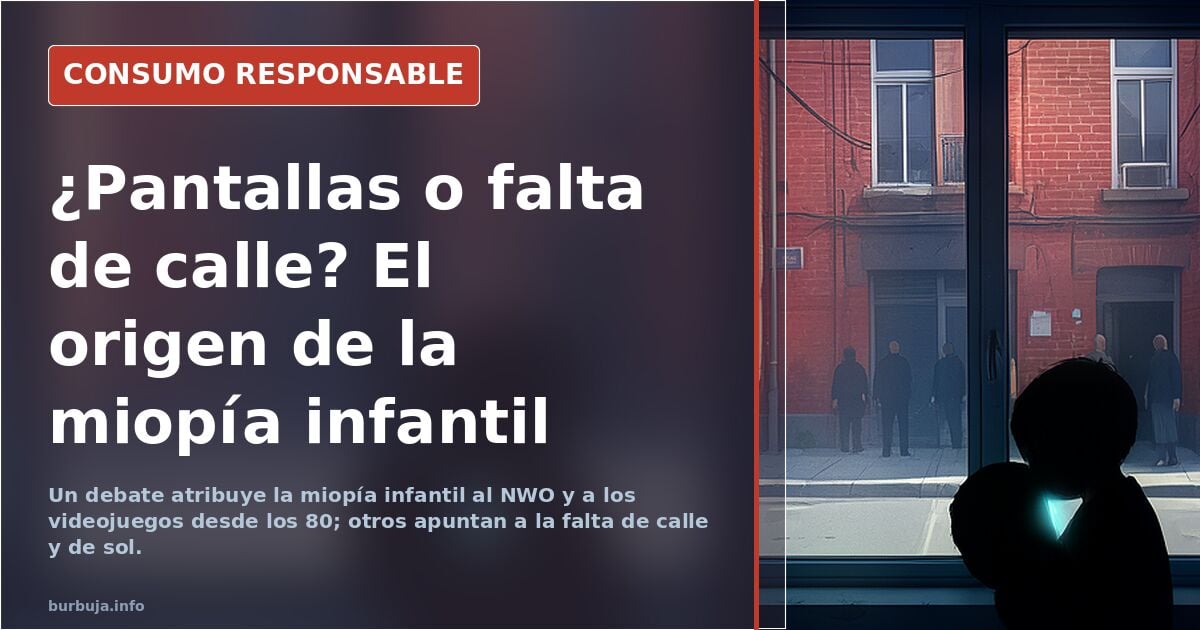
Childhood myopia: the price of raising kids on screens
Childhood myopia is no longer the exception — it has become the norm. From the old arcade machines to the smartphone a one-year-old was holding thirty centimetres from their face in the middle of a café, early screen exposure has been normalised without anyone fully measuring the consequences. The scene is no exception: it is the everyday landscape of any Spanish restaurant.
The most repeated diagnosis points not to a conspiracy but to a lifestyle change. Less time outdoors, less sun, more confinement and more focusing at short distances. Eyesight, specialists say, needs to scan the horizon; daily life forces it to focus at thirty centimetres.
Why do today's children have more myopia than before?
The short answer: because they live indoors. A myopic eye is an eye that gradually gets squashed, taking on an egg shape, and that process accelerates when it never focuses on distant objects. The comparison with ultra-Orthodox Jews, who spend hours reading the Torah in dim light and suffer from myopia problems, is the most cited example: it is not the screen itself, it is straining the eyes up close in poor light.
Some argue the problem is not the video games of decades ago, which were played by older kids on a fixed screen, but the tablet handed to a three-year-old to keep them quiet. The difference is one of degree, not of nature.
The myth of the screen that squashes the eye
Not every theory stands up to scrutiny. A myopic eye is an eye that elongates, and that is not caused by looking at a screen a metre away. What is dangerous, according to this view, are the flickering and the strain of focusing at short distances in dim light. Reading in poor light, something people have done since Gutenberg, remains the original sin.
School also plays its part. Rote-learning schools with endless homework turned kids into four-eyed swots and teacher's pets long before the first Game Boy existed. Eyesight needs a horizon, and the school day denies it.
Singapore already took action: more playground, less screen
In Singapore's authoritarian system, seeing the damage, they sent children out to the playground more often. The measure is no accident: kids who regularly play football rarely have myopia. Outdoor sport is the best eye protection there is, and it is free.
The same pattern shows up in prison: whoever never focuses into the distance loses that ability. Eyesight is a muscle and it atrophies like any other.
The myopia business and diffuse blame
The thesis that the New World Order designed video games to ruin children's eyesight is not supported by data. But the underlying suspicion — that there is a consumption model that prioritises profit over child development — has legs. The phone destroys, and nobody wants to look.
The question is not whether screens cause myopia, but how many parents are willing to switch off the phone at the table. For now, the answer is given by the one-year-old watching Bluey thirty centimetres away.
Also available in: Deutsch
Summary of a discussion on Burbuja.info - Foro de economía, actualidad y política., translated from Spanish and reviewed before publication. Read the full discussion (18 replies).
More summaries
-
MacBook Air M5 vs Windows: best laptop for €1,500?
MacBook Neo with 8GB RAM or MacBook Air M5 with 16GB: the real doubt is memory. The refurbished ThinkPad enters the fight.
-
Myopia surgery: patients report halos and incomplete vision
Patients who had myopia surgery report halos, chronic dryness and incomplete vision. Some point out that the ophthalmologists who perform it still wear glasses.
-
Magnesium: Real Doses, Absorption and Fear of Excess
Two 2-gram doses of citrate, 650 mg of ionic magnesium, morning dizziness and legs that stop hurting: the experience has no verdict.
-
Dark beer: the passion that divides drinkers
Guinness has as many fans as detractors; Vol Damm divides opinions and even a supermarket surprises. A look at the dark beer map in Spain.
-
Spend your savings now: the extreme strategy against inflation
With 30% inflation forecast within a year, the call to spend savings immediately is gaining ground. Some are taking it to the extreme: leveraging up, buying land or…
-
Geox shoes: comfortable and breathable, but durability divides wearers
Reviews agree that Geox footwear is comfortable and breathable, but point to inconsistent durability and soles that slip on wet surfaces.