
The real cost of cutting Europe off from Russian gas
Europe stops buying Russian gas directly but pays more for it through third countries. An analysis of the real cost of sanctions and who profits from the trade rerouting.
English · Original discussion in Spanish · Published
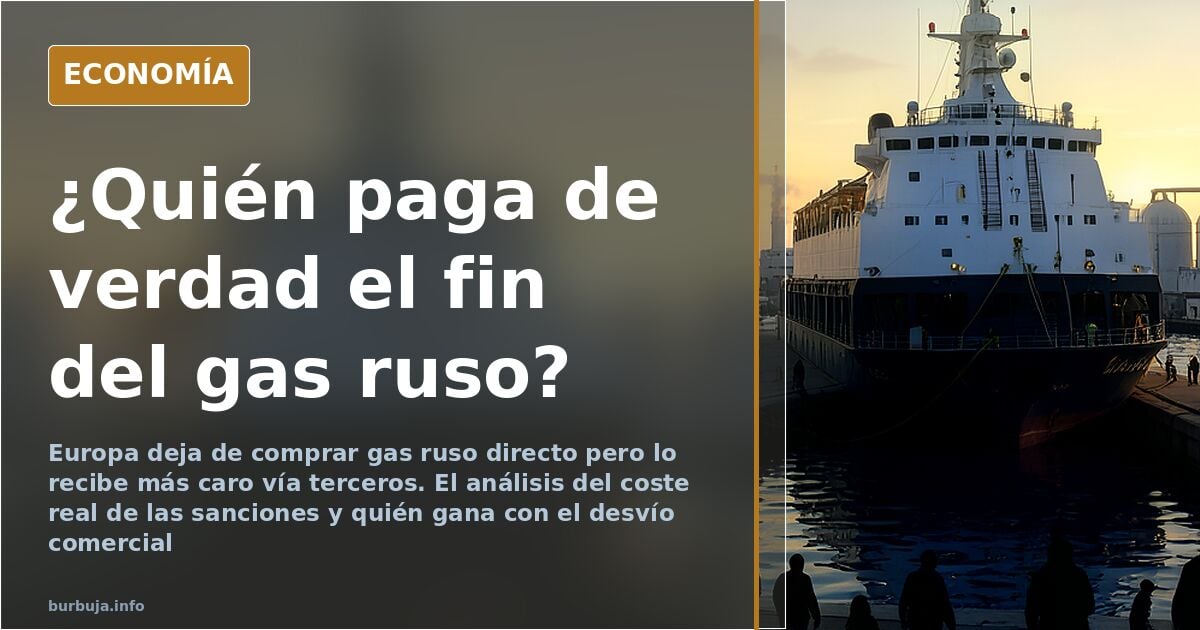
Europe pays for Russian gas three times over: sanctioned, expensive and through middlemen
Who wins when Europe stops buying Russian gas? The short answer: not Europe. The long answer is what is being debated these days trinc the latest twist in the trade war surrounding Ukraine, and it leaves a hard-to-swallow picture: the continent that pledged to strangle Moscow economically ends up buying the same gas, at a higher price, through intermediaries. The official story speaks of Atlantic unity; the bill tells a different story.
Sanctions Russia turns into industrial policy
The first argument making the rounds is counterintuitive. Against the idea that sanctions are strangling Russia, some argue the opposite: that capital that used to leave the country now stays inside, is invested in domestic sectors and accelerates an import substitution drive Moscow had been trying for years without success. The native population and natural resources, in that reading, make up for the loss of Western markets.
It is not a peaceful thesis. The pessimistic scenario for Russia assumes that critical technology and financial markets cannot be replaced by political will. But the fact that does hold up is trade rerouting: if Europe does not buy directly, someone buys and resells. And that someone charges a fee.
Who pays for the gas Europe keeps consuming?
Here lies the crux of the matter. The purchase does not disappear; it changes hands. Russian gas reaches Western Europe through third countries, with the middleman's markup and, in many cases, with US origin somewhere in the chain. The result is a higher energy bill for European industry and an extra margin for whoever plays bridge.
The question hanging over the whole debate is uncomfortable: if the goal was to stop financing Moscow, what exactly has been achieved? Has the flow been cut off, or has the same flow just become more expensive? The answer depends on whom you ask, and that is where the disagreement begins.
The tug-of-war between Washington and Brussels
There is a second layer to the analysis that goes beyond gas. The argument is that the United States is going through a crisis of hegemony and, finding it hard to admit its decline, prefers to treat Europe as a sphere of influence rather than as a partner. In that reading, the collateral damage to the European economy is no accident: it is part of the calculation.
The opposite view points out that Europe is not a passive victim. Its own mistakes —energy dependence, lack of industrial autonomy, decisions made in tow— explain much of the mess. The empire calls the shots, yes, but the one being pushed around also signed on the dotted line.
Frozen Russian assets and the financial standoff
Another open front is the Russian sovereign funds blocked in the West. The debate over their use for war reparations has a financial spin-off that worries decision-making centres: touching those assets sets a precedent about the legal security of foreign reserves. If frozen money stops being untouchable, confidence in the Western financial system takes a blow that is hard to recover from.
The final irony comes from the calendar: while the debate rages over how to punish Moscow with its own money, Europe is still negotiating its next energy bill. And that, like it or not, is paid in euros.
Also available in: Deutsch
Summary of a discussion on Burbuja.info - Foro de economía, actualidad y política., translated from Spanish and reviewed before publication. Read the full discussion (21 replies).
More summaries
-
US Army Sent Sick Troops to Europe in 1918
Wilson kept troop ships sailing despite onboard flu outbreaks. The biological weapon theory lacks evidence.
-
Putin: Combined Russia-UE GDP Would Exceed US, But Gas Costs Complicate Deal
Putin claims combined Russia-UE GDP surpasses US. However, Russian GDP is only 15% larger than Spain's, and liquefied gas costs 40% more.
-
Ignacio Lázaro: 'Maricarmen paid €154 rent while we paid €750'
Ignacio Lázaro, grandson of the original owner, reveals the other side of the Maricarmen case: 'We subsidized her for years and now, with our taxes.'
-
Morocco's King Mohamed VI pardons 1,788 prisoners: cost or investment for Spain?
1,788 prisoners pardoned by Morocco, around 1,500 of whom are already in Spain. What does their reception cost? The financial hole of an opaque deal.
-
Juan Manuel de Prada vs Real Madrid: loyalty clashes with players' luxury lifestyle
Juan Manuel de Prada's remarks about Real Madrid players reignite the debate over fan loyalty in the face of multi-million salaries and a lifestyle far removed from supporters.
-
Theory claims US and Israel orchestrate migration pressure on Spain
The theory that the US and Israel orchestrate migration pressure on Spain is spreading. The 1786 treaty with Morocco and a US Congress report fuel the claim.