
The real cost of 100 km in an electric car: the fine print breaks the story
Charging your car at home can cost 8.9 euros per 100 km or 2.10 depending on your contract: the fixed capacity charge and the higher kW rate eat up the savings of going electric.
English · Original discussion in Spanish · Published
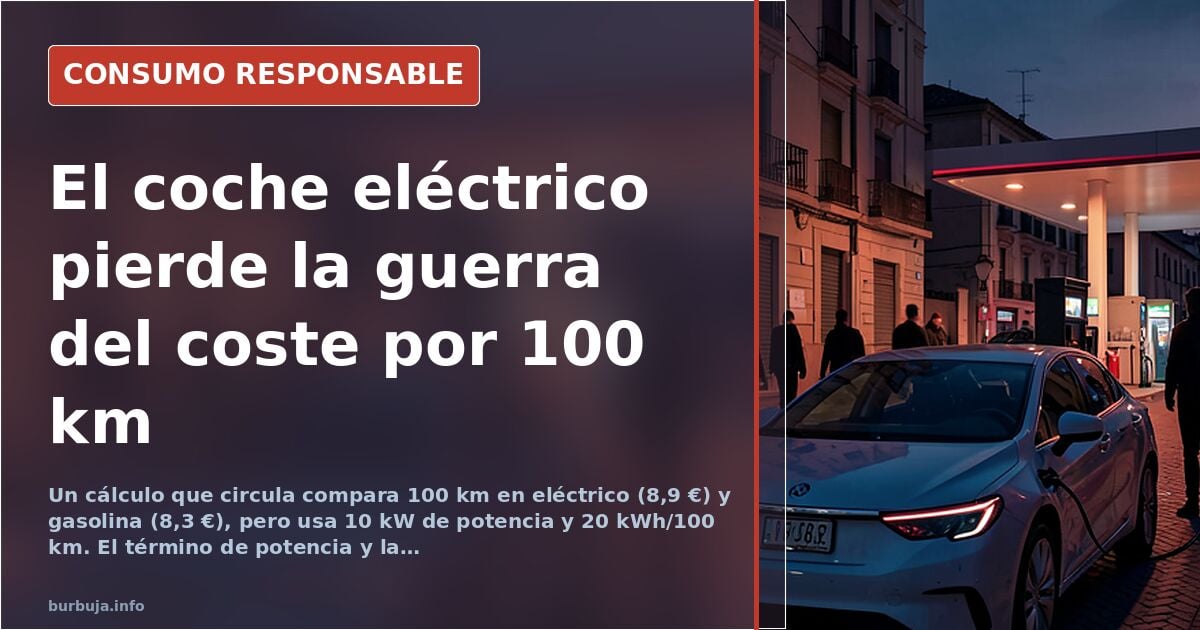
The real cost of 100 km in an electric car: the fine print
Driving 100 kilometres in an electric car can cost 8.9 euros. Or 2.10. Or less than 4. The range is not decided by the car: it is decided by your electricity contract. A detailed calculation circulating these days puts figures to the mantra that charging at home is always cheap and reveals that the fixed capacity charge and excess contracted kilowatts can eat up the entire saving.
The starting point is a comparison exercise with two typical drivers. One spends 5 litres per 100 km on petrol at 1.66 euros a litre: 83 euros a month for 1,000 kilometres, 8.3 euros per 100. The other pays 14 cents per kilowatt hour on a fixed-price market tariff and 24 cents in fixed charges per kilowatt per day, with 10 kW contracted: 89 euros, 8.9 per 100. The electric car loses by six euros. And the effective price of the kilowatt hour shoots up to 44 cents.
What it really costs to charge an electric car at home
The first objection raised is the contracted capacity. For 1,000 kilometres a month, about 30 a day, you don't need 10 kW. With **3.45 kW** overnight, two or three hours is plenty to fill the battery, and the fixed charge plummets. Those making this correction calculate that, with a more realistic consumption of 15 kWh per 100 km in mixed use, the cost drops to **2.10 euros per 100 kilometres**: 21 euros a month.
The original calculation, however, defends its figures: 20 kWh per 100 km is normal consumption on ring roads and motorways at moderate estimulante ilegal, and the electric car is not designed for the city, but for long daily commutes like Collado Villalba-San Sebastián de los Reyes. The discrepancy is not about physics, it is about assumptions. Change the consumption, change the contract, and the result moves by a factor of four.
The fixed capacity charge: 61 euros in extra cost
Here is the figure that dismantles the naive comparison. The difference between the fixed charge of 9 cents and 24, added to the excess contracted capacity, means an extra cost of **61 euros** a month. No matter how cheap the kilowatt hour is: if you pay through the nose for a contract sized to charge at 6 kW when you charge at 2, the saving evaporates.
Some point out that the problem is not the car, but the contract: there are fixed charges of **7 cents** per kilowatt per day, less than a third of what the driver in the example pays. And those who defend the PVPC (Spain's regulated electricity tariff) argue that at night the kilowatt hour drops to 14 cents and in the afternoon, especially at weekends, it can even be free. The tariff battle is, in reality, the battle over the cost of going electric.
Wallbox, electrical certificate and capacity upgrade: from 700 to 4,000 euros
Charging at 6 kW is not free. A schuko socket can handle 2,300 watts in prolonged use, of which about 2,000 reach the battery. To charge faster you need to install a wallbox, upgrade the fuse box, get an electrical certificate and, sometimes, pay for grid extension to your area. The realistic breakdown: between **800 and 1,500 euros** with a short cable run, and up to **2,000-3,000** if you have to cross a courtyard or basement. The capacity upgrade adds its share.
The practical conclusion that dominates the conversation is uncomfortable for the official story: for 150 kilometres a day, a slow socket overnight is enough. The infrastructure investment only pays off if you really make the most of the car. And making the most of it has an expiry date: the battery and the motor bearing are the two components that get replaced or scrapped, and those calculating the lifespan talk of **1,000 to 2,000 cycles** before losing 20% of capacity with NCA chemistry, less if charged at high rates.
Depreciation eats the savings
The argument that carries the most weight is not on the electricity bill. An electric car costs more upfront, and battery depreciation determines the residual value. The verdict that sums up the sceptical view comes from a taxi driver: what I save on the purchase buys me a lot of petrol. Consumption, in a car, is the small part of the equation.
Against that, the real cases of those who have made the switch: one with solar panels and two electric cars who pays **90 euros for electricity** where he previously paid 1,000 between gas, electricity and diesel; another who drives 45 kilometres a day and charges with **3.7 kW** in his community parking space. They are not lying. They are not the norm either. They are the scenario where the installation is already paid for.
What's coming: the tax on kilometres
Petrol carries roughly **50% in taxes**; electricity, 26%. The hydrocarbons tax raises about 13,000 million a year. The question hanging over the whole calculation is how long it will take the State to recover that revenue as the car fleet goes electric. In the United Kingdom, you already pay per kilometre driven at the MOT.
With all this, the cost of 100 kilometres in an electric car is not a number: it is a function of the tariff, the capacity, the consumption and the years you plan to keep the car. Anyone who gives you a single figure is selling you something. And it is probably not electricity.
Also available in: Deutsch
Summary of a discussion on Burbuja.info - Foro de economía, actualidad y política., translated from Spanish and reviewed before publication. Read the full discussion (330 replies).
More summaries
-
Cheaper electricity and a €50 bonus (Octopus Energy)
We analyse whether Octopus Energy is really the cheapest electricity option or whether the savings get lost in the fixed capacity charge. A technical, real-world debate on Burbuja.info.
-
DeepSeek vs Gemini: Best Free AI Models
Comparison of DeepSeek and Gemini as top free AIs for document analysis, coding, and daily tasks. Which one wins without paying?
-
Tesla Model Y: €50,000 and a cheap sunshade from China
A Tesla Model Y owner says the glass roof forces him to fit a cheap Chinese sunshade held on with double-sided tape every summer. The roof turns the cabin into an oven.
-
robin.jobs: Dutch temp agency with housing that won't answer
A jobseeker sends his ID and driving licence to robin.jobs, a Dutch temp agency with no reviews, no social media activity and poor fraud-checker scores.
-
Squatting to poop: the accessory the developed world is starting to eye
The case for squatting as the natural posture clashes with the price of accessories, the risk of breaking the bowl and splashback. Data and warnings.
-
Mapfre's legal protection cover: the fine print on when it doesn't pay
Home legal expenses cover pays for a lawyer and court agent with limits of 600 to 3,400 euros, but it cannot be used to claim against your own insurer.