
The Peruvian 2-metre theory: anatomy of a historical hoax
An image claims Peruvians were two metres tall when the conquistadors arrived. The available data points the other way: an average of 168-170 cm…
English · Original discussion in Spanish · Published
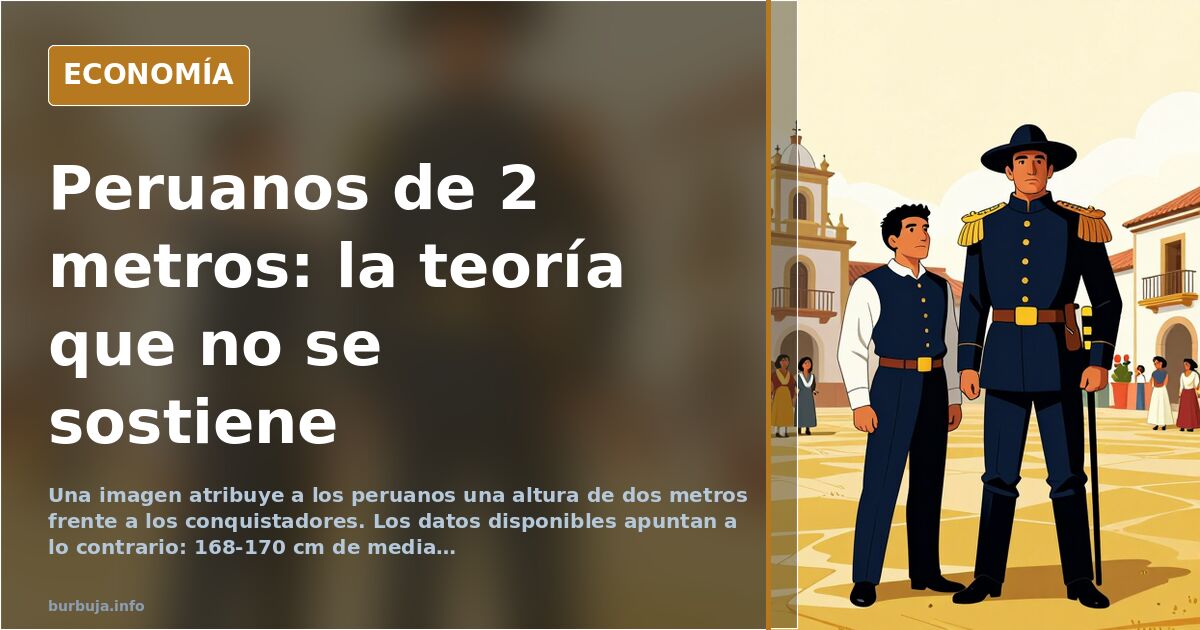
The Peruvian 2-metre theory falls apart on its own
An image circulating on social media claims that Peruvian indigenous people were more than two metres tall when the Spanish conquistadors arrived, and that it was the Spaniards, with their short stature, who imposed their rule. The claim, presented as a scientific finding, rests on a 19th-century illustration and a very free reading of the chronicles. The result is a story that says more about the present than about the 16th century.
The central figure does not withstand comparison with basic arithmetic. Spaniards of the 16th century averaged around 168-170 centimetres, according to the calculations used in the discussion. The Andean peoples, by contrast, are among the shortest on the continent. The difference is not two metres: it is centimetres, and in some cases in favour of the Europeans.
Where the legend of the Patagonian giants comes from
The confusion has a specific origin. The chronicles of Magellan's expedition describe the peoples of Patagonia as men of great bulk, and from there the myth of the giants was born. That description, applied to a specific tribe at the southern tip, has been shamelessly transferred to the entire continent and, in the most creative version, to the Andes.
Some argue that average indigenous height varied greatly and that in some tribes of northern Mexico or Patagonia it could exceed the Spanish average. The argument is reasonable, but it does not support the two-metre thesis or that of a generalised physical superiority. Variability exists; exaggeration does too.
Diet as an explanation for stature
The most solid piece of data in the discussion has nothing to do with giants, but with protein. The introduction of the chicken, pig, cow, sheep and goat to the American continent coincided with an increase in the height of locals incorporated into the army of 8 centimetres in 100 years. In other words: height was not an essence, but a consequence of diet.
That figure dismantles the racial reading of the matter. If stature depended on genetics, it would not have risen eight centimetres in a century. It rose because what people ate changed. The theory of the two-metre Peruvians is not only false: it is unnecessary to explain anything.
The narrative that turns the conquest into a antiestéticat of dwarves
The discussion drifts into irony. People joke that Isabella the Catholic sent the shortest Spaniards so as not to frighten the natives, and that the Pinzón brothers of the song were not brothers but dwarves. The mockery is not innocent: it points to a widespread idea, that the conquest of America was a antiestéticat of a few against millions.
The calculation that keeps coming up is that of 14 Spaniards capable of subduing an empire. The figure, more symbolic than literal, sums up the astonishment. And from there comes the defensive response: if the natives were giants, the antiestéticat is greater; if they were short, the antiestéticat is even more inexplicable. In both cases, the narrative is built to justify the same thing.
Why the hoax works better than the data
The two-metre theory circulates because it fits a prior narrative. Some attribute it to a supposed current of French historians interested in discrediting Spain, and others reduce it to resentment propaganda. Neither explanation holds up with evidence, but both feed the same fire.
The underlying problem is not historical but psychological. Once someone has built their mental structure on an idea, they avoid delving into what breaks it. That applies to the Peruvian giants and to almost everything else. The image keeps circulating because the data that refutes it requires reading, and the hoax only requires sharing.
The discussion gets stuck at the same point where it began: no one has produced a single tomb, a single skeleton or a single record confirming the two metres. The available archaeology does not support the legend. And yet the image will keep circulating, because the story is more entertaining than reality.
Also available in: Deutsch
Summary of a discussion on Burbuja.info - Foro de economía, actualidad y política., translated from Spanish and reviewed before publication. Read the full discussion (103 replies).
More summaries
-
Forum debate debunks the myth that mixing lowered average height
A forum user claims mixing reduced height from 1.90 m to 1.60 m. Other participants question the calculation and attribute it to insecurities.
-
Ukrainian Drone Strikes on Yandex Cripple Russian Bot Traffic
Ukrainian attacks on Yandex data centers in Vladimir, Sasovo and Kaluga have caused a sharp drop in Russian bot traffic, with reports of a 56% decline.
-
Forum user claims Spain's right can only win united under Alvise
A forum user argues that a divided PP and VOX hand victory to the PSOE, and that only a union with Alvise would change the useful vote; another user recalls he was singled out.
-
Puente and the fake quote about Ábalos contracts: the narrative war
A tweet attributes to Óscar Puente a defense of Ábalos's contracts without providing any evidence. The hoax spreads while the real debate over public contracting…
-
Abascal cuts rally to 12 minutes and walks in silence to Valladolid city hall
Santiago Abascal's rally in Valladolid, Spain lasted just 12 minutes, followed by a condolence message and a walk to the city hall for a minute of silence. Attendees criticized the brevity.
-
Charo suggests train crashes are right-wing sabotage
Spanish X user Charo blames rail accidents on a "diabolical hand" of "the right wings of Spain and the world." With no evidence, the suspicion spreads like a slogan.