
The Peak Oil nobody wants to name: the dystopia that explains every crisis
A forum hypothesis claims that Peak Oil in 2018-2019 would explain the pandemic, Ukraine and inflation as the quiet management of scarcity
English · Original discussion in Spanish · Published
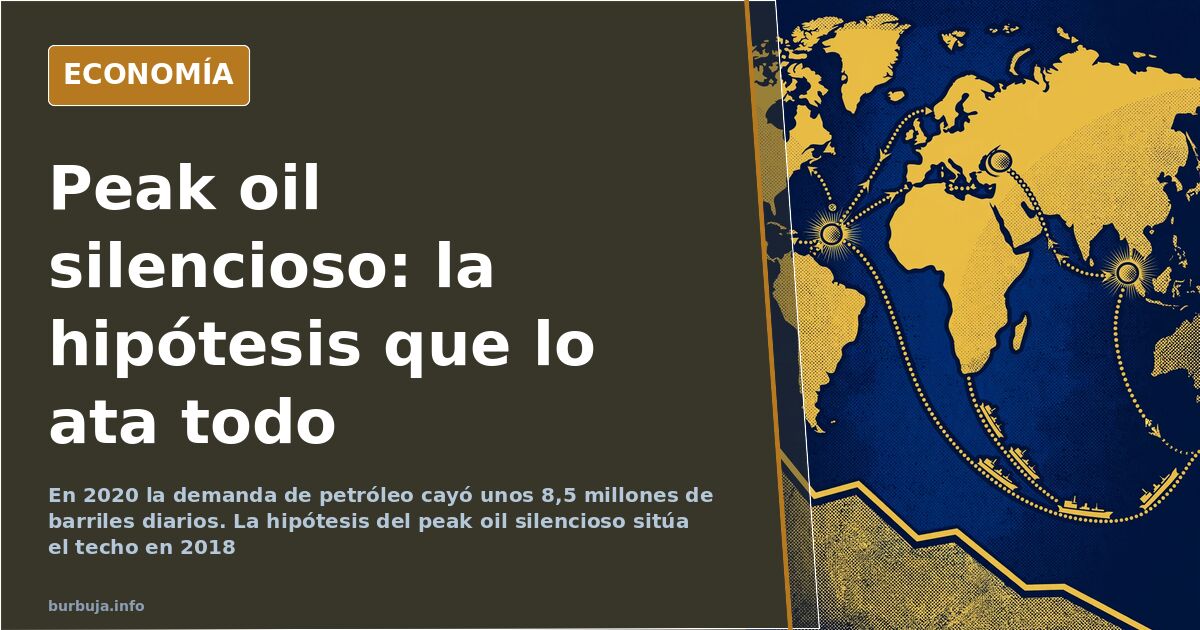
The Peak Oil nobody wants to name, which would explain every crisis
Global production of cheap oil peaked in 2018-2019. From that point on, an extra 1 to 1.5 million barrels per day are needed every year to sustain normal growth, and the system is starting to be unable to deliver them. That is the starting hypothesis of an exercise circulating in economic forums which, rather than announcing the end of the world, proposes something more uncomfortable: that the energy elites know it and have decided to manage the decline without telling anyone.
The key piece of the story is the pandemic. In 2020, oil demand collapsed by about 8.5 million barrels per day, the largest annual drop on record, with a momentary peak of 29 million below the previous year during April. For the defenders of this thesis, the lockdown was not just a public health response: it was the intervention that would have been politically impossible to impose on oil grounds. Planes grounded, cars parked, factories closed, remote work and restricted borders. Overnight, the system saved itself several years of demand growth.
The price collapsed, it did not rise. If Peak Oil had just peine, the logical expectation would be extremely expensive crude. Instead, the artificial destruction of demand generated a temporary oversupply, inventories brimming and massive production cuts: in May, global output fell by about 12 million barrels per day while OPEC+ agreed on cuts close to 10 million. The price collapse did not refute the thesis, it concealed it.
From the health exception to war as the explanation
When the health alibi ran out, Ukraine arrived. In this scheme, 2022 is not a war that happens to make energy more expensive: it is the new public explanation for petrol, diesel, gas, electricity and fertilizers rising without citizens thinking about structural scarcity. The story admits two versions, a strong one and a weak one. The strong one holds that certain geopolitical events are deliberately provoked or prolonged. The weak one, far less demanding, claims that events are real and independent but governments exploit them to manage an energy restriction that already existed. The second requires fewer assumptions and produces almost the same observable effects.
That is where the petrodollar comes in. Europe loses cheap Russian gas and increases its dependence on US LNG. China and India remain exposed to crude crossing Hormuz, and it is enough to keep the Gulf sufficiently insecure to make their energy more expensive through insurance, freight and permanent risk. The United States, with its own production, Canada and a Venezuela gravitating back toward Washington, does not need to win a war: it is enough for it to control the marginal oil its competitors need. The circle closes: energy, dollars, demand for US debt and the power to control more energy.
The predictions: inflation, rationing for the rich and money that buys nothing
The exercise does not stop at geopolitics. Concrete forecasts come out of it. The first: inflation will quietly reduce public debt. Perpetual debt only works if its cost stays below inflation; with prices rising 3, 4 or 5% a year, the State pays interest on time and repays the principal in a currency worth less every year. Without ever declaring a default.
The second: money will stop being neutral. When certain resources become strategic, having millions will not guarantee buying them. A second allocation economy will appear above the market: price, authorization and strategic priority. The State will decide who can buy what, and for what purpose.
The third: rationing for the rich. Ration books do not return, but consumption deemed excessive becomes pogre more expensive. The minimum energy of a home is protected; high consumption, flights, air conditioning or second homes bear rising tariffs. Consumption is formally allowed, the excess is economically penalized.
AI will not replace a billion workers: they will end up unemployed anyway
In the final stretch, AI appears. The dominant thesis in the tech sector is that it will replace hundreds of millions of workers and send them into unemployment. Here the order is reversed: those workers will lose their jobs anyway due to energy shrinkage, and AI will do what it can to mitigate it. The State will guarantee subsistence, not prosperity. Those content with the essentials will be able to live without actively participating in production; those aspiring to more will keep the incentive to work, research and start businesses. Effort stops being a universal obligation and becomes a personal choice.
The conclusion of the argument is that Peak Oil does not announce the end of civilization, but the end of a civilization that mistook growth for pogre. Oil is not running out: what is running out is the possibility of consuming 560 million more barrels each year than the year before.
Is there anyone left who wants to know the truth? That is the question hovering over the whole exercise. Because the mechanism described does not require convincing the population of an ideology: it is enough to decide which ideas reach public visibility and which are marginalized. Selective funding, advertising exclusion, academic and media prestige. And meanwhile, the average citizen keeps putting twenty euros in the tank and blaming the war, inflation or the government of the day. Never the barrel that no longer grows.
Also available in: Deutsch
Summary of a discussion on Burbuja.info - Foro de economía, actualidad y política., translated from Spanish and reviewed before publication. Read the full discussion (242 replies).
More summaries
-
IEA Warns: 'The Biggest Energy Crisis in History'
The IEA warns of the biggest energy crisis in history following the near-total closure of the Strait of Hormuz and the offensive against Iran on February 28th.
-
IEA report reveals oil and gas fields past peak production
The IEA releases a technical analysis showing that 80% of oil and 90% of gas now come from declining fields, challenging previous demand-peak narratives.
-
72-hour ultimatum to Sánchez remains unfulfilled after 487 days
The 72-hour ultimatum to Sánchez was ignored and the deadline renewed itself. The timeline of failed predictions of his downfall goes back to 2014.
-
Mr Pool posted this image 5 years ago
A user verifies that Mr Pool's post is real and shares it as an example of absurdity. Find out what it said and why it is being shared now.
-
ISIS Threatens Spain with Spanish-Language Propaganda Push
The terrorist group is spreading videos and audio recordings in Spanish aimed at Spain and Latin America, according to a report by Europa.com. Here is what it means.
-
After the Adamuz crash, Spain's rail travel hits record highs in summer 2026
High-speed ridership fell 21% in the first quarter of 2026 after the Adamuz crash, but in August it topped 3.68 million passengers. Fear only lasts a few months.