
The PC is not dead, but mandatory apps are killing it
As websites fail and mobile apps become essential, the PC loses ground to smartphones despite its superior power and privacy.
English · Original discussion in Spanish · Published
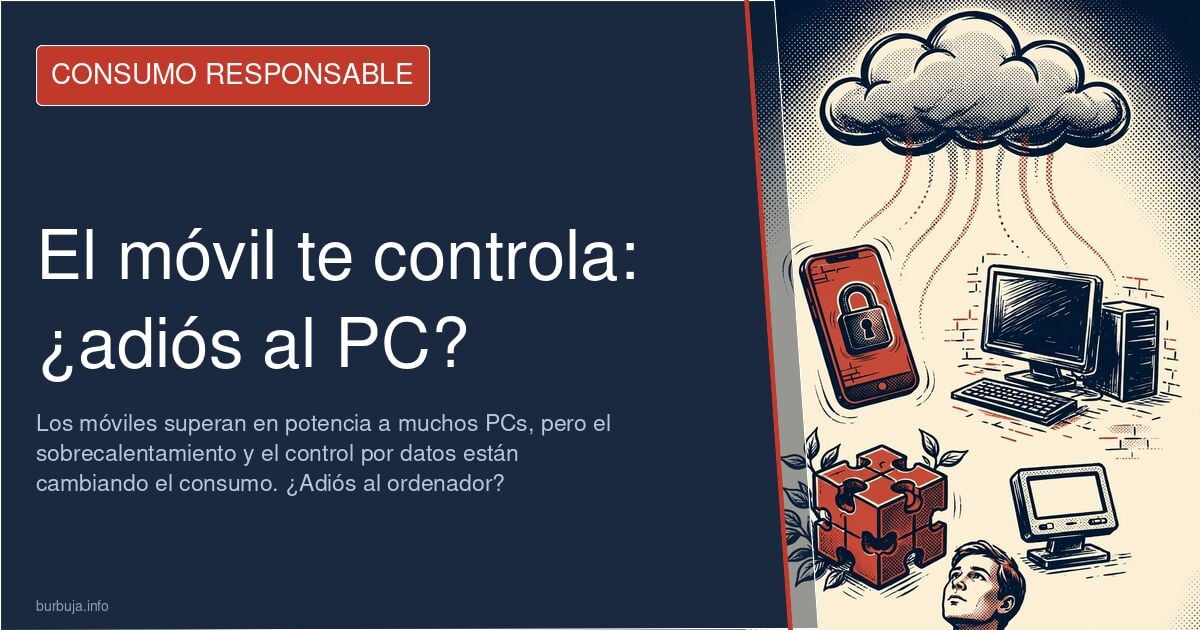
Why mobile is becoming mandatory and the PC an obstacle
Online check-in for certain airlines repeatedly fails on computer browsers, yet works perfectly on the first try via the phone app. This is not bad luck: it is by design. The same pattern repeats in banking, administration, and several daily services, where websites break exactly when needed most, leaving the app as the only gateway. This usability sabotage explains why a growing number of consumers feel that the PC—more powerful, more ergonomic, with a real screen and keyboard—is losing ground to the smartphone. It is losing, but not due to the latter's technical merits.
The closing circle: from terminals to cloud services
For decades, home computing was born to escape the old terminal-and-server model used by companies and governments: dumb terminals connected to a central computer doing all the heavy lifting. The PC won because connections were slow and power had to be local. Now that networks are fast and cheap, the pendulum is swinging back.
The trend of pushing software toward remote servers—using subscription-based licenses—anticipates a future where the device is merely an interface. A phone plugged into a keyboard and monitor would suffice, because the program wouldn't even run on it. Video streaming already works this way and is sold as the standard model. In short: less complex hardware at home and more monthly fees.
Mobile tracks you; the PC stays at home
At this point, the analysis is no longer technical. A desktop computer is anonymous hardware: it doesn't know where you are and doesn't demand your location to function. The phone, however, lives attached to a communication tower and carries an ecosystem that monetizes every gesture. This is the most powerful argument in the final stages of the debate.
Daily proof is not conspiratorial; it is bureaucratic. Some banks require a selfie to access their website, and others won't let you into your account without an SMS confirmation. Email providers, under the guise of security, push the same agenda. Those wishing to avoid it have alternative operating systems, but they come with a price: they break banking and messaging apps due to integrity systems. Escaping the fold has a cost.
Plentiful power and a heat problem
The performance argument is the most common and the most deceptive. High-end iOS and Android chips surpass most office computers and laptops in power and memory, with negligible consumption in comparison. On paper, one could work using only a mobile phone today.
In practice, heat becomes an issue. When truly pushed, these processors struggle to maintain pace: after 5-10 minutes of intense load, they throttle down to avoid overheating. They are more than enough for office work and light gaming, but not for sustained heavy workloads. And when you move into high-end territory, workstation laptops cost no less than 2000 euros, with cooling that still feels insufficient.
Desktop mode exists (but hardly anyone uses it)
The irony is that the fusion of mobile and PC is not science fiction. Android has long allowed connecting a phone via USB-C to a hub that charges the device while providing USB ports, HDMI for a screen, a keyboard, and a mouse. The phone opens a desktop with windows and treats each screen separately, like two distinct sessions. One cable and you have a PC.
What's missing is the usual: for applications to adapt to this mode and for Google to have an interest in pushing it. As long as the business model targets the captive mobile app, the phone's desktop will remain a permanent demo. It is not an engineering problem; it is an incentive problem.
Those who will never return to the computer
There is a generational gap that no technical improvement can fix. More and more households do not own a PC: everything is resolved with a phone or tablet, and the computer is only turned on to print a paper or handle a single task. Those who grew up with messenger at home remember connecting when they arrived, not all the time. The phone, by contrast, hooks you in wherever you are.
For serious work, however, the consensus remains: sooner or later, you need a keyboard, mouse, large screen, and power. The rest of the day is absorbed by the phone. Thus, between convenience and the app that won't let you escape, the PC loses the battle on the street while winning it at the desk. Given the prices of portable workstations, one might say the 'dead' PC is quite expensive.
Online check-in for certain airlines repeatedly fails on computer browsers, yet works perfectly on the first try via the phone app. This is not bad luck: it is by design. The same pattern repeats in banking, administration, and several daily services, where websites break exactly when needed most, leaving the app as the only gateway. This usability sabotage explains why a growing number of consumers feel that the PC—more powerful, more ergonomic, with a real screen and keyboard—is losing ground to the smartphone. It is losing, but not due to the latter's technical merits.
The closing circle: from terminals to cloud services
For decades, home computing was born to escape the old terminal-and-server model used by companies and governments: dumb terminals connected to a central computer doing all the heavy lifting. The PC won because connections were slow and power had to be local. Now that networks are fast and cheap, the pendulum is swinging back.
The trend of pushing software toward remote servers—using subscription-based licenses—anticipates a future where the device is merely an interface. A phone plugged into a keyboard and monitor would suffice, because the program wouldn't even run on it. Video streaming already works this way and is sold as the standard model. In short: less complex hardware at home and more monthly fees.
Mobile tracks you; the PC stays at home
At this point, the analysis is no longer technical. A desktop computer is anonymous hardware: it doesn't know where you are and doesn't demand your location to function. The phone, however, lives attached to a communication tower and carries an ecosystem that monetizes every gesture. This is the most powerful argument in the final stages of the debate.
Daily proof is not conspiratorial; it is bureaucratic. Some banks require a selfie to access their website, and others won't let you into your account without an SMS confirmation. Email providers, under the guise of security, push the same agenda. Those wishing to avoid it have alternative operating systems, but they come with a price: they break banking and messaging apps due to integrity systems. Escaping the fold has a cost.
Plentiful power and a heat problem
The performance argument is the most common and the most deceptive. High-end iOS and Android chips surpass most office computers and laptops in power and memory, with negligible consumption in comparison. On paper, one could work using only a mobile phone today.
In practice, heat becomes an issue. When truly pushed, these processors struggle to maintain pace: after 5-10 minutes of intense load, they throttle down to avoid overheating. They are more than enough for office work and light gaming, but not for sustained heavy workloads. And when you move into high-end territory, workstation laptops cost no less than 2000 euros, with cooling that still feels insufficient.
Desktop mode exists (but hardly anyone uses it)
The irony is that the fusion of mobile and PC is not science fiction. Android has long allowed connecting a phone via USB-C to a hub that charges the device while providing USB ports, HDMI for a screen, a keyboard, and a mouse. The phone opens a desktop with windows and treats each screen separately, like two distinct sessions. One cable and you have a PC.
What's missing is the usual: for applications to adapt to this mode and for Google to have an interest in pushing it. As long as the business model targets the captive mobile app, the phone's desktop will remain a permanent demo. It is not an engineering problem; it is an incentive problem.
Those who will never return to the computer
There is a generational gap that no technical improvement can fix. More and more households do not own a PC: everything is resolved with a phone or tablet, and the computer is only turned on to print a paper or handle a single task. Those who grew up with messenger at home remember connecting when they arrived, not all the time. The phone, by contrast, hooks you in wherever you are.
For serious work, however, the consensus remains: sooner or later, you need a keyboard, mouse, large screen, and power. The rest of the day is absorbed by the phone. Thus, between convenience and the app that won't let you escape, the PC loses the battle on the street while winning it at the desk. Given the prices of portable workstations, one might say the 'dead' PC is quite expensive.
Also available in: Deutsch
Summary of a discussion on Burbuja.info - Foro de economía, actualidad y política., translated from Spanish and reviewed before publication. Read the full discussion (102 replies).
More summaries
-
Costco Spain Tire Service: Premium Brands, Balancing Issues
Costco offers Michelin, Pirelli, and Bridgestone tires at competitive prices in Spain, but a customer reports missing wheel balancing. Key service details.
-
Mercadona's €3 burger sparks debate among shoppers
A €3 burger from the Spanish supermarket Mercadona has divided customers, with some comparing it to McDonald's and others criticizing its ingredients.
-
Mobile FM radio chips are being phased out by manufacturers
Despite costing only cents, FM radio chips are disappearing from high-end smartphones. Without data or networks, FM remains a vital fallback channel.
-
15-year-old BMW diesel vs. car leasing: which is cheaper?
Is an old BMW diesel more economical than a modern SUV rental? We compare fuel consumption, costs, and reliability in the classic car debate.
-
The potato chip wars: artisanal quality vs. industrial brands
A comparison of the best potato chip brands in Spain, analyzing the shift from industrial mass production to premium artisanal options.
-
Mercadona's decline: quality concerns, additives, and political tension
From artisanal horchata to additive-laden milk: loyal customers claim Spain's Mercadona is losing its quality standards and transparency.