
Mobile FM radio chips are being phased out by manufacturers
Despite costing only cents, FM radio chips are disappearing from high-end smartphones. Without data or networks, FM remains a vital fallback channel.
English · Original discussion in Spanish · Published
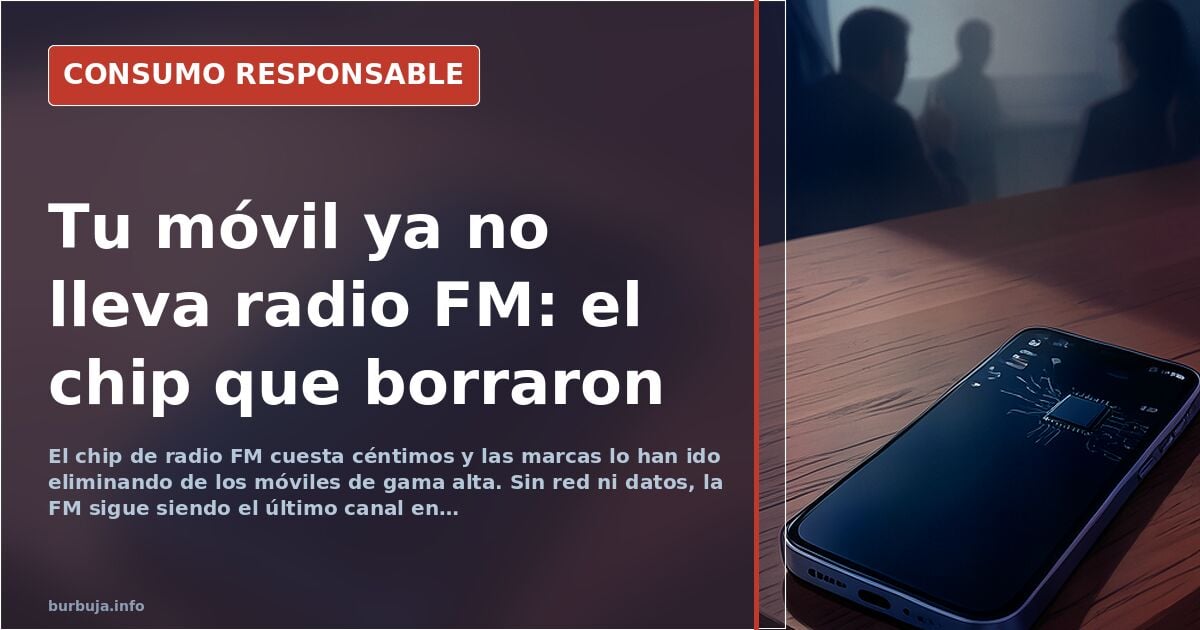
The loss of FM radio chips in mobile phones
A blackout leaves half of Spain without power, data, or signal. Suddenly, a long-forgotten question resurfaces: why do high-end smartphones no longer include FM radio? This issue, which seemed like a relic of the past, reappears every time the power grid fails and a mobile phone becomes nothing more than a screen-equipped brick. The short answer: the chip costs cents, and brands decided it wasn't worth it. The long answer is more uncomfortable.
At the heart of the matter is a technical detail that almost no one disputes. A phone's FM radio does not require data, Wi-Fi, a user account, or a cloud server. It only needs the chip and, in most models, a pair of wired headphones to act as an antenna. This is where the debate heats up: many current devices have removed the 3.5 mm jack, leaving the function in an absurd limbo. Some describe the case of a phone with a pre-installed radio app that requires wired headphones to tune in, yet the device no longer has a headphone jack. The paradox speaks for itself.
Which phones keep FM radio and which have removed it
The most common comparison is between a recent high-end device without radio and a budget model from five years ago that still has it. The latter, even with a cracked screen, continues to tune into stations, while the former relies on a connection that does not exist during a blackout. This is not an isolated case: the complaint is repeated across several brands, and the pattern is clear. The more expensive the phone, the more likely the function has disappeared.
The argument used by brands, when they provide one, is that internet radio meets the demand. The counter-argument is obvious and requires no expertise: without a network, there is no internet radio. And without battery, there is none either. This brings in another recurring point: mobile FM radio consumes very little, but if the device runs out of power, everything goes dark. A battery-powered radio lasts many more hours. The comparison between the two solutions is, in reality, a comparison between two different consumption philosophies.
The real cost of relying on the internet for radio
There is a calculation underlying the entire discussion that is worth examining closely. Listening to radio via the internet involves using data, maintaining an active connection, and accepting that the stream passes through third-party servers. Analog radio does not pass through any server. That difference, which seems minor, becomes structural when the network fails or when the user does not want to pay to hear what used to be free.
The full breakdown of what it costs to keep the radio on via one method versus the other reveals a difference that surprises first-timers. It is not just data consumption; it is dependency. Someone listening to FM radio needs permission from no one. Someone listening via the internet needs the infrastructure to work, the operator not to limit them, and the app not to cut off the feed.
Radio as an information source during emergencies
It is worth noting that the actual utility of radio during a blackout is limited. In several areas, no stations were tuned in except for recorded music or segments without news bulletins. Other stations were broadcasting, but with content described by many as propaganda or entertainment lacking useful data. The uncomfortable conclusion is this: having a radio does not guarantee you will find out anything if the stations are not broadcasting information.
Even so, the function serves a role that no other channel covers. When mobile coverage drops and data runs out, FM continues to broadcast openly. It is the last channel that does not depend on an account, a subscription, or a server. This is why its disappearance from product catalogs causes such irritation: it is not an extra being removed, but a backup network.
Why brands are removing both the jack and the radio
The coincidence is not accidental. The 3.5 mm jack served, among other things, as an antenna for FM radio. By removing it, the function is left crippled. Some manufacturers keep the radio and allow it to be used with an adapter or a piece of cable in the port, but the experience becomes cumbersome. The practical result is that radio disappears without anyone formally banning it.
The trend defending these changes argues that users prioritize water resistance, battery life, and design. Critics respond that a cent-cost chip does not compromise any of those things. For now, the struggle is being won by the brands. And the user who wants radio, a jack, NFC, and a replaceable battery in the same device finds that such a combination no longer exists in the current catalog.
Battery-powered radio vs. mobile radio
The comparison between the two solutions is not just technical; it is about expectations. A battery-powered or dynamo radio works without a network, an account, or updates. A mobile radio works as long as there is battery and, in many cases, as long as there are wired headphones. The former is an autonomous object. The latter is a conditional function.
That is where the analysis hits a wall. Mobile radio is more convenient, cheaper to maintain, and always at hand. A battery-powered radio is more robust, more independent, and does not depend on any brand. Neither solves the fundamental problem: if stations do not broadcast useful information, the medium does not matter. The discussion about the chip almost always ends with the same unanswered question.
A blackout leaves half of Spain without power, data, or signal. Suddenly, a long-forgotten question resurfaces: why do high-end smartphones no longer include FM radio? This issue, which seemed like a relic of the past, reappears every time the power grid fails and a mobile phone becomes nothing more than a screen-equipped brick. The short answer: the chip costs cents, and brands decided it wasn't worth it. The long answer is more uncomfortable.
At the heart of the matter is a technical detail that almost no one disputes. A phone's FM radio does not require data, Wi-Fi, a user account, or a cloud server. It only needs the chip and, in most models, a pair of wired headphones to act as an antenna. This is where the debate heats up: many current devices have removed the 3.5 mm jack, leaving the function in an absurd limbo. Some describe the case of a phone with a pre-installed radio app that requires wired headphones to tune in, yet the device no longer has a headphone jack. The paradox speaks for itself.
Which phones keep FM radio and which have removed it
The most common comparison is between a recent high-end device without radio and a budget model from five years ago that still has it. The latter, even with a cracked screen, continues to tune into stations, while the former relies on a connection that does not exist during a blackout. This is not an isolated case: the complaint is repeated across several brands, and the pattern is clear. The more expensive the phone, the more likely the function has disappeared.
The argument used by brands, when they provide one, is that internet radio meets the demand. The counter-argument is obvious and requires no expertise: without a network, there is no internet radio. And without battery, there is none either. This brings in another recurring point: mobile FM radio consumes very little, but if the device runs out of power, everything goes dark. A battery-powered radio lasts many more hours. The comparison between the two solutions is, in reality, a comparison between two different consumption philosophies.
The real cost of relying on the internet for radio
There is a calculation underlying the entire discussion that is worth examining closely. Listening to radio via the internet involves using data, maintaining an active connection, and accepting that the stream passes through third-party servers. Analog radio does not pass through any server. That difference, which seems minor, becomes structural when the network fails or when the user does not want to pay to hear what used to be free.
The full breakdown of what it costs to keep the radio on via one method versus the other reveals a difference that surprises first-timers. It is not just data consumption; it is dependency. Someone listening to FM radio needs permission from no one. Someone listening via the internet needs the infrastructure to work, the operator not to limit them, and the app not to cut off the feed.
Radio as an information source during emergencies
It is worth noting that the actual utility of radio during a blackout is limited. In several areas, no stations were tuned in except for recorded music or segments without news bulletins. Other stations were broadcasting, but with content described by many as propaganda or entertainment lacking useful data. The uncomfortable conclusion is this: having a radio does not guarantee you will find out anything if the stations are not broadcasting information.
Even so, the function serves a role that no other channel covers. When mobile coverage drops and data runs out, FM continues to broadcast openly. It is the last channel that does not depend on an account, a subscription, or a server. This is why its disappearance from product catalogs causes such irritation: it is not an extra being removed, but a backup network.
Why brands are removing both the jack and the radio
The coincidence is not accidental. The 3.5 mm jack served, among other things, as an antenna for FM radio. By removing it, the function is left crippled. Some manufacturers keep the radio and allow it to be used with an adapter or a piece of cable in the port, but the experience becomes cumbersome. The practical result is that radio disappears without anyone formally banning it.
The trend defending these changes argues that users prioritize water resistance, battery life, and design. Critics respond that a cent-cost chip does not compromise any of those things. For now, the struggle is being won by the brands. And the user who wants radio, a jack, NFC, and a replaceable battery in the same device finds that such a combination no longer exists in the current catalog.
Battery-powered radio vs. mobile radio
The comparison between the two solutions is not just technical; it is about expectations. A battery-powered or dynamo radio works without a network, an account, or updates. A mobile radio works as long as there is battery and, in many cases, as long as there are wired headphones. The former is an autonomous object. The latter is a conditional function.
That is where the analysis hits a wall. Mobile radio is more convenient, cheaper to maintain, and always at hand. A battery-powered radio is more robust, more independent, and does not depend on any brand. Neither solves the fundamental problem: if stations do not broadcast useful information, the medium does not matter. The discussion about the chip almost always ends with the same unanswered question.
Also available in: Deutsch
Summary of a discussion on Burbuja.info - Foro de economía, actualidad y política., translated from Spanish and reviewed before publication. Read the full discussion (101 replies).
More summaries
-
Motorola G84 beats Xiaomi for under €200
A €139 Samsung M20 cost €3.23/month; its 5G, NFC successor was bought for under €200 after rejecting Xiaomi.
-
Budget Phones vs iPhone: The Endless Value Debate
A user calculates a €139 phone costs €3.60/month; matching an iPhone's value requires 23 years of use.
-
Smartphone for €150: Forum warns Samsung A13 is a mistake
A buyer looking for a reliable €150 smartphone chooses a Samsung A13, but technical analysis suggests it underperforms compared to the Redmi 10C.
-
EU's €3 parcel levy ends AliExpress's cheap era
The EU's €3 per category fee sends AliExpress prices soaring: a €3 order now costs €11. The Chinese parcel model faces collapse.
-
Tattoo study of 6,000 twins sparks health and safety debate
A summary of a study involving 6,000 twins links tattoo inks to heavy metals and lymph nodes, raising concerns over health and melanoma.
-
Monk parakeets in Spain: legal limits on controlling invasive species
Invasive monk parakeets are destroying native bird nests, but Spanish citizens lack legal ways to control them, from air rifles to poisons.