
The Pandemic List That's Still Growing Nearly Five Years Later
A list of individuals and voices criticized for their handling of the COVID-19 pandemic continues to expand, featuring prominent names from the crisis.
English · Original discussion in Spanish · Published
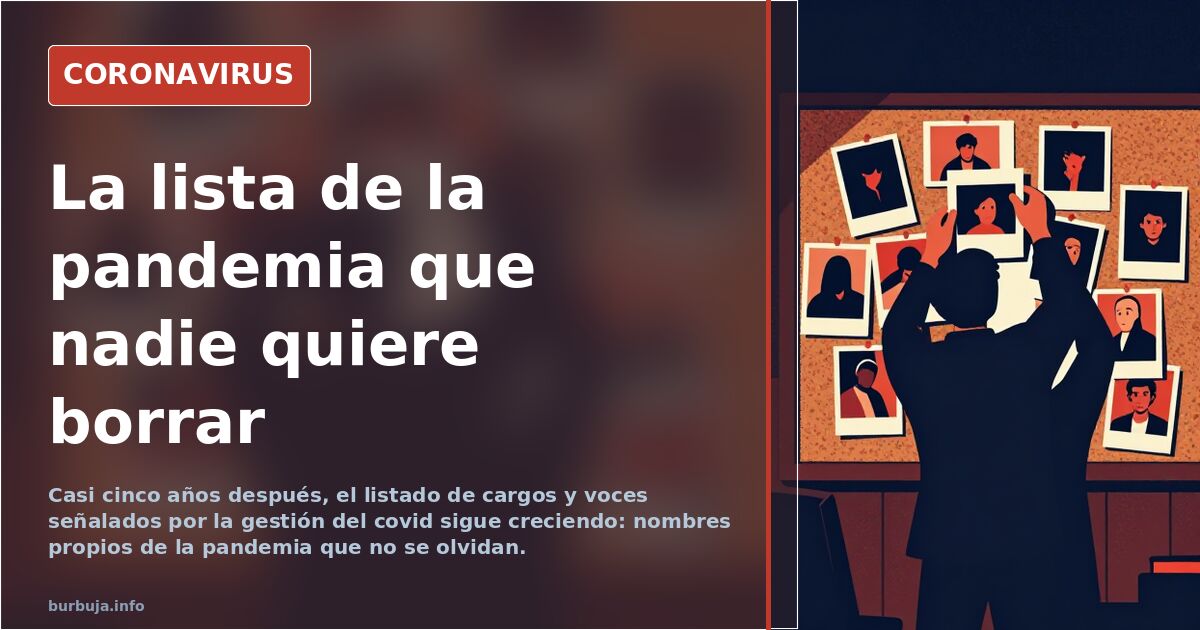
The Ever-Growing List of Pandemic Blame
One name. Then five. Then twenty. Since 2021, the pattern has repeated with consistent regularity: every so often, someone revisits the inventory of those they believe should be held accountable for actions taken during the pandemic. Nearly five years after the health emergency began, the list has only gotten longer. At the forefront, time and again, are Pedro Sánchez, Salvador Illa, Fernando Simón, and Carolina Darias.
It's not a closed list. Those managing it insist it's just a starting point, and what began as a handful of names has become a never-ending crowdsourcing of accusations. The fundamental question—whether these responsibilities will ever reach a courtroom—remains unanswered.
Which Names Appear Repeatedly on Pandemic Lists
The inventory is not uniform. Some focus on the national leaders of health management, while others delve into regional and local details. Among the most cited are former Andalusian president Juanma Moreno and his former ministers Jesús Aguirre, Elías Bendodo, and Juan Marín, Miguel Ángel Revilla from Cantabria, or Basque premier Ramiro González. The roster is completed with local officials, such as the mayor of Roquetas de Mar, Gabriel Amat, criticized for monitoring mask use on terraces.
The list also points to the scientific sphere. CSIC virologist Margarita del Val heads many compilations, alongside microbiology professors and pediatricians who signed vaccination protocols. At the other end of the same criticism, some place the signatories of articles on denialism.
From Lockdown to ELbichito Passports in Hospitality
The discontent isn't limited to names; it extends to the measures. Home confinement, mandatory masks even outdoors under penalty of fines, and later, the ELbichito Pass for hospitality and nightlife venues concentrate a significant portion of the anger. The judicial ratification of that pass in Andalusia, celebrated at the time as an endorsement, is now one of the most frequently cited episodes.
The criticism extends to small businesses that didn't reopen and schools with windows open in the dead of winter. A testimony collected from a source recounts how, when complaining that leaving children out in the cold was madness, the response was, 'Do you prefer a cold or ELbichito?' Four years later, that phrase continues to circulate as a symbol of a broken consensus.
Criticism of the Press and Experts
A significant part of the anger is directed at those who amplified the official narrative. Journalists and pundits appear repeatedly in the crosshairs, with particular emphasis on voices that once defended one position and the next day held the opposite. The most frequent accusation isn't that they were wrong, but that they never admit it.
One current suggests the media 'promoted' not allowing unvaccinated people into homes, and months later, lamented the social rejection of those living with HIV. The contrast, they argue, admits no interpretation. The unvoiced counterargument is that without restrictions, the death toll would have been worse.
Denialism, Vaccines, and Science
Parallel to the demand for accountability runs the denial of the bicho's severity. Some material labels the pandemic a 'farce' and the 'poisoning of almost the entire population' as fact. This interpretation is not supported by evidence; the material itself includes an article from Diario de València—dated during the sixth wave, November 27, 2021—defining denialism as an irrational attitude with health consequences.
The mirror play reaches pure sarcasm. Some suggest Russia wouldn't need missiles to collapse Ukraine: it would suffice to spread the cobi19 that kept Europe 'imprisoned at home for 6 months' and 'paralyzed for over two years.' The calculation of the cost of a general strike day, made in March 2012, is used as a contrast to ask who benefited from the shutdown.
An Ending Without a Judge in Sight
The French text that titles all this, with its litany of 'I will never forget'—the deserted beaches, the police combing forests, the 'don't call your doctor'—better summarizes the mood of a segment of the population than any report.
The hurdle that no one overcomes remains: to demand accountability, one must be in a position to do so. And among those who have spent years pointing fingers, a bitter conclusion is heard—'we are neither, nor will we be'—turning the list into a monument to impotence. That's the dislocating fact: an endless list with no one able to present it in court.
Note: The calls for punishment and accusations recorded in the material are opinions of those making them, not proven facts.
One name. Then five. Then twenty. Since 2021, the pattern has repeated with consistent regularity: every so often, someone revisits the inventory of those they believe should be held accountable for actions taken during the pandemic. Nearly five years after the health emergency began, the list has only gotten longer. At the forefront, time and again, are Pedro Sánchez, Salvador Illa, Fernando Simón, and Carolina Darias.
It's not a closed list. Those managing it insist it's just a starting point, and what began as a handful of names has become a never-ending crowdsourcing of accusations. The fundamental question—whether these responsibilities will ever reach a courtroom—remains unanswered.
Which Names Appear Repeatedly on Pandemic Lists
The inventory is not uniform. Some focus on the national leaders of health management, while others delve into regional and local details. Among the most cited are former Andalusian president Juanma Moreno and his former ministers Jesús Aguirre, Elías Bendodo, and Juan Marín, Miguel Ángel Revilla from Cantabria, or Basque premier Ramiro González. The roster is completed with local officials, such as the mayor of Roquetas de Mar, Gabriel Amat, criticized for monitoring mask use on terraces.
The list also points to the scientific sphere. CSIC virologist Margarita del Val heads many compilations, alongside microbiology professors and pediatricians who signed vaccination protocols. At the other end of the same criticism, some place the signatories of articles on denialism.
From Lockdown to ELbichito Passports in Hospitality
The discontent isn't limited to names; it extends to the measures. Home confinement, mandatory masks even outdoors under penalty of fines, and later, the ELbichito Pass for hospitality and nightlife venues concentrate a significant portion of the anger. The judicial ratification of that pass in Andalusia, celebrated at the time as an endorsement, is now one of the most frequently cited episodes.
The criticism extends to small businesses that didn't reopen and schools with windows open in the dead of winter. A testimony collected from a source recounts how, when complaining that leaving children out in the cold was madness, the response was, 'Do you prefer a cold or ELbichito?' Four years later, that phrase continues to circulate as a symbol of a broken consensus.
Criticism of the Press and Experts
A significant part of the anger is directed at those who amplified the official narrative. Journalists and pundits appear repeatedly in the crosshairs, with particular emphasis on voices that once defended one position and the next day held the opposite. The most frequent accusation isn't that they were wrong, but that they never admit it.
One current suggests the media 'promoted' not allowing unvaccinated people into homes, and months later, lamented the social rejection of those living with HIV. The contrast, they argue, admits no interpretation. The unvoiced counterargument is that without restrictions, the death toll would have been worse.
Denialism, Vaccines, and Science
Parallel to the demand for accountability runs the denial of the bicho's severity. Some material labels the pandemic a 'farce' and the 'poisoning of almost the entire population' as fact. This interpretation is not supported by evidence; the material itself includes an article from Diario de València—dated during the sixth wave, November 27, 2021—defining denialism as an irrational attitude with health consequences.
The mirror play reaches pure sarcasm. Some suggest Russia wouldn't need missiles to collapse Ukraine: it would suffice to spread the cobi19 that kept Europe 'imprisoned at home for 6 months' and 'paralyzed for over two years.' The calculation of the cost of a general strike day, made in March 2012, is used as a contrast to ask who benefited from the shutdown.
An Ending Without a Judge in Sight
The French text that titles all this, with its litany of 'I will never forget'—the deserted beaches, the police combing forests, the 'don't call your doctor'—better summarizes the mood of a segment of the population than any report.
The hurdle that no one overcomes remains: to demand accountability, one must be in a position to do so. And among those who have spent years pointing fingers, a bitter conclusion is heard—'we are neither, nor will we be'—turning the list into a monument to impotence. That's the dislocating fact: an endless list with no one able to present it in court.
Note: The calls for punishment and accusations recorded in the material are opinions of those making them, not proven facts.
Summary of a discussion on Burbuja.info - Foro de economía, actualidad y política., translated from Spanish and reviewed before publication. Read the full discussion (408 replies).
More summaries
-
Doctor Papaya: The anonymous account digging up dark crimes
The anonymous account Doctor Papaya has reopened the Alcásser case and other crimes. We analyze its claims, identity, and whether it genuinely possesses information...
-
Raw Pandemic Data: Official Narrative vs Real Figures
An analysis of initial coronavirus data and firsthand accounts, tracing the outbreak from its epicenter to healthcare consequences across Spain and Europe.
-
Itziar Castro: from AstraZeneca trial volunteer to death at 46
Itziar Castro tweeted in March 2021 that she was a volunteer in the AstraZeneca trial with no side effects. She died in December 2023 at 46.
-
Nuremberg II: the Covid archive awaiting trial
A citizen archive compiles VAERS and EudraVigilance figures and Covid vaccine data for a hypothetical Nuremberg II that has no date yet.
-
Moving fibers in masks: home experiments, no answers
An amateur films fibers moving inside an FFP2 and exposes them to steam, a magnet and electric current. A lab attributes it to polypropylene microfibers.
-
Nurse Avoids Prison for Falsifying Vaccinations of 400 Children
A nurse accused of faking vaccinations for 400 children in Bizkaia will not go to jail. Prosecutors seek psychiatric treatment instead.