
The 'Oracle' Who Predicted Crisis: Hits or Hoax?
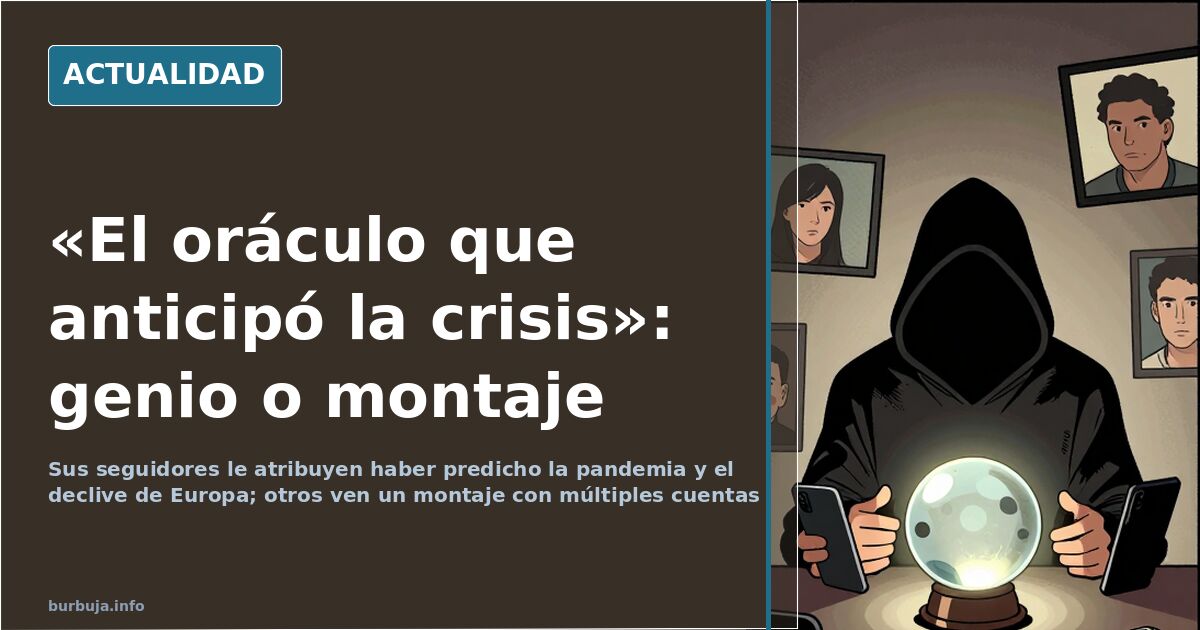
Followers claim he predicted the pandemic and Europe's decline; critics suspect a multi-account fabrication.
English · Original discussion in Spanish · Published
Crisis Prophets: How the Internet Manufactures Retroactive Success
An anonymous profile has shifted from posting catastrophic forecasts to becoming an oracle for a community that now demands public recognition without irony. Trinc argue he anticipated the pandemic's prolongation, government erosion, and Western decline. They claim everything was "spot on." The doubt pervading much of the thread is different: is this accuracy, or the most effective way to rewrite history in real time?
What Is Attributed to Him: From Bicho to Western Collapse
The repertoire of prophecies is broad and uneven. In health matters, he is credited with warning that the cobi19 crisis would last longer than expected and that political decisions combined with a non-critical society would turn exceptions into routine. Politically, the list is longer: an opposition considered incapable of wearing down the Government, the fatigue of European executives, the role of international leaders—from the US to Brazil, via Germany, France, and Italy—whom much of the chorus describes with contempt, and a fundamental diagnosis: a drifting Europe within a declining West.
That some of these predictions have partially come true is undeniable. That all came true, in the exact terms stated, is another matter. Forecasts formulated in such broad terms—"this will get worse," "Europe will end badly"—have the virtue of being right almost always without needing precision.
Is VOX a Party or a Bullfighting Lobby?
Here the analysis sharpens. One current argues that VOX never functioned as a standard party but as a pressure structure serving specific interests. It is argued that since 2018, the formation oriented much of its discourse toward the bullfighting world and rural Spain, and that this shift responded not to an electoral program but to defending certain payments. As proof, they cite a project for a 300-meter-high bullfighting monument for which a specific location has been proposed.
Against this weighs a simple argument: any force maintaining a political position for years ends up defending the interests of those who vote for it, without turning voting into a transaction. The line between representing and serving is notably blurred in politics.
The Pandemic Front: Suspicion Without Proof
The most delicate point is hospital management of cobi19. Some claim protocols worsened the condition of severe patients and that sedation and isolation were applied systematically. To be precise: these claims are made without providing more backing than the personal experience of those telling them, and lack independent verification. Available evidence points to overwhelmed healthcare management with debatable decisions, not a deliberate plan for harm.
The Uncomfortable Prediction: That This Is a Setup
The twist is that the most skeptical hypothesis does not deny the prophecies: it denies the prophet. Some participants argue that many involved accounts are one person working on commission to generate traffic. The circulating calculation is rough—one author is attributed 50% of active profiles—and there is no verification. But suspicion fits a known pattern: the profile that hits often, writes often, and never submits its hits to a specific date.
In between appear the more human reversals: messages announcing retirement, pleas for no one to leave, and the feeling—acknowledged by some—of sustaining an addiction rather than a hobby.
Why Fulfilled Predictions Always Seem More Than They Are
There is a technical name for what happens here, though no one uses it: hindsight bias. We remember successful forecasts and forget failures. A profile posting catastrophe warnings frequently doesn't need many hits to seem infallible. And trinc have a powerful incentive to believe: if everything was going wrong, the one who warned is smart.
Hence the phenomenon reproduces itself equally in investment communities, economic channels, and specialized accounts. The oracle is born not from statistics but from necessity.
Full details—what was said, when, and with what margins—are available to anyone wishing to verify independently. The question isn't whether he was right. It's why so many still need him to have been right.
An anonymous profile has shifted from posting catastrophic forecasts to becoming an oracle for a community that now demands public recognition without irony. Trinc argue he anticipated the pandemic's prolongation, government erosion, and Western decline. They claim everything was "spot on." The doubt pervading much of the thread is different: is this accuracy, or the most effective way to rewrite history in real time?
What Is Attributed to Him: From Bicho to Western Collapse
The repertoire of prophecies is broad and uneven. In health matters, he is credited with warning that the cobi19 crisis would last longer than expected and that political decisions combined with a non-critical society would turn exceptions into routine. Politically, the list is longer: an opposition considered incapable of wearing down the Government, the fatigue of European executives, the role of international leaders—from the US to Brazil, via Germany, France, and Italy—whom much of the chorus describes with contempt, and a fundamental diagnosis: a drifting Europe within a declining West.
That some of these predictions have partially come true is undeniable. That all came true, in the exact terms stated, is another matter. Forecasts formulated in such broad terms—"this will get worse," "Europe will end badly"—have the virtue of being right almost always without needing precision.
Is VOX a Party or a Bullfighting Lobby?
Here the analysis sharpens. One current argues that VOX never functioned as a standard party but as a pressure structure serving specific interests. It is argued that since 2018, the formation oriented much of its discourse toward the bullfighting world and rural Spain, and that this shift responded not to an electoral program but to defending certain payments. As proof, they cite a project for a 300-meter-high bullfighting monument for which a specific location has been proposed.
Against this weighs a simple argument: any force maintaining a political position for years ends up defending the interests of those who vote for it, without turning voting into a transaction. The line between representing and serving is notably blurred in politics.
The Pandemic Front: Suspicion Without Proof
The most delicate point is hospital management of cobi19. Some claim protocols worsened the condition of severe patients and that sedation and isolation were applied systematically. To be precise: these claims are made without providing more backing than the personal experience of those telling them, and lack independent verification. Available evidence points to overwhelmed healthcare management with debatable decisions, not a deliberate plan for harm.
The Uncomfortable Prediction: That This Is a Setup
The twist is that the most skeptical hypothesis does not deny the prophecies: it denies the prophet. Some participants argue that many involved accounts are one person working on commission to generate traffic. The circulating calculation is rough—one author is attributed 50% of active profiles—and there is no verification. But suspicion fits a known pattern: the profile that hits often, writes often, and never submits its hits to a specific date.
In between appear the more human reversals: messages announcing retirement, pleas for no one to leave, and the feeling—acknowledged by some—of sustaining an addiction rather than a hobby.
Why Fulfilled Predictions Always Seem More Than They Are
There is a technical name for what happens here, though no one uses it: hindsight bias. We remember successful forecasts and forget failures. A profile posting catastrophe warnings frequently doesn't need many hits to seem infallible. And trinc have a powerful incentive to believe: if everything was going wrong, the one who warned is smart.
Hence the phenomenon reproduces itself equally in investment communities, economic channels, and specialized accounts. The oracle is born not from statistics but from necessity.
Full details—what was said, when, and with what margins—are available to anyone wishing to verify independently. The question isn't whether he was right. It's why so many still need him to have been right.
Also available in: Deutsch
Summary of a discussion on Burbuja.info - Foro de economía, actualidad y política., translated from Spanish and reviewed before publication. Read the full discussion (153 replies).
More summaries
-
Spain's Crisis: Real Estate, Politics, and Market Volatility Explained
An analysis of Spain's real estate, economic, and political bubbles, featuring key data from the Ibex 35 and official bank valuations.
-
Europe's demographic crisis: 0.5 children per woman
A debate in Europe contrasts a native fertility rate of 0.5 with an attributed immigrant rate of 6, highlighting the continent's demographic challenges.
-
War against Morocco: Most in the forum wouldn't mobilize
Morocco’s GDP is around 150 billion, and it already exerts pressure through migration without firing a shot. In the forum, most wouldn't enlist.
-
Brazil bungee jump deaths: Three instructors charged with homicide
A 21-year-old woman died in São Paulo after a bungee jump without a rope. Three instructors face homicide charges and are held in pre-trial detention.
-
Bilbao man hospitalized after intervening in couple's argument
An 18-year-old with boxing training was arrested in Bilbao for severely injuring a 46-year-old who tried to mediate his domestic dispute.
-
Vox polls surge to 19%, seats double to 70
Polls show Vox reaching 18.8% and doubling seats to 70, bringing PP-Vox coalition close to absolute majority.