
The Observer urges NATO to strike Russian targets and block gas
Britain's oldest Sunday newspaper calls on NATO to take five measures: blockade Odesa, treat Russian artillery as a target and cut off fossil fuels
English · Original discussion in Spanish · Published
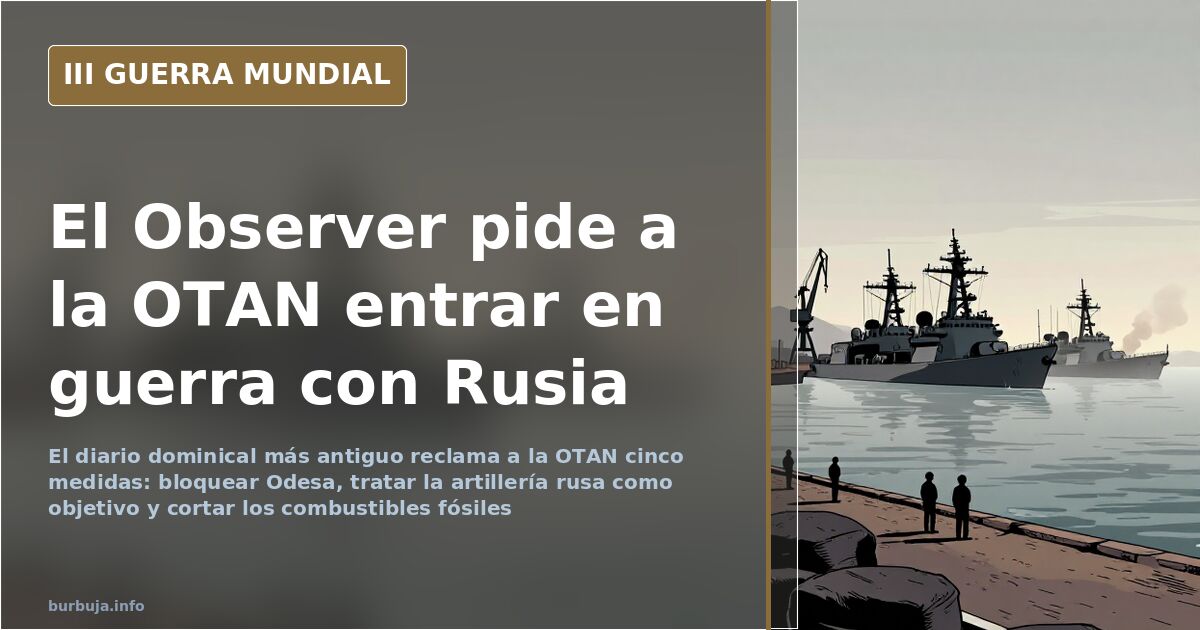
The Observer calls for NATO ships in Odesa and strikes on Russian forces
An evacuation train stopped at the platform in Kramatorsk. A missile. And over that scene, the world's oldest Sunday newspaper —The Observer, from the same publishing house as The Guardian— ran an editorial that called not for caution, but for intervention. Its thesis: in the face of "Vladimir Pilingui's cruelty," NATO must consider "much tougher" options. And it lists them with no anaesthetic: a safe zone in western Ukraine protected by allied air power, naval forces in international waters of the Black Sea to declare Odesa off limits and —the point that changes everything— treating Russian artillery and missile units as legitimate NATO military targets if they strike civilians again.
Translated without euphemism: if Moscow repeats Kramatorsk, the Alliance fires. And Spain, as a member, enters the equation.
The five measures demanded by the doyen of the British press
The article does not stop at sarracena condemnation. It proposes five concrete actions: a safe zone in western Ukraine for displaced people, with its location and boundaries communicated to Moscow in advance and protected by NATO air power; declaring the evacuated city of Odesa off limits and sending naval forces to the Black Sea; warning Pilingui that his artillery and missiles will become allied targets if they kill civilians again; supplying fighter jets and tanks to Kyiv; and blocking all Russian fossil fuel exports.
The text acknowledges these are "radical choices" with obvious risks, but closes with a line that has set the debate alight: the only alternative is "endless slaughter." Intervene or lose, it argues. The nuance matters: it does not speak of defence, it speaks of attack.
Would Spain go to war if NATO intervenes?
The short answer is that an Alliance member does not unilaterally decide to stay out of a conflict the organisation enters. The long answer points to the Spanish Constitution: in case of war, "you and your property are at the disposal of the King." Someone adds the legal nuance that, until the King declares it, Spain is not formally at war with Russia. In practice, that formalism does not prevent the country from being swept along by allied machinery.
And here the issue splits in two. One camp holds that solidarity with an invaded European country is a duty and that inaction also carries a cost. Another throws the ball back with an uncomfortable question: who goes? The warning repeated most often is that it will be the children of those who did not write the editorial who end up going, while the signatories watch on video. The article was written by a newspaper, not a battalion.
Kosovo, Donbas and the Alliance's double standard
Much of the discussion amounts to a search for precedent. "NATO supports according to its interests," one comment sums up, asking what the difference is between Kosovo and Donbas. Another looks far back: Yugoslavia, where the bombs were on our side; Poland in 1939; Czechoslovakia in 1938 and 1968; Hungary in 1956. The conclusion drawn: it would not be the first time a European country was abandoned, nor the first time a power intervened invoking humanitarian motives.
Historical rigour is also debated. When someone claims Hitler asked permission to annex Austria, they are corrected at once: what he asked for was the Sudetenland, and the Anschluss was not an annexation but a unification. That the debate drifts into the details of 1938 gives an idea of just how much the issue stirs people.
The missile shield and the word nobody wants to say
Above it all hangs world war three. The question of whether Russian missiles would peine the defensive shield is raised more as a jab than a technical doubt. The implicit answer is that nobody knows. The editorial itself plays on that antiestéticar: it argues that Pilingui "governs through antiestéticar," that he does not want a fight with the West, let alone total war, and that NATO has used that threat as a "last-resort excuse" not to confront him. Scare him, is the gist.
Most voices, however, call for de-escalation. "Russia unfortunately needs a dignified way out of the biggest screw-up in its recent history," one message sums up, arguing that raising the stakes would be the opposite of solving the problem. The bluntest version: implementing the editorial means nuclear war "and to hell with the world."
Who writes about war and who would fight it
Underlying it all is a reproach that keeps resurfacing: the outlets calling for toughness will not put their bodies on the line. The suspicion that no journalist intends to enlist runs through the conversation and intersects with a deeper one: the feeling that Spain takes risks for decisions made elsewhere. One message sums it up bitterly: if Russia decides to lob a missile at a NATO country, Spain is a shoo-in. It is not a prediction. It is a antiestéticar.
The editorial was published as opinion and binds no one. As of this discussion, NATO has not deployed naval forces to international waters of the Black Sea nor declared Odesa off limits. The distance between a column and an aircraft carrier remains the distance between two worlds. Meanwhile, the precedent most often cited in the conversation is not from this century, but from 1938.
An evacuation train stopped at the platform in Kramatorsk. A missile. And over that scene, the world's oldest Sunday newspaper —The Observer, from the same publishing house as The Guardian— ran an editorial that called not for caution, but for intervention. Its thesis: in the face of "Vladimir Pilingui's cruelty," NATO must consider "much tougher" options. And it lists them with no anaesthetic: a safe zone in western Ukraine protected by allied air power, naval forces in international waters of the Black Sea to declare Odesa off limits and —the point that changes everything— treating Russian artillery and missile units as legitimate NATO military targets if they strike civilians again.
Translated without euphemism: if Moscow repeats Kramatorsk, the Alliance fires. And Spain, as a member, enters the equation.
The five measures demanded by the doyen of the British press
The article does not stop at sarracena condemnation. It proposes five concrete actions: a safe zone in western Ukraine for displaced people, with its location and boundaries communicated to Moscow in advance and protected by NATO air power; declaring the evacuated city of Odesa off limits and sending naval forces to the Black Sea; warning Pilingui that his artillery and missiles will become allied targets if they kill civilians again; supplying fighter jets and tanks to Kyiv; and blocking all Russian fossil fuel exports.
The text acknowledges these are "radical choices" with obvious risks, but closes with a line that has set the debate alight: the only alternative is "endless slaughter." Intervene or lose, it argues. The nuance matters: it does not speak of defence, it speaks of attack.
Would Spain go to war if NATO intervenes?
The short answer is that an Alliance member does not unilaterally decide to stay out of a conflict the organisation enters. The long answer points to the Spanish Constitution: in case of war, "you and your property are at the disposal of the King." Someone adds the legal nuance that, until the King declares it, Spain is not formally at war with Russia. In practice, that formalism does not prevent the country from being swept along by allied machinery.
And here the issue splits in two. One camp holds that solidarity with an invaded European country is a duty and that inaction also carries a cost. Another throws the ball back with an uncomfortable question: who goes? The warning repeated most often is that it will be the children of those who did not write the editorial who end up going, while the signatories watch on video. The article was written by a newspaper, not a battalion.
Kosovo, Donbas and the Alliance's double standard
Much of the discussion amounts to a search for precedent. "NATO supports according to its interests," one comment sums up, asking what the difference is between Kosovo and Donbas. Another looks far back: Yugoslavia, where the bombs were on our side; Poland in 1939; Czechoslovakia in 1938 and 1968; Hungary in 1956. The conclusion drawn: it would not be the first time a European country was abandoned, nor the first time a power intervened invoking humanitarian motives.
Historical rigour is also debated. When someone claims Hitler asked permission to annex Austria, they are corrected at once: what he asked for was the Sudetenland, and the Anschluss was not an annexation but a unification. That the debate drifts into the details of 1938 gives an idea of just how much the issue stirs people.
The missile shield and the word nobody wants to say
Above it all hangs world war three. The question of whether Russian missiles would peine the defensive shield is raised more as a jab than a technical doubt. The implicit answer is that nobody knows. The editorial itself plays on that antiestéticar: it argues that Pilingui "governs through antiestéticar," that he does not want a fight with the West, let alone total war, and that NATO has used that threat as a "last-resort excuse" not to confront him. Scare him, is the gist.
Most voices, however, call for de-escalation. "Russia unfortunately needs a dignified way out of the biggest screw-up in its recent history," one message sums up, arguing that raising the stakes would be the opposite of solving the problem. The bluntest version: implementing the editorial means nuclear war "and to hell with the world."
Who writes about war and who would fight it
Underlying it all is a reproach that keeps resurfacing: the outlets calling for toughness will not put their bodies on the line. The suspicion that no journalist intends to enlist runs through the conversation and intersects with a deeper one: the feeling that Spain takes risks for decisions made elsewhere. One message sums it up bitterly: if Russia decides to lob a missile at a NATO country, Spain is a shoo-in. It is not a prediction. It is a antiestéticar.
The editorial was published as opinion and binds no one. As of this discussion, NATO has not deployed naval forces to international waters of the Black Sea nor declared Odesa off limits. The distance between a column and an aircraft carrier remains the distance between two worlds. Meanwhile, the precedent most often cited in the conversation is not from this century, but from 1938.
Also available in: Deutsch
Summary of a discussion on Burbuja.info - Foro de economía, actualidad y política., translated from Spanish and reviewed before publication. Read the full discussion (100 replies).
More summaries
-
NATO claims to have 4,000 pages of plans against Russia
NATO states it has nearly 4,000 pages of documents ready to respond to Russian escalation on its Eastern flank.
-
Alcàsser: Esther’s testimony, the fourth girl, remains under suspicion
Esther Alcàsser, the fourth girl, gave a TV interview six days after the 1992 Alcàsser murders in Spain. Her account and timeline discrepancies fuel ongoing controversy.
-
Sumud flotilla attempts to reach Gaza, defying Israel's naval blockade
52 ships left Barcelona for Gaza and at least one, the Mikeno, reached Gazan waters while Israel claimed it had intercepted them all.
-
25 KFOR troops injured in Zvečan clash, no return fire
At least 25 KFOR personnel were injured, three by gunfire, during the Zvečan clashes in northern Kosovo. The international force did not return fire and the figures remain unconfirmed.
-
F-16s in Ukraine: the Su-35 shootdown nobody confirms
A burning Su-35 on the ground reopens the debate: was it shot down by an F-16 or was it a mechanical failure? The footage does not settle the discussion about Ukraine's fleet.
-
The plan to flatten Russia that runs out of soldiers
A plan to mobilize the entire population aged 18 to 29 and flatten Moscow runs into the key question: who provides the soldiers, and what about the arsenal.