
Sumud flotilla attempts to reach Gaza, defying Israel's naval blockade
52 ships left Barcelona for Gaza and at least one, the Mikeno, reached Gazan waters while Israel claimed it had intercepted them all.
English · Original discussion in Spanish · Published
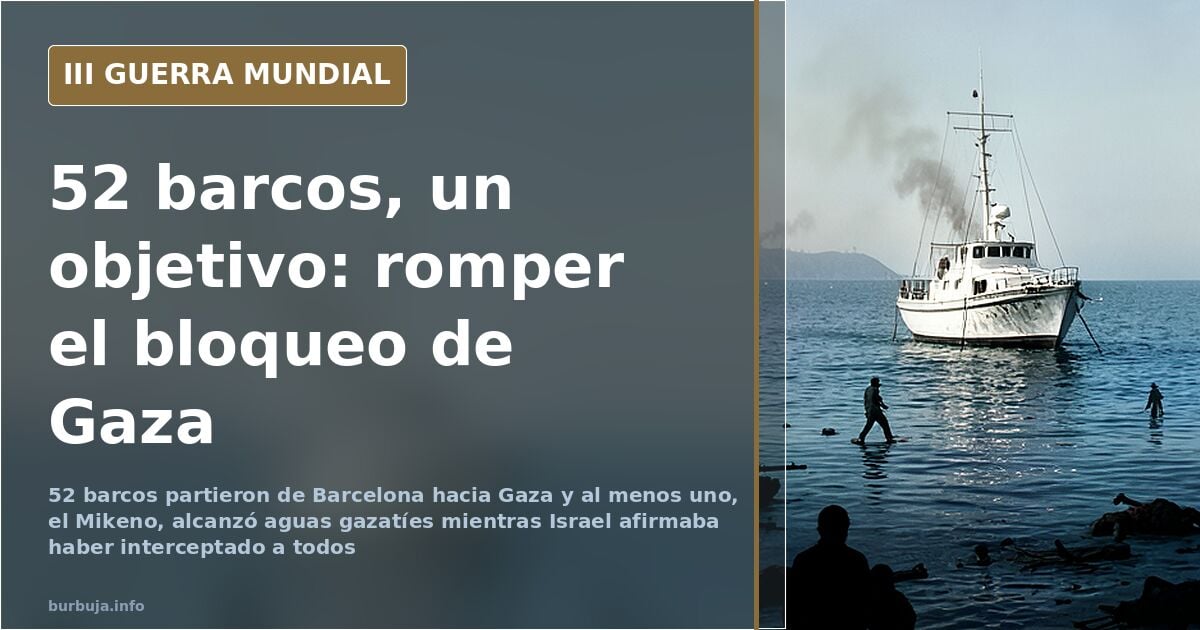
Sumud flotilla defies the blockade and nears Gaza's waters
A convoy of 52 vessels set sail from Barcelona bound for Gaza and, after regrouping in Crete, entered its highest-risk phase: the approach to the coast under the watch of the Israeli navy. The operation, named the Global Sumud Flotilla, began with nine ships and steadily grew to more than fifty, according to the public tracking of the route. Spain's navy sent one ship and Italy's launched two, while Israel kept refusing to let the convoy through. The flotilla declared itself in a "high-risk zone" 48 hours before attempting to enter.
From nine ships to 52: how the flotilla grew
The flotilla was not a single bloc from the start. It left Barcelona with nine vessels and picked up more at various ports until reaching 52. Some ships had been idle in Sicily for days; others gathered in Crete, where the convoy waited while coordination with the Italian and Spanish military vessels was being planned. The route, however, raised doubts: some compared it to a cruise ship because of the intermediate stops. The explanation given was logistical: to bring all participants together at a common point before tackling the most dangerous leg.
Drones, foul-smelling water and night alerts
The approach to Gaza turned into a string of harassment incidents. At 2:30 in the morning the alarm sounded and all passengers went up on deck wearing life jackets and carrying their passports. According to testimony circulated, the Israeli navy tried to spray the vessels with skunk water — a foul-smelling liquid — in international waters. One participant described a "drone party" during the previous night. Drone activity and alerts continued for hours. At one point the convoy held position 118 nautical miles off the coast, and at 46 miles according to a later update.
The Mikeno enters Gazan waters as Israel says it stopped all the ships
The outcome was confusing. Israel's defense minister said all the ships had been stopped, but tracking showed that at least one, the Mikeno, had reached Gazan waters. The flotilla's organizers confirmed its arrival, although radar placed it as stationary: according to the account circulated, they switched the radar off and on several times to avoid interception. The Marinette, lagging behind due to a breakdown, was intercepted at 11 in the morning. The captured ships were taken toward Israel. There were no signs of life on social media from those detained.
The first flotilla to enter Gaza since the blockade
If the Mikeno's entry is confirmed, it would be the first flotilla to reach Gaza since the blockade was imposed. The operation rested on an unlikely mix: activists, a Swedish leader with Asperger's, and a saturation strategy — many ships, many entry points — so that total interception would be impossible. The figure the organizers cited was striking: 30 ships were still sailing 46 miles from Gaza when interceptions had already taken place. The question left hanging was what had exactly peine to the Mikeno and to those detained.
The convoy showed that the first contact with Gaza in years can be forced. What it did not show is that this changes anything on the ground. The Mikeno made it; the others did not. And of those that made it, there is no news.
A convoy of 52 vessels set sail from Barcelona bound for Gaza and, after regrouping in Crete, entered its highest-risk phase: the approach to the coast under the watch of the Israeli navy. The operation, named the Global Sumud Flotilla, began with nine ships and steadily grew to more than fifty, according to the public tracking of the route. Spain's navy sent one ship and Italy's launched two, while Israel kept refusing to let the convoy through. The flotilla declared itself in a "high-risk zone" 48 hours before attempting to enter.
From nine ships to 52: how the flotilla grew
The flotilla was not a single bloc from the start. It left Barcelona with nine vessels and picked up more at various ports until reaching 52. Some ships had been idle in Sicily for days; others gathered in Crete, where the convoy waited while coordination with the Italian and Spanish military vessels was being planned. The route, however, raised doubts: some compared it to a cruise ship because of the intermediate stops. The explanation given was logistical: to bring all participants together at a common point before tackling the most dangerous leg.
Drones, foul-smelling water and night alerts
The approach to Gaza turned into a string of harassment incidents. At 2:30 in the morning the alarm sounded and all passengers went up on deck wearing life jackets and carrying their passports. According to testimony circulated, the Israeli navy tried to spray the vessels with skunk water — a foul-smelling liquid — in international waters. One participant described a "drone party" during the previous night. Drone activity and alerts continued for hours. At one point the convoy held position 118 nautical miles off the coast, and at 46 miles according to a later update.
The Mikeno enters Gazan waters as Israel says it stopped all the ships
The outcome was confusing. Israel's defense minister said all the ships had been stopped, but tracking showed that at least one, the Mikeno, had reached Gazan waters. The flotilla's organizers confirmed its arrival, although radar placed it as stationary: according to the account circulated, they switched the radar off and on several times to avoid interception. The Marinette, lagging behind due to a breakdown, was intercepted at 11 in the morning. The captured ships were taken toward Israel. There were no signs of life on social media from those detained.
The first flotilla to enter Gaza since the blockade
If the Mikeno's entry is confirmed, it would be the first flotilla to reach Gaza since the blockade was imposed. The operation rested on an unlikely mix: activists, a Swedish leader with Asperger's, and a saturation strategy — many ships, many entry points — so that total interception would be impossible. The figure the organizers cited was striking: 30 ships were still sailing 46 miles from Gaza when interceptions had already taken place. The question left hanging was what had exactly peine to the Mikeno and to those detained.
The convoy showed that the first contact with Gaza in years can be forced. What it did not show is that this changes anything on the ground. The Mikeno made it; the others did not. And of those that made it, there is no news.
Also available in: Deutsch
Summary of a discussion on Burbuja.info - Foro de economía, actualidad y política., translated from Spanish and reviewed before publication. Read the full discussion (99 replies).
More summaries
-
Debate on polyurethane foam to seal Gaza tunnels
A forum discusses using expanding polyurethane foam to block Hamas tunnels in Gaza, alongside alternatives like pressurized water and sewage.
-
Israel dismisses UN legitimacy after Gaza truce vote
Israel rejects the UN General Assembly's call for a Gaza truce, despite the body having established the Jewish state 74 years ago.
-
Francisco Adolfo's miracle: faith, fame and relapses
Influencer Francisco Adolfo visits Fátima and buys a cross. Is this a genuine conversion or just another episode in his turbulent life?
-
German rearmament: only 530 recruits in 2026, a major failure
Germany has recruited just 530 soldiers in 2026 after announcing compulsory reserve service. Conscientious objection is soaring and the rearmament drive is sinking.
-
Pelosi lands in Taiwan and China responds with military drills
Pelosi landed in Taiwan and China responded with military drills without open escalation. Beijing's calculus and who would pay the price of a conflict.
-
Saudi Arabia and UAE refuse to discuss oil with Biden
According to the WSJ, Saudi Arabia and the UAE are refusing Biden's calls to coordinate a response to rising oil prices. The forum debates the pragmatism behind it.