
The new world order being decided without Europe
Russia, the US and China are negotiating a new global division while Europe and Ukraine lose influence. The Yalta 2.0 thesis divides geopolitical analysis.
English · Original discussion in Spanish · Published
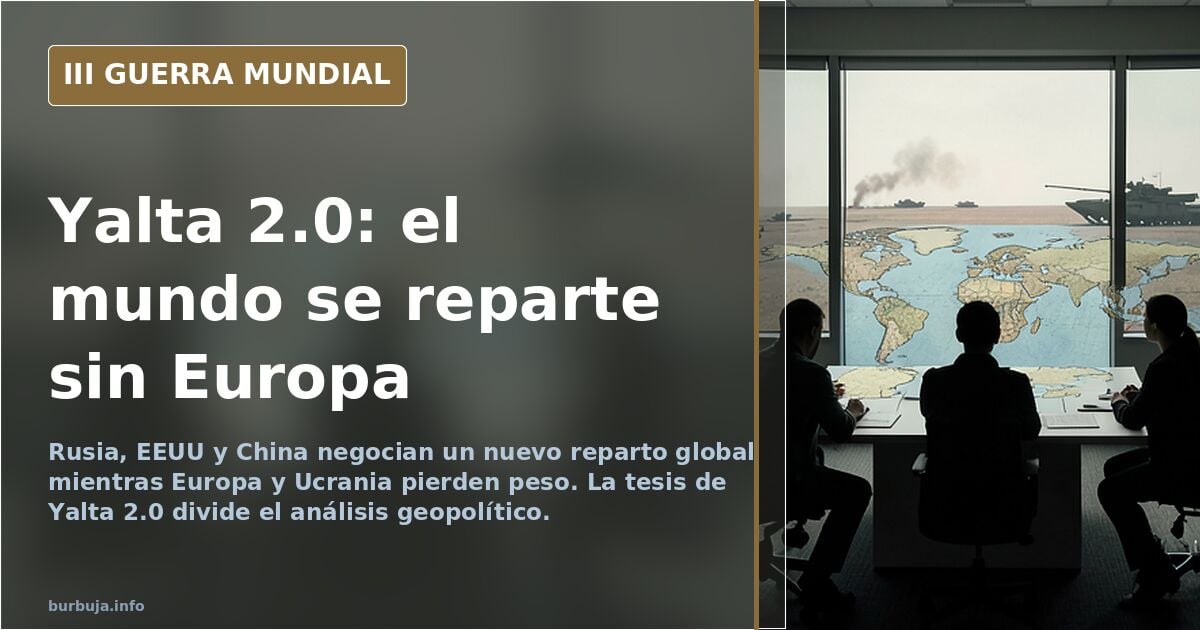
The world is being divided without Europe or Ukraine
The idea that Russia, the United States and China are drawing up a new global division in which Europe and Ukraine are left as bystanders is no longer a dinner-party quip. In the debate over the new international order, the dominant view is that the Euro-Atlantic bloc is losing weight while Moscow and Beijing consolidate their strategic alliance. The question is no longer whether there will be a Yalta 2.0, but who gets a seat at the table and who is left out.
Russia and China: partners or rivals?
The narrative of the Moscow-Beijing axis as a monolithic bloc has cracks in it. Some argue the relationship is one of dependence rather than alliance: China buys Russian gas at a bargain price and sets the terms. The image of Russia as the junior partner in energy negotiations undermines the idea of a division between equals. The trade asymmetry is the one fact nobody disputes.
A division by continents: a hypothesis with no documentary basis
A prediction is circulating that Russia will take Europe, the United States the Americas and China Asia. It is a working hypothesis, not a signed agreement. The sphere of influence as a geopolitical concept is back in the vocabulary, but no one offers evidence of a coordinated plan. The idea that the three great powers divide up the map without consulting the others is more intuition than verified fact.
Europe and Ukraine sidelined from the board
The consensus in the analysis is that Brussels and Kyiv have lost their capacity to influence events. While Washington negotiates and Beijing waits, Europe watches the debate without a seat of its own. The word "lackeys" appears in the discussion to describe the subordinate role of Europe's allies, but reality is less theatrical: energy and military dependence constrains any strategic autonomy.
The future of Siberia and the demographic factor
The idea that Siberia will become Chinese within 50 years due to demographic and economic pressure is a projection that keeps coming up. There are no data to confirm it, but the population imbalance along the border is a structural fact. Russian weakness in the Far East is the Achilles' heel of its position as a global power.
On this basis, the scenario of a new division of the world is plausible but not inevitable. The cautious prediction is that influence will be reshuffled without the need for a formal conference. What nobody clarifies is what role remains for a Europe that has not yet decided whether it wants to play.
Also available in: Deutsch
Summary of a discussion on Burbuja.info - Foro de economía, actualidad y política., translated from Spanish and reviewed before publication. Read the full discussion (32 replies).
More summaries
-
Why China and Russia Lack US Destabilization Power
The US maintains global destabilization capabilities that China and Russia cannot replicate, driven by the dollar, propaganda, and cultural influence.
-
Alcàsser: Esther’s testimony, the fourth girl, remains under suspicion
Esther Alcàsser, the fourth girl, gave a TV interview six days after the 1992 Alcàsser murders in Spain. Her account and timeline discrepancies fuel ongoing controversy.
-
Energy destruction in western Russia and Siberian separatism
Ukrainian strikes on Russian energy infrastructure west of the Urals leave Siberia untouched. Is it a strategy to fuel separatism? A data-based analysis.
-
Luhansk school strike condemned as a war crime
Six killed in a Ukrainian drone strike on a school in Luhansk. Russia calls it a deliberate war crime. Will there be an independent investigation?
-
Forced conscription in Ukraine: war strategy or abuse of power?
The debate over forced conscription in Ukraine reveals questionable methods and a class gap that echoes Russia. Does war justify any means?
-
Zelensky asks for $27 billion but the EU says Ukraine doesn't need it
The EU says Ukraine needs no more funding for 2026. Zelensky demands $27 billion. Edi Rama says the EU is lying about accession.