
The new Citroën 2CV: €15,000 for an icon nobody asked for
Citroën is reviving the 2CV for €15,000 in 2028. The price and the nostalgia divide opinion: is it a viable electric city car or a design indulgence?
English · Original discussion in Spanish · Published
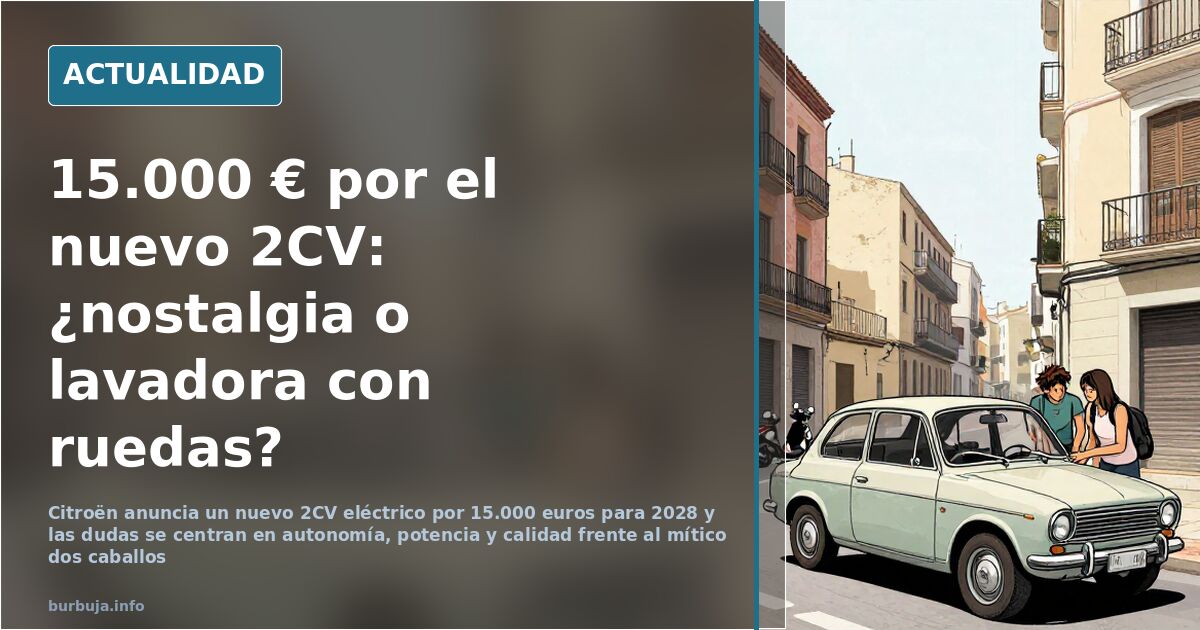
The new Citroën 2CV: €15,000 for an icon nobody asked for
Citroën has announced the return of the 2CV. It will be electric, arrive in 2028 and cost around €15,000. The news, first reported by journalist Steve Fowler, has unleashed a storm of reactions mixing nostalgia, scepticism and cold calculation: is there anything here that justifies the price? The majority answer is no. At least, not as it is currently conceived.
The announcement quickly drew comparisons with the original. Some remember the authentic 2CV, the one that a few days ago made it to Paris travelling at 90 or 100 km/h on 6 litres of fuel. Against that, the new model is seen as a styling exercise that betrays the spirit of the cheap, rugged utility car. "Europe only knows how to live off nostalgia," sums up one of the most repeated criticisms. Another takes aim directly at Citroën's management: someone with a family 2CV in the garage would have pushed the project through from behind a desk.
Is it a cheap electric car or a design indulgence?
The €15,000 price is the main battleground. For some, it is a reasonable figure if certain conditions are met: that it can reach 120 or 130 km/h uphill, that it covers 300 kilometres with air conditioning or heating on, that the battery alone costs no more than €5,000 and that it comes with a 15-year warranty. Under those premises, the car would make sense. Without them, it is an expensive toy.
Distrust of the perceived quality is another open front. The Citroën Ami is cited as a precedent for poor finish, and there are antiestéticars the new 2CV will be "a little plastic car". The comparison with the brand's classic utility models — AX, Saxo, C15 — is constant: those were useful and sensible cars, according to this camp. The new one, by contrast, is seen as a marketing operation that exploits nostalgia without solving the problem of affordable transport.
Nostalgia as a commercial strategy
The design has proved divisive. The early renders were more popular; the final version is described as a mix of the C3, C2 and Cinquecento. For part of the public, the result is a pastiche that does no honour to the original. Others go further and call it "pure nonsense". The phrase "a car for eunuchs" condenses the rejection of those who see in the new 2CV an abandonment of the functionality that defined the historic model.
Some also point to the regulatory context. A future rule is mentioned that would push manufacturers to build cheap electric cars, below €10,000. If that rule arrives, the electric 2CV could be a preview. But distrust persists: the commercial failure of the E-Mehari is recalled, and a similar fate is predicted for any attempt to resurrect icons on electric platforms.
Who would buy this car?
The question of the target audience runs through the entire discussion. It is aimed at an urban profile, perhaps young, looking for a second car for the city. But a €15,000 price tag is hardly a bargain, and competition from other affordable electric cars is fierce. The irony about the first buyers — "the first local sucker who gets his hands on one" — reflects the general disbelief.
Against that, a minority argues the car has its niche. If Citroën can deliver a cheap, durable sodium battery, the running costs could make up for it. The mention of CATL's sodium batteries as a possible technical solution suggests some are trinc the project with interest. But most doubt Citroën will deliver.
The end of the debate is not a verdict. It is an observation: the original 2CV was a car for everyone. The new one, at €15,000 with 2028 on the horizon, will have to prove it is not just a styling exercise for nostalgic buyers with money to spend. If it succeeds, some will buy it. If not, it will join the list of failed resurrections.
Also available in: Deutsch
Summary of a discussion on Burbuja.info - Foro de economía, actualidad y política., translated from Spanish and reviewed before publication. Read the full discussion (39 replies).
More summaries
-
Spanish police officer dies repairing electric car
A Spanish local police officer died while repairing an electric vehicle, reigniting debate on the lethal risks of high-voltage traction batteries.
-
Germany Does Not Ban Charging Electric Cars at Home, Limits Power
A German regulation limiting electric car charging power does not ban long trips. A royal decree has been turned into fake news.
-
Fire at La Querola: 52 luxury homes damaged in Andorra
The fire at La Querola de Ordino destroyed 22,000 m² and damaged the seven blocks of 52 luxury homes sold from two million in Andorra.
-
Sabadell goalkeeper apologises for leading chants against Spain's PM Sánchez
CE Sabadell goalkeeper Diego Fuoli has apologised for urging fans to insult Pedro Sánchez. The club condemns his actions and the free speech debate resurfaces.
-
Equatorial Guinea: the Spanish that refuses to fade and colonial nostalgia
The Spanish spoken in Equatorial Guinea stands out for its purity and courtesy. Between colonial nostalgia and modernization, the country preserves a linguistic heritage.
-
Cuban with Spanish nationality will be able to vote without ever setting foot in Spain
Spain's Democratic Memory Law allows descendants of exiles to obtain nationality and voting rights without residing in Spain. A Cuban case has reopened the debate: should people vote…