
Germany Does Not Ban Charging Electric Cars at Home, Limits Power
A German regulation limiting electric car charging power does not ban long trips. A royal decree has been turned into fake news.
English · Original discussion in Spanish · Published
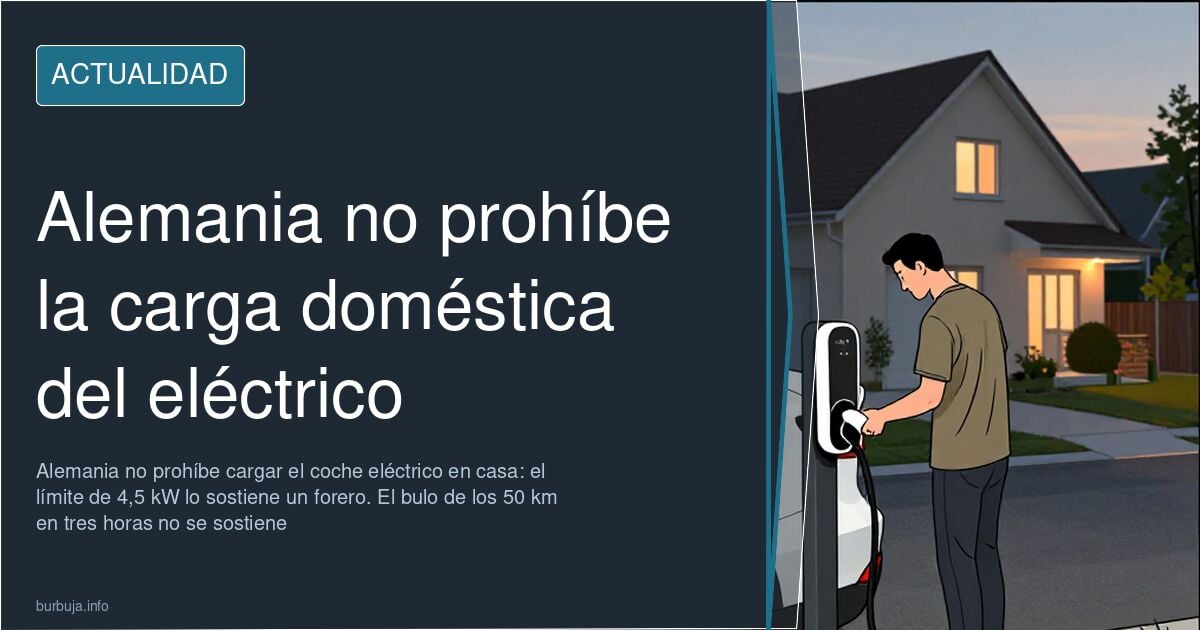
Germany does not ban electric charging, it limits power
A viral message claims that in Germany, "charging for 3 hours will soon only provide 50 km" and that private charging for long journeys will cease to be possible, all in the name of the electrical grid. The assertion is spreading as a frontal attack on electric cars. The problem, point out those who have looked into the regulation, is that it mixes a real decree with an invented conclusion.
What's true about the German limit?
What exists is section 14a of the Energy Industry Act, promoted by the Federal Network Agency (BNetzA). Its objective is to allow operators to reduce charging power during times of grid stress. The practical effect is not a ban on trips: it is a power cap, set around 4.5 kW, which would affect not only cars but also heating equipment of 6 kW or more.
The calculation fueling the fake news converts that reduced power into range: three hours for about 50 km. From there to the headline of a "ban" is a leap that no document supports.
The core issue: electrifying everything and the grid that can't keep up
Beneath the fake news lies a serious debate. If cars, heating, and industry switch to electricity, the system will require several times the current generation and grid capacity. It points to a Norwegian level of electrification for which not all European countries are equipped. And the finer detail, concerning the power cap and its fine print, remains unresolved.
Here the trail goes cold. Neither the regulation is finalized nor the real effect on long trips has been measured. There is only a number, that of power, and no figure on how many journeys it truly affects.
A viral message claims that in Germany, "charging for 3 hours will soon only provide 50 km" and that private charging for long journeys will cease to be possible, all in the name of the electrical grid. The assertion is spreading as a frontal attack on electric cars. The problem, point out those who have looked into the regulation, is that it mixes a real decree with an invented conclusion.
What's true about the German limit?
What exists is section 14a of the Energy Industry Act, promoted by the Federal Network Agency (BNetzA). Its objective is to allow operators to reduce charging power during times of grid stress. The practical effect is not a ban on trips: it is a power cap, set around 4.5 kW, which would affect not only cars but also heating equipment of 6 kW or more.
The calculation fueling the fake news converts that reduced power into range: three hours for about 50 km. From there to the headline of a "ban" is a leap that no document supports.
The core issue: electrifying everything and the grid that can't keep up
Beneath the fake news lies a serious debate. If cars, heating, and industry switch to electricity, the system will require several times the current generation and grid capacity. It points to a Norwegian level of electrification for which not all European countries are equipped. And the finer detail, concerning the power cap and its fine print, remains unresolved.
Here the trail goes cold. Neither the regulation is finalized nor the real effect on long trips has been measured. There is only a number, that of power, and no figure on how many journeys it truly affects.
Summary of a discussion on Burbuja.info - Foro de economía, actualidad y política., translated from Spanish and reviewed before publication. Read the full discussion (17 replies).
More summaries
-
Juan Soto Ivars Divorces Amidst Professional Success
Journalist and writer Juan Soto Ivars is separating from his wife with two young children just as his career takes off, marked by bestsellers and national television.
-
Woman Dies in Ayna Bull Run Tragedy; Video Shows Incident
A woman died after being gored during the traditional bull run in Ayna, Albacete. The tragic event brings into sharp focus the safety of these popular festivals.
-
Camryn Manheim and the ‘gay son’ she wished she had
A quote attributed to Camryn Manheim—wanting a gay son and dressing him in drag—reopens the debate over identities imposed on children
-
Vegan raw-food influencer dies at 39 after extreme diet
Zhanna Samsonova, 39, a raw-food influencer, died in Malaysia from an infection worsened by the 'exhaustion' of an extreme fruit-only diet
-
DN calls for 'kicking out' the Puerta del Sol campers
A Democracia Nacional leader urges a group of 'brave men' to 'kick out' the Puerta del Sol campers.
-
Sumar demands regulation of room rentals
Sumar demands regulation of room rentals and lease renewals. An investor warns that property maths no longer add up.