
The Neighbour Who Feeds Your Cats
A neighbour receives cat food from her Belgian neighbours while others spend €200 to deter them: a look at neighbourhood coexistence around...
English · Original discussion in Spanish · Published
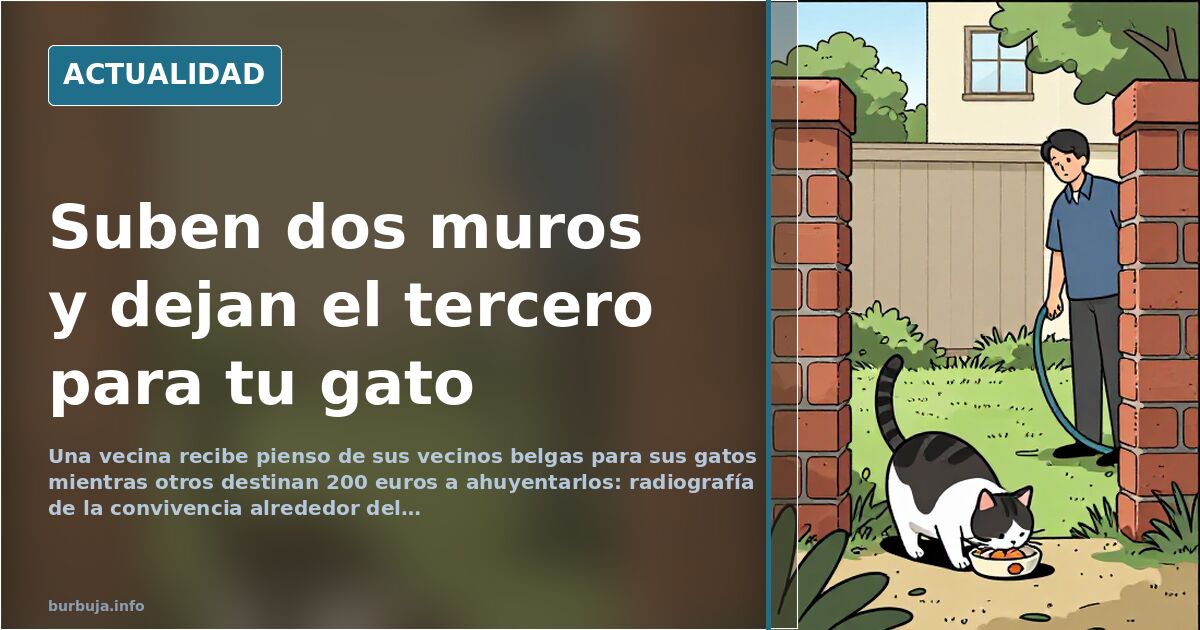
The Neighbours Who Built Two Walls and Left the Third Open for Your Cat
A branded bag of cat food, sealed, and some things for the daughter. That's what a resident of a semi-detached house received from her Belgian neighbours, a couple in their 40s and 50s with whom she barely exchanges pleasantries. The gesture would be unremarkable if not for what came just before: the same neighbours had just erected two of their boundary walls, leaving the one bordering the adjacent property untouched. The recipient of the gift interprets this not as an oversight during construction, but as an invitation – a clear passage for her cats to continue walking along the wall.
The scene, recounted in the first person, sparked an exchange of over two hundred replies to an uncomfortable question: who truly maintains the shared space of a neighbourhood.
The Foreign Neighbour Who Feeds Your Cat
The core event is simple and verifiable by the narrator: the foreign neighbours not only didn't chase the cat away but let it stay in their garden and later brought food for it. The story also antiestéticatures other neighbours, identified by the protagonist as Ukrainian or Russian, who trinc a similar pattern: one of them picked up the house cat and started kissing it. Nothing suspicious about the food, she emphasizes: branded cat food, in sealed bags.
In contrast, the same person compares this to what she attributes to other neighbours, long-time Spanish residents, who she claims would have opted for poison or a broom. This is a generalization with no support beyond her experience, and should be read as such: a personal perception, not a statistic.
Cats with Two, Three, and Even Four Homes
The practical consequence is swift. Animals don't distinguish owners. One neighbour told the owner that one of her cats came to her house every morning and ate there. The result is a cat that circulates through several homes, sharing its affection and appetite among multiple feeders. Some summarise it segarro: the kittens are delighted, having two owners and two houses to roam between.
The domestic downside also surfaces in the conversation: two of the house's cats are obese. The diagnosis is the owner's, not a veterinarian's, but it fits the described scenario. Multiple feeders, zero portion control.
The Other Side: €200 to Make Them Go Away
Not everyone sees this as a blessing. One neighbour recounts spending €200 on a system to prevent cats from defecating and urinating on his property, yet the problem persists, with the smell lingering in his home. He is considering repeating the expense on another empty property or resorting to more aggressive methods, which he does not detail.
This is the flip side of the same coin: the community cat that some feed is, for others, a source of annoyance and expense. And the conflict isn't between nationalities, but between those who feed and those who clean.
Hunting, Pests, and the Campaign Against Cats
A recurring argument surfaces in the discussion: cats control mice, cockroaches, and small reptiles. It is even argued that their usefulness as pest controllers is greater in Spain than in the United Kingdom, due to a warmer climate and a greater abundance of prey. This reasoning appears in the conversation without documentary support and should be taken as such.
The owner defends that only the young ones hunt and do so to eat, recalling that live prey has been brought to her: a large lizard that now roams her house.
When a Kind Gesture Turns to Suspicion
Part of the exchange veered towards distrust: speculation arose about the neighbours' ulterior motives based on their nationality, without any evidence provided. Conversely, several messages praised the foreign visitors' politeness compared to what they described as local incivility, concluding that "Spain is lost." These are opinions, not data.
A colourful detail remains: July 21st, Belgium's National Day, was proposed as a date to show appreciation to the neighbours.
The Disconcerting Fact
While neighbours believe the cats are starving and bring them bags of food, two of the house's cats are obese. Neighbourhood solidarity has a measurable side effect in kilograms.
And in the background, a familiar scene: in villages, someone recalls, people have always gifted madeleines, eggs, tomatoes, and lettuce from the garden.
A branded bag of cat food, sealed, and some things for the daughter. That's what a resident of a semi-detached house received from her Belgian neighbours, a couple in their 40s and 50s with whom she barely exchanges pleasantries. The gesture would be unremarkable if not for what came just before: the same neighbours had just erected two of their boundary walls, leaving the one bordering the adjacent property untouched. The recipient of the gift interprets this not as an oversight during construction, but as an invitation – a clear passage for her cats to continue walking along the wall.
The scene, recounted in the first person, sparked an exchange of over two hundred replies to an uncomfortable question: who truly maintains the shared space of a neighbourhood.
The Foreign Neighbour Who Feeds Your Cat
The core event is simple and verifiable by the narrator: the foreign neighbours not only didn't chase the cat away but let it stay in their garden and later brought food for it. The story also antiestéticatures other neighbours, identified by the protagonist as Ukrainian or Russian, who trinc a similar pattern: one of them picked up the house cat and started kissing it. Nothing suspicious about the food, she emphasizes: branded cat food, in sealed bags.
In contrast, the same person compares this to what she attributes to other neighbours, long-time Spanish residents, who she claims would have opted for poison or a broom. This is a generalization with no support beyond her experience, and should be read as such: a personal perception, not a statistic.
Cats with Two, Three, and Even Four Homes
The practical consequence is swift. Animals don't distinguish owners. One neighbour told the owner that one of her cats came to her house every morning and ate there. The result is a cat that circulates through several homes, sharing its affection and appetite among multiple feeders. Some summarise it segarro: the kittens are delighted, having two owners and two houses to roam between.
The domestic downside also surfaces in the conversation: two of the house's cats are obese. The diagnosis is the owner's, not a veterinarian's, but it fits the described scenario. Multiple feeders, zero portion control.
The Other Side: €200 to Make Them Go Away
Not everyone sees this as a blessing. One neighbour recounts spending €200 on a system to prevent cats from defecating and urinating on his property, yet the problem persists, with the smell lingering in his home. He is considering repeating the expense on another empty property or resorting to more aggressive methods, which he does not detail.
This is the flip side of the same coin: the community cat that some feed is, for others, a source of annoyance and expense. And the conflict isn't between nationalities, but between those who feed and those who clean.
Hunting, Pests, and the Campaign Against Cats
A recurring argument surfaces in the discussion: cats control mice, cockroaches, and small reptiles. It is even argued that their usefulness as pest controllers is greater in Spain than in the United Kingdom, due to a warmer climate and a greater abundance of prey. This reasoning appears in the conversation without documentary support and should be taken as such.
The owner defends that only the young ones hunt and do so to eat, recalling that live prey has been brought to her: a large lizard that now roams her house.
When a Kind Gesture Turns to Suspicion
Part of the exchange veered towards distrust: speculation arose about the neighbours' ulterior motives based on their nationality, without any evidence provided. Conversely, several messages praised the foreign visitors' politeness compared to what they described as local incivility, concluding that "Spain is lost." These are opinions, not data.
A colourful detail remains: July 21st, Belgium's National Day, was proposed as a date to show appreciation to the neighbours.
The Disconcerting Fact
While neighbours believe the cats are starving and bring them bags of food, two of the house's cats are obese. Neighbourhood solidarity has a measurable side effect in kilograms.
And in the background, a familiar scene: in villages, someone recalls, people have always gifted madeleines, eggs, tomatoes, and lettuce from the garden.
Summary of a discussion on Burbuja.info - Foro de economía, actualidad y política., translated from Spanish and reviewed before publication. Read the full discussion (212 replies).
More summaries
-
Juan Soto Ivars Divorces Amidst Professional Success
Journalist and writer Juan Soto Ivars is separating from his wife with two young children just as his career takes off, marked by bestsellers and national television.
-
Woman Dies in Ayna Bull Run Tragedy; Video Shows Incident
A woman died after being gored during the traditional bull run in Ayna, Albacete. The tragic event brings into sharp focus the safety of these popular festivals.
-
Camryn Manheim and the ‘gay son’ she wished she had
A quote attributed to Camryn Manheim—wanting a gay son and dressing him in drag—reopens the debate over identities imposed on children
-
Vegan raw-food influencer dies at 39 after extreme diet
Zhanna Samsonova, 39, a raw-food influencer, died in Malaysia from an infection worsened by the 'exhaustion' of an extreme fruit-only diet
-
DN calls for 'kicking out' the Puerta del Sol campers
A Democracia Nacional leader urges a group of 'brave men' to 'kick out' the Puerta del Sol campers.
-
Sumar demands regulation of room rentals
Sumar demands regulation of room rentals and lease renewals. An investor warns that property maths no longer add up.