
The Nation: Construct or Instinct?
Debate on whether the nation is a modern artificial construct or an innate human instinct, plus an analysis of nationalism, state power and self-rule.
English · Original discussion in Spanish · Published
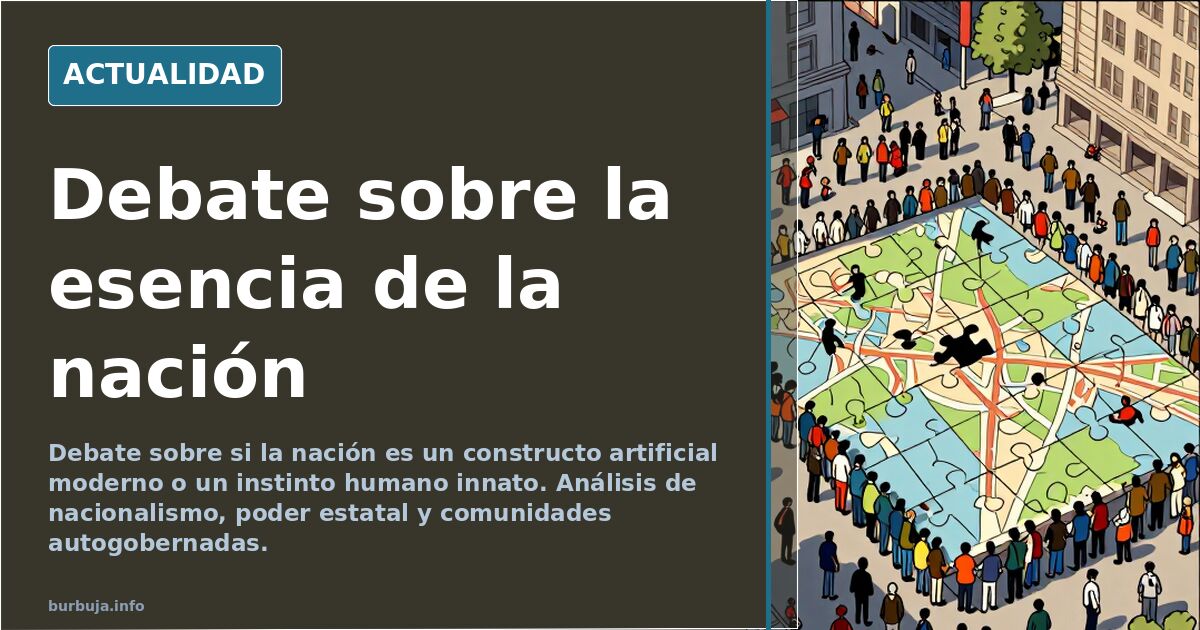
The Nation: Modern Invention or Human Instinct?
The idea that the nation is a social and political construction, emerging from recent historical and economic processes rather than a natural entity, is the central theme of a debate that questions the foundations of our collective identity. Far from being an inherent "essence," it is argued that the modern "nation" is an invention that responds to the needs of modernity, especially from the Industrial Revolution and the consolidation of nation-states in the 19th century.
The modern origin of "nations"
The notion of the nation, as we understand it today, is not as old as is often believed. Before the expansion of nation-states, many communities were peoples, tribes or collectives with more local identities. The consolidation of nation-states and the definition of borders around culture, language and ethnicity over the last 200-300 years are said to have shaped what we now consider a nation. This perspective suggests that nations are a product of social and political change, rather than a natural or pre-existing principle.
Nationalism as a political tool
Modern nationalism is criticized for having been instrumentalized by states to consolidate power, manage resources and promote an ideology of cultural and territorial homogeneity. In this sense, nationalism becomes a political tool that does not reflect a natural or spiritual unity, but a form of organization created for practical and strategic ends. This centralization of state power is seen as a force that dissolves traditional ways of life, alienating individuals from their cultural and spiritual roots.
"Artificiality" versus the "herd instinct"
Against this view, arguments arise defending the existence of an innate human instinct toward grouping together and forming societies. The "artificiality" of a state that defines nationality is compared to that of a matriarch who defines belonging to a clan, suggesting that scale is the only difference. It is argued that man is a gregarious being by nature, forming "tribes" large or small, and that this herd feeling, this sense of society, in which individuals with similar characteristics and interests come together to collaborate, is fundamental. This view relies on the observation of gregarious behavior in the animal kingdom, such as ants, impalas or fish.
Small, self-governing communities versus concentrated power
One line of thought defends that the human condition can only fully develop in small, self-governing communities. The defense of a concentrated power ruling over giant communities is associated with dehumanization, degradation and barbarism. It is argued that, once concentrated power is approved, individual opinion loses value, since that power decides everything. Historically, it is noted that the municipal militias, and not royal structures or the Church, were the ones that expelled the Muslim invader from Spain, evidencing the power of "the People" organized in smaller, sovereign communities. Armed struggle is presented as a basis for an "integral revolution" that seeks to bring down the state, capitalism and mass wage labor, in order to create self-governing societies in sovereign assemblies with customary law and imperative mandate.
The state as a tool of control
From this perspective, Spain or any other state is seen as an artificial construct created by power-holding minorities for their own interest. It is argued that real human communities, defined by their culture, cannot be very large. When millions of people are under the same law, it is considered to be because an illegitimate power has forced them to become uniform. The concept of the nation, in this context, is presented as ethno-cultural and non-binding, as opposed to the state, which is political and binding. It is suggested that the state, and the "state-capital duo," manipulate mass immigration as a form of control and to weaken "welfarism," using migrants as mercenaries or future voluntary slaves. It is even pointed out that the state saves billions of euros for every baby not born, due to education and social welfare costs.
The nation as a "unit of destiny" versus "national submission"
Against the idea of the nation as a "unit of destiny in the universal," there is the opposing view of the nation as submission to a national social contract that imposes only obligations without clear counterparts. The idea that a nation is the place where one is born and that gives rise to a political and social organization is questioned. It is argued that the concept of nationality and citizenship has been corrupted in favor of global interests, of the capitalist system. The obligation to pay taxes, for example, is perceived as theft, and the state's counterpart (such as medical care) is not always a concrete obligation, but an availability "if there is one."
The discussion underscores a fundamental tension: is the nation an artificial construction imposed by power, or a reflection of a natural human instinct toward belonging and collective organization? The arguments suggest that, regardless of its origin, the nation and the state continue to be determining forces in social organization, although their legitimacy and their form are in constant debate.
The idea that the nation is a social and political construction, emerging from recent historical and economic processes rather than a natural entity, is the central theme of a debate that questions the foundations of our collective identity. Far from being an inherent "essence," it is argued that the modern "nation" is an invention that responds to the needs of modernity, especially from the Industrial Revolution and the consolidation of nation-states in the 19th century.
The modern origin of "nations"
The notion of the nation, as we understand it today, is not as old as is often believed. Before the expansion of nation-states, many communities were peoples, tribes or collectives with more local identities. The consolidation of nation-states and the definition of borders around culture, language and ethnicity over the last 200-300 years are said to have shaped what we now consider a nation. This perspective suggests that nations are a product of social and political change, rather than a natural or pre-existing principle.
Nationalism as a political tool
Modern nationalism is criticized for having been instrumentalized by states to consolidate power, manage resources and promote an ideology of cultural and territorial homogeneity. In this sense, nationalism becomes a political tool that does not reflect a natural or spiritual unity, but a form of organization created for practical and strategic ends. This centralization of state power is seen as a force that dissolves traditional ways of life, alienating individuals from their cultural and spiritual roots.
"Artificiality" versus the "herd instinct"
Against this view, arguments arise defending the existence of an innate human instinct toward grouping together and forming societies. The "artificiality" of a state that defines nationality is compared to that of a matriarch who defines belonging to a clan, suggesting that scale is the only difference. It is argued that man is a gregarious being by nature, forming "tribes" large or small, and that this herd feeling, this sense of society, in which individuals with similar characteristics and interests come together to collaborate, is fundamental. This view relies on the observation of gregarious behavior in the animal kingdom, such as ants, impalas or fish.
Small, self-governing communities versus concentrated power
One line of thought defends that the human condition can only fully develop in small, self-governing communities. The defense of a concentrated power ruling over giant communities is associated with dehumanization, degradation and barbarism. It is argued that, once concentrated power is approved, individual opinion loses value, since that power decides everything. Historically, it is noted that the municipal militias, and not royal structures or the Church, were the ones that expelled the Muslim invader from Spain, evidencing the power of "the People" organized in smaller, sovereign communities. Armed struggle is presented as a basis for an "integral revolution" that seeks to bring down the state, capitalism and mass wage labor, in order to create self-governing societies in sovereign assemblies with customary law and imperative mandate.
The state as a tool of control
From this perspective, Spain or any other state is seen as an artificial construct created by power-holding minorities for their own interest. It is argued that real human communities, defined by their culture, cannot be very large. When millions of people are under the same law, it is considered to be because an illegitimate power has forced them to become uniform. The concept of the nation, in this context, is presented as ethno-cultural and non-binding, as opposed to the state, which is political and binding. It is suggested that the state, and the "state-capital duo," manipulate mass immigration as a form of control and to weaken "welfarism," using migrants as mercenaries or future voluntary slaves. It is even pointed out that the state saves billions of euros for every baby not born, due to education and social welfare costs.
The nation as a "unit of destiny" versus "national submission"
Against the idea of the nation as a "unit of destiny in the universal," there is the opposing view of the nation as submission to a national social contract that imposes only obligations without clear counterparts. The idea that a nation is the place where one is born and that gives rise to a political and social organization is questioned. It is argued that the concept of nationality and citizenship has been corrupted in favor of global interests, of the capitalist system. The obligation to pay taxes, for example, is perceived as theft, and the state's counterpart (such as medical care) is not always a concrete obligation, but an availability "if there is one."
The discussion underscores a fundamental tension: is the nation an artificial construction imposed by power, or a reflection of a natural human instinct toward belonging and collective organization? The arguments suggest that, regardless of its origin, the nation and the state continue to be determining forces in social organization, although their legitimacy and their form are in constant debate.
Summary of a discussion on Burbuja.info - Foro de economía, actualidad y política., translated from Spanish and reviewed before publication. Read the full discussion (288 replies).
More summaries
-
Catalan Becomes 'Unfriendly' as Speaker Numbers Decline
Young people speak less Catalan, and imposition breeds rejection: Santi Rodríguez's diagnosis sparks debate on schools and language policy.
-
Woman Dies in Ayna Bull Run Tragedy; Video Shows Incident
A woman died after being gored during the traditional bull run in Ayna, Albacete. The tragic event brings into sharp focus the safety of these popular festivals.
-
Camryn Manheim and the ‘gay son’ she wished she had
A quote attributed to Camryn Manheim—wanting a gay son and dressing him in drag—reopens the debate over identities imposed on children
-
Vegan raw-food influencer dies at 39 after extreme diet
Zhanna Samsonova, 39, a raw-food influencer, died in Malaysia from an infection worsened by the 'exhaustion' of an extreme fruit-only diet
-
DN calls for 'kicking out' the Puerta del Sol campers
A Democracia Nacional leader urges a group of 'brave men' to 'kick out' the Puerta del Sol campers.
-
Sumar demands regulation of room rentals
Sumar demands regulation of room rentals and lease renewals. An investor warns that property maths no longer add up.