
The mysterious 'Xiphis' of the Nile: hippo, elephant or made-up beast?
The 'Pygmies on the Nile' mosaic from Pompeii shows a beast called Xiphis. Hippo, elephant or prehistoric creature? The debate over its identity rages on.
English · Original discussion in Spanish · Published
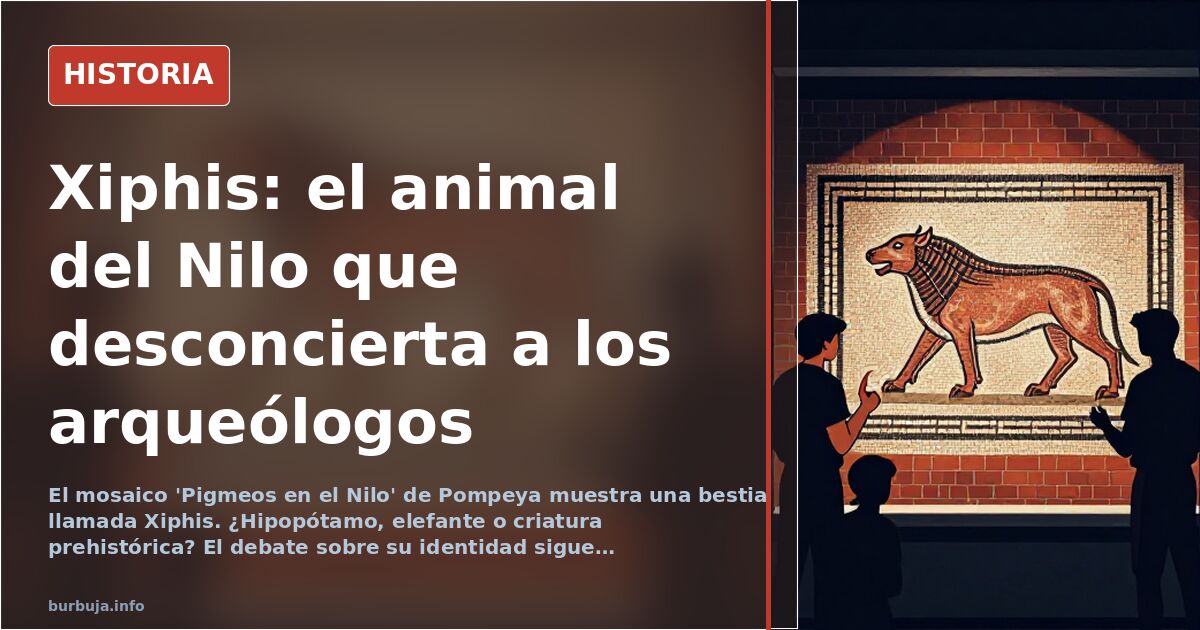
The 'Xiphis' nobody can identify: a Pompeii mosaic and its Nile beasts
The National Archaeological Museum of Naples houses a Greco-Roman fresco known as 'Pygmies on the Nile', in which one of the creatures depicted bears the name 'Xiphis'. The scene shows a group of African pygmies hunting a hippopotamus and a crocodile, but a strangely shaped beast — marked in red in some reproductions — has sparked an intense debate: what on earth was the Xiphis?
The most widely held hypothesis is that it is a hippopotamus misinterpreted by the artist. The animal appears with a bulky body, a large head and a kind of tail that some point to as unmistakably hippo. However, the same work antiestéticatures a perfectly recognisable hippopotamus in another corner, which rules out the theory of a simple 'botched drawing'. The contrast between the two depictions suggests the artist was working from different references, perhaps oral and second-hand.
A trunkless elephant or an extinct animal
Another school of thought argues that the Xiphis is a poorly drawn African elephant, since a trunk would have been hard to conceive for someone who had never seen one. The presence of elephants in North Africa (like Hannibal's) was well known, but their artistic representation could become distorted. Even so, it lacks the characteristic tusks and its morphology does not quite fit.
It has also been speculated that it could be a prehistoric species, such as an entelodont or an astrapothere — an extinct pachyderm — or even a dinosaur like the spinosaurus. The idea that the bones of ancient animals were interpreted as fantastic creatures is not new; in fact, it has been linked to the origin of the dragon myth. But the lack of fossil remains in Egypt — because they were ground up for fertiliser — makes this hard to confirm.
A game of broken telephone in Antiquity
For many, the most convincing explanation is the 'game of broken telephone': someone who had actually seen a hippopotamus described it to another person, who told a third, until it reached the mosaicist who rendered it unrecognisably. The result is an animal with a crocodile's head, a hippo's body and a tail that matches neither. The scene also includes a more stylised crocodile and some pygmies who, according to some interpretations, would be an idealised depiction of the peoples of the Nile.
The truth is that the Xiphis remains a mystery. Hypotheses pile up, but none closes the case. We will probably never know for certain what animal the Romans saw that inspired this creature, but the fresco is a fascinating testament to how visual information becomes distorted across cultures and distances. Who knows — in a thousand years, some archaeologist may find our depiction of a dachshund and think it was a reptile.
The National Archaeological Museum of Naples houses a Greco-Roman fresco known as 'Pygmies on the Nile', in which one of the creatures depicted bears the name 'Xiphis'. The scene shows a group of African pygmies hunting a hippopotamus and a crocodile, but a strangely shaped beast — marked in red in some reproductions — has sparked an intense debate: what on earth was the Xiphis?
The most widely held hypothesis is that it is a hippopotamus misinterpreted by the artist. The animal appears with a bulky body, a large head and a kind of tail that some point to as unmistakably hippo. However, the same work antiestéticatures a perfectly recognisable hippopotamus in another corner, which rules out the theory of a simple 'botched drawing'. The contrast between the two depictions suggests the artist was working from different references, perhaps oral and second-hand.
A trunkless elephant or an extinct animal
Another school of thought argues that the Xiphis is a poorly drawn African elephant, since a trunk would have been hard to conceive for someone who had never seen one. The presence of elephants in North Africa (like Hannibal's) was well known, but their artistic representation could become distorted. Even so, it lacks the characteristic tusks and its morphology does not quite fit.
It has also been speculated that it could be a prehistoric species, such as an entelodont or an astrapothere — an extinct pachyderm — or even a dinosaur like the spinosaurus. The idea that the bones of ancient animals were interpreted as fantastic creatures is not new; in fact, it has been linked to the origin of the dragon myth. But the lack of fossil remains in Egypt — because they were ground up for fertiliser — makes this hard to confirm.
A game of broken telephone in Antiquity
For many, the most convincing explanation is the 'game of broken telephone': someone who had actually seen a hippopotamus described it to another person, who told a third, until it reached the mosaicist who rendered it unrecognisably. The result is an animal with a crocodile's head, a hippo's body and a tail that matches neither. The scene also includes a more stylised crocodile and some pygmies who, according to some interpretations, would be an idealised depiction of the peoples of the Nile.
The truth is that the Xiphis remains a mystery. Hypotheses pile up, but none closes the case. We will probably never know for certain what animal the Romans saw that inspired this creature, but the fresco is a fascinating testament to how visual information becomes distorted across cultures and distances. Who knows — in a thousand years, some archaeologist may find our depiction of a dachshund and think it was a reptile.
Also available in: Deutsch
Summary of a discussion on Burbuja.info - Foro de economía, actualidad y política., translated from Spanish and reviewed before publication. Read the full discussion (83 replies).
More summaries
-
1936 coup in Spain: false flag operation?
The 1936 uprising was launched under the republican flag and Mola was a republican. Was it a reaction to the Popular Front or a false flag operation to...
-
The Curious Ideological Formula: Fascism, the Vatican, and Nationalism
Explore the complex relationship between fascism, the Vatican, and nationalism—from Mussolini's initial anti-clericalism to its eventual evolution. Discover their intertwined history.
-
ETA and GAL: two arms of the same Gladio network in Spain
Investigation linking ETA and GAL as arms of the same NATO Gladio network, with drug trafficking funding and CIA control.
-
Risorgimento: conquest of the south or inevitable unification?
The Kingdom of the Two Sicilies was richer than the north and had Italy's first railway. Was it really destroyed by a Masonic conspiracy? The data and the geopolitics.
-
Prehispanic Canary Islands: the enigma of an empty land
Though known to Phoenicians and Romans, prehispanic Canary Islands in Spain had no metals, large buildings or seafaring. Was it poverty that held them back?
-
Arabic Surnames in Spain: Separating Historical Myth from Reality
Most Spanish surnames have Latin and Germanic roots, but the Arab legacy also left its mark. How much truth is there in the debate over Arabic surnames in Spain?