
The map that corrects Russia's narrative of the Ukraine war
One month into the war: the offensive on Kyiv stalled at Irpin, the Crimea-Donbas corridor as Russia's only success, and Mariupol resisting as a drain on resources.
English · Original discussion in Spanish · Published
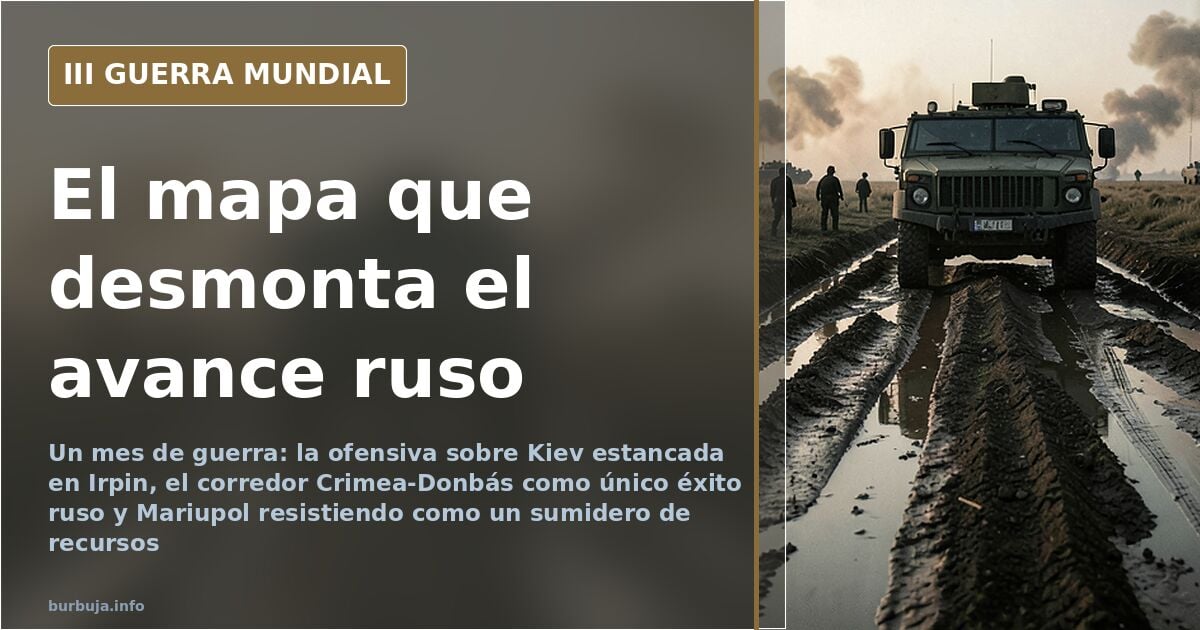
The map that dismantles the story of Russia's advance in Ukraine
How far has the Russian army actually got, one month after the invasion? That is the question anyone comparing official reports with an open-source map is asking. The answer that emerges from the analysis is uncomfortable for Moscow: the offensive against Kyiv from the north has stalled, and the Ukrainians have counterattacked until the front was anchored at Irpin. The land corridor between Crimea and the Donbas is, at this point, the only significant Russian success.
The starting point of the analysis is a live map that is updated only with events confirmed by several sources and that, it is argued, waits until a situation is well backed up before moving a line. Circulating alongside it is the map of the Russian army itself, which draws a band of controlled territory that would imply the encirclement of Chernihiv and the envelopment of the entire northeastern border. The objection is one of military logic: if that attacking arm existed, the Ukrainians would not be counterattacking northwest of Kyiv and in Mykolaiv instead of closing that gap.
What the front looks like a month on
East of the capital, Russian advances in depth did not translate into control of the ground: tanks driving along the road without subsequent domination. The Ukrainians were gradually rebuilding the front and closing gaps. Neither Chernihiv, nor Sumy, nor Kharkiv are encircled. A couple of cities with airfields remain, where Ukrainian troops would have fortified themselves to deny those runways to the Russian air force.
In the Donbas, the line remains practically where it has been since 2015, with Russian advances north of Luhansk. In the south, the land link between Crimea and the Donbas constitutes the only strategic achievement. The Ukrainians counterattack in Mykolaiv and advance on Kherson, with an objective that can be read between the lines: to retake the city and push the Russians back beyond the Dnipro, which would provide a secure defensive line and take the army in the East out of danger of encirclement.
Mariupol as a drain on resources
Mariupol's resistance forces the Russians to divert resources to a single point and gives Ukrainian troops breathing room on other fronts. The comparison with Stalingrad is made without embarrassment. In parallel, the deeper reading is that the Ukrainians are normalizing the front line while the Russians pull back overextended spearheads.
Moscow's most optimistic calculation spoke of decapitating the government in Kyiv with little bloodshed; the fallback scenario involves keeping the coastal strip and the Donbas. Some add that the Crimea-Donbas corridor is non-negotiable because of its railway value: it would allow an armored division to move from Siberia to Crimea without the current logistical problems.
The rasputitsa and the mud debate
The arrival of the thaw fuels expectations of a halt to the fighting. Not everyone buys it. The argument is made that mud was a decisive factor in World War II because of the absence of roads and because armored vehicles crossed open country, whereas this war is being fought in urban environments and on asphalt. The experience of anyone who has driven on tracks in the Baltic countries points in the same direction: with an off-road vehicle and a winch, no quagmire will stop the advance.
The army that was not so big after all
The underlying question is one of capability. It is argued that Russia has not deployed enough troops to complete encirclements like those of Kharkiv, Sumy or Kyiv, and that it would need more forces to do so. The ratio being cited —hundreds of thousands of Ukrainian defenders against a notably smaller invading force— would explain why the assault on the cities is bogging down. The other side of the coin: an army that fails to impose itself on the poorest country in Europe earns the label of mediocre.
The most ambitious predictions speak of a large-scale offensive once the ground dries, with concentrations in the Urals and figures that sound like fantasy. The more sober ones point to consolidating the south and digging in elsewhere. And hanging over everything is the question of what would happen if peace were signed: whether Ukraine would accept the loss of the east, or whether the war would continue on a smaller scale, as before.
In the end, the only certainty is that the map moves less than the reports claim. The rest is mud.
Also available in: Deutsch
Summary of a discussion on Burbuja.info - Foro de economía, actualidad y política., translated from Spanish and reviewed before publication. Read the full discussion (94 replies).
More summaries
-
Putin fails to win total victory as Ukraine faces ceding the Donbas
Moscow would settle for Crimea and almost the entire Donbas after a war of attrition, according to the analysis circulating in the debate.
-
Debate: Ukraine has lost the war and the cost of prolonging it
Forum users argue that Ukraine cannot recover territory, that the war is kept going for profit, and that reconstruction is a black hole for the EU.
-
Ukraine enters 2025 facing a critical shortage of young troops
Ukraine enters 2025 with fewer than one child per woman and only 250 young volunteers in two months: the shortage of young troops is weighing down its defense against Russia.
-
Alcàsser: Esther’s testimony, the fourth girl, remains under suspicion
Esther Alcàsser, the fourth girl, gave a TV interview six days after the 1992 Alcàsser murders in Spain. Her account and timeline discrepancies fuel ongoing controversy.
-
César Vidal and the Israeli leak: 157,000 Ukrainian dead versus 18,000 Russians
A tweet attributes to an Israeli leak 157,000 Ukrainian dead against 18,000 Russian. The ratio is so extreme that even skeptics are doubtful.
-
Debate over a possible peace deal leaving 75% of territory intact
Debate on a possible peace agreement and the 75% of the map at stake. The scene has something of a bureaucratic paradox: a country that has spent years requesting…