
The Magnetic Effect of Vaccines: No Magnetism, No Nanoparticles
The 'magnetic effect' of vaccines and the magnetism theory linked to 5G: there is no physical evidence to support it.
English · Original discussion in Spanish · Published
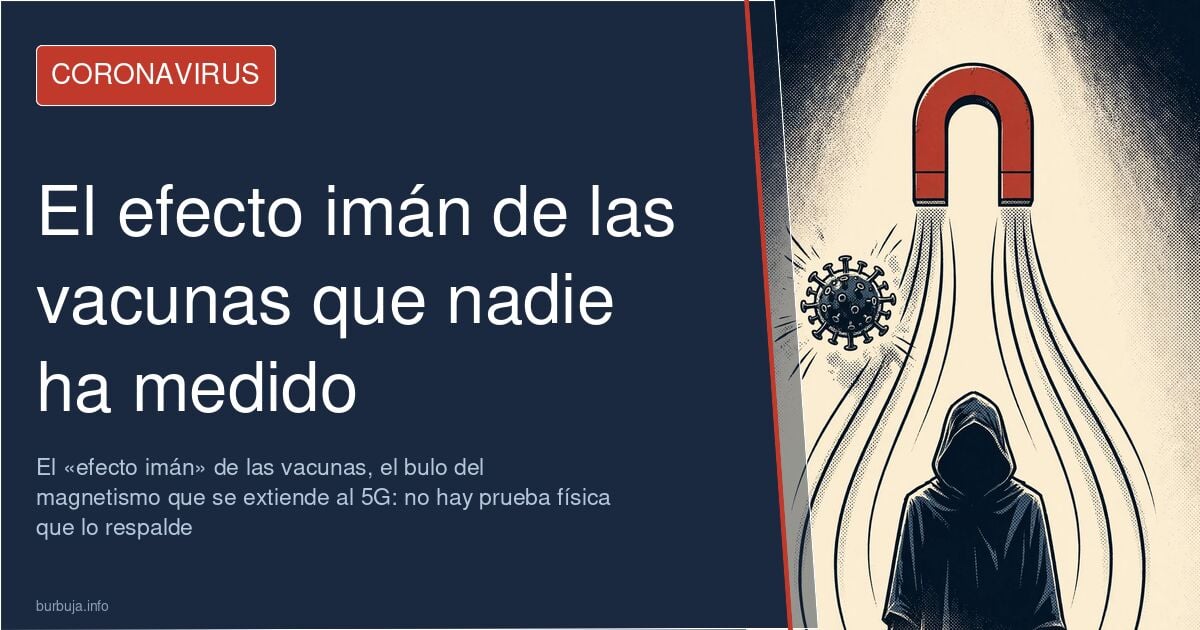
Vaccine Magnetism: The Spoon Stuck to the Arm and the Copper Coins
A 130 euro radio frequency meter, capable of reading signals up to 10 GHz, was the latest gadget someone bought to check if a vaccinated arm emitted anything. Before that, it was magnets, spoons, and a foot-long pair of scissors. The supposed 'magnetic effect' of cobi19 vaccines circulated strongly since mid-2021 and has resurfaced periodically since, without any physical evidence to back it up. The human body does not generate magnetic fields of that intensity after an intramuscular injection, and 10, 20, or 50 cent coins do not stick to a magnet: anyone can check this at home.
What Exactly Was the Magnetic Effect
In its initial version, the phenomenon was presented as something discovered just two weeks earlier. The closest comparison, they claimed, was a classic magnet, but it wasn't a classic magnet: what attracted, what didn't, and how long it lasted remained unknown. The account placed the effect within a three or four-centimeter radius of the injection site and claimed that vaccinated individuals months later were still 'magnetized.' Over time, the supposed phenomenon widened: videos appeared with magnets stuck to the noses and foreheads of unvaccinated individuals who had undergone PCR tests, and even those vaccinated against the flu in late 2020. None of these materials came with reproducible measurements.
The Copper Coins That Don't Stick to a Magnet
The most basic counter-argument came from domestic physics: if the arm were magnetized, it would also attract 10, 20, and 50 cent coins, which do not respond to a magnet. This was the first sustancia ilegal in the narrative. The second came with Faraday-Lenz's law: a magnet dropped inside a copper tube slows down, yes, but not because the copper is magnetic; it's because movement induces currents that generate an opposing field. Confusing induced braking with attraction is the typical error of someone learning electromagnetism from a ten-second video.
Regarding nanoparticles, the same objection applies: without an external variable and measurable field, there is nothing to amplify.
Fat, Sweat, and Skin That Isn't Flat
The most prosaic explanation is adhesion: the skin secretes fat and sweat, has curvature, and offers resistance through friction and viscosity. A small magnet or a light spoon can remain motionless for a few seconds on a sticky surface without any magnetic force being present. Conversely, the most repeated argument was that the attraction 'is noticeable' and that the magnet doesn't fall even when released from a certain distance. The most cited rebuttal from the other side came from the dean of the Official College of Chemists of Madrid: that people place magnets under their arms. Between these two extremes, the only verifiable thing is a measurement using calibrated instrumentation, and that still does not exist.
From Nanoparticles to 5G
The narrative mutated several times. First, there was talk of superparamagnetic nanoparticles, which genuinely exist in other contexts: contrast agents, ferrofluids, laboratory experiments. The leap was going from 'they exist' to 'they are in the vial and couple up until they become superferromagnetic.' Supermagnetism is a real phenomenon, but it requires controlled concentrations and interparticle distances at the nanometer scale, homogeneous sizes, low temperatures in many cases, and synthesis in a laboratory. Not a lipid vial containing 30 micrograms of mRNA.
Then came the 5G phase: domestic meters, 'dangerous' pulses in the 10 GHz band, and the suspicion that the organism had become a router. Since no identifiable coded signal appeared, the argument was repositioned: what was being measured was 'something.' That something is, most likely, the background noise of the device itself.
The Bits in the Arm and the Detector Business
A popularizer who publishes content on technological biomechanics presented measurements of disturbances attributed to the injected arm, described as bits of coded information. The anecdote is almost better than the theory: the device cost 130 euros, and when tested, frequencies previously 'hidden' appeared that were undetectable with the older model. The obvious conclusion is missing. A radio receiver detects radio waves. 10 GHz is declared 5G territory, and a mobile phone transmits and receives by definition. None of that makes an arm an autonomous emitter, no matter how much the gadget beeps.
The File That Returns Periodically
Over the years, the issue stopped being discussed as physics and began functioning as a marker. In October 2024, the balance circulating was: almost everyone vaccinated, 5G everywhere, and no mass casualty in the streets. The contrast with more dramatic predictions was the uncomfortable part for some and the definitive argument for others. The other uncomfortable part is how similar this is to what peine in 1975, when an Israeli illusionist, Uri Geller, bent spoons on the show Directísimo of José María Íñigo and encouraged the public to try it at home. Much of Spain tried it. Many swore it worked. The difference is that then there was no phone to record it or digital archive to preserve it. Years after the first video, the 10, 20, and 50 cent coins still do not stick to any magnet.
A 130 euro radio frequency meter, capable of reading signals up to 10 GHz, was the latest gadget someone bought to check if a vaccinated arm emitted anything. Before that, it was magnets, spoons, and a foot-long pair of scissors. The supposed 'magnetic effect' of cobi19 vaccines circulated strongly since mid-2021 and has resurfaced periodically since, without any physical evidence to back it up. The human body does not generate magnetic fields of that intensity after an intramuscular injection, and 10, 20, or 50 cent coins do not stick to a magnet: anyone can check this at home.
What Exactly Was the Magnetic Effect
In its initial version, the phenomenon was presented as something discovered just two weeks earlier. The closest comparison, they claimed, was a classic magnet, but it wasn't a classic magnet: what attracted, what didn't, and how long it lasted remained unknown. The account placed the effect within a three or four-centimeter radius of the injection site and claimed that vaccinated individuals months later were still 'magnetized.' Over time, the supposed phenomenon widened: videos appeared with magnets stuck to the noses and foreheads of unvaccinated individuals who had undergone PCR tests, and even those vaccinated against the flu in late 2020. None of these materials came with reproducible measurements.
The Copper Coins That Don't Stick to a Magnet
The most basic counter-argument came from domestic physics: if the arm were magnetized, it would also attract 10, 20, and 50 cent coins, which do not respond to a magnet. This was the first sustancia ilegal in the narrative. The second came with Faraday-Lenz's law: a magnet dropped inside a copper tube slows down, yes, but not because the copper is magnetic; it's because movement induces currents that generate an opposing field. Confusing induced braking with attraction is the typical error of someone learning electromagnetism from a ten-second video.
Regarding nanoparticles, the same objection applies: without an external variable and measurable field, there is nothing to amplify.
Fat, Sweat, and Skin That Isn't Flat
The most prosaic explanation is adhesion: the skin secretes fat and sweat, has curvature, and offers resistance through friction and viscosity. A small magnet or a light spoon can remain motionless for a few seconds on a sticky surface without any magnetic force being present. Conversely, the most repeated argument was that the attraction 'is noticeable' and that the magnet doesn't fall even when released from a certain distance. The most cited rebuttal from the other side came from the dean of the Official College of Chemists of Madrid: that people place magnets under their arms. Between these two extremes, the only verifiable thing is a measurement using calibrated instrumentation, and that still does not exist.
From Nanoparticles to 5G
The narrative mutated several times. First, there was talk of superparamagnetic nanoparticles, which genuinely exist in other contexts: contrast agents, ferrofluids, laboratory experiments. The leap was going from 'they exist' to 'they are in the vial and couple up until they become superferromagnetic.' Supermagnetism is a real phenomenon, but it requires controlled concentrations and interparticle distances at the nanometer scale, homogeneous sizes, low temperatures in many cases, and synthesis in a laboratory. Not a lipid vial containing 30 micrograms of mRNA.
Then came the 5G phase: domestic meters, 'dangerous' pulses in the 10 GHz band, and the suspicion that the organism had become a router. Since no identifiable coded signal appeared, the argument was repositioned: what was being measured was 'something.' That something is, most likely, the background noise of the device itself.
The Bits in the Arm and the Detector Business
A popularizer who publishes content on technological biomechanics presented measurements of disturbances attributed to the injected arm, described as bits of coded information. The anecdote is almost better than the theory: the device cost 130 euros, and when tested, frequencies previously 'hidden' appeared that were undetectable with the older model. The obvious conclusion is missing. A radio receiver detects radio waves. 10 GHz is declared 5G territory, and a mobile phone transmits and receives by definition. None of that makes an arm an autonomous emitter, no matter how much the gadget beeps.
The File That Returns Periodically
Over the years, the issue stopped being discussed as physics and began functioning as a marker. In October 2024, the balance circulating was: almost everyone vaccinated, 5G everywhere, and no mass casualty in the streets. The contrast with more dramatic predictions was the uncomfortable part for some and the definitive argument for others. The other uncomfortable part is how similar this is to what peine in 1975, when an Israeli illusionist, Uri Geller, bent spoons on the show Directísimo of José María Íñigo and encouraged the public to try it at home. Much of Spain tried it. Many swore it worked. The difference is that then there was no phone to record it or digital archive to preserve it. Years after the first video, the 10, 20, and 50 cent coins still do not stick to any magnet.
Summary of a discussion on Burbuja.info - Foro de economía, actualidad y política., translated from Spanish and reviewed before publication. Read the full discussion (471 replies).
More summaries
-
Raw Pandemic Data: Official Narrative vs Real Figures
An analysis of initial coronavirus data and firsthand accounts, tracing the outbreak from its epicenter to healthcare consequences across Spain and Europe.
-
Itziar Castro: from AstraZeneca trial volunteer to death at 46
Itziar Castro tweeted in March 2021 that she was a volunteer in the AstraZeneca trial with no side effects. She died in December 2023 at 46.
-
Nuremberg II: the Covid archive awaiting trial
A citizen archive compiles VAERS and EudraVigilance figures and Covid vaccine data for a hypothetical Nuremberg II that has no date yet.
-
Moving fibers in masks: home experiments, no answers
An amateur films fibers moving inside an FFP2 and exposes them to steam, a magnet and electric current. A lab attributes it to polypropylene microfibers.
-
Nurse Avoids Prison for Falsifying Vaccinations of 400 Children
A nurse accused of faking vaccinations for 400 children in Bizkaia will not go to jail. Prosecutors seek psychiatric treatment instead.
-
22.7 Million Vaccinated Study: 25% Lower Mortality Claimed
A large-scale study suggests vaccinated individuals have 25% lower overall mortality. Critics cite the 'healthy vaccinee effect' and conflicts of interest.