
Police charge at Vox rally in A Coruña, Spain, after boycott attempt
A Vox rally in A Coruña, Spain, ended with police charges and objects thrown at officers, according to posts in the thread. The debate over sabotage of campaign events…
English · Original discussion in Spanish · Published
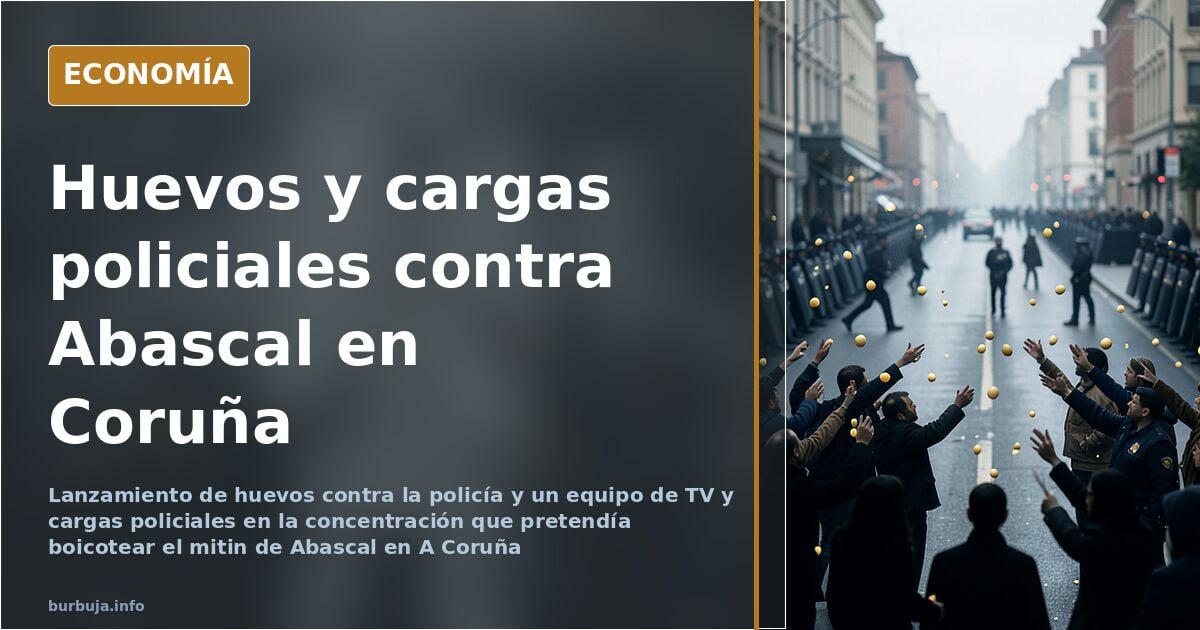
Police charges in A Coruña: stones and chairs thrown at Vox rally
A Vox rally in María Pita square, in A Coruña, Spain, ended with police charges and episodes of street violence, according to posts in the thread. According to accounts gathered in the discussion, groups behind an "antifascist" mobilization called to boycott the event threw stones, chairs and bollards at officers. A bar worker in the area described the scare as "horrible" after seeing protesters take furniture from the premises to throw at the police. The unrest ended with growing tension and a debate over who has the right to occupy public space.
The episode reopens the discussion about sabotaging campaign events, a practice several voices in the thread describe as illegal. The confrontation is nothing new: the Vito Quiles precedent was cited as proof that incidents against right-wing events repeat themselves without anyone being held accountable. The difference this time is the scale of the clashes and the police response.
What peine in María Pita square?
The posts themselves sum up the sequence: calls for up to three far-left demonstrations to disrupt Santiago Abascal's rally, police charges to contain the violent elements, and a stream of heavy objects hurled at riot police. A police union spokesperson warned that if the right wins, "the far left will burn the streets." On the other side, a political scientist argued that "the police protect the fascists," to which the union representative replied that her colleagues cannot be called "murderers."
The account of the day includes a detail that, according to some posts, debunks the idea of spontaneous sabotage: the call to boycott the event was organized in advance. It was not an improvised gathering. There was time to gather flags, slogans and a repertoire of action that repeats itself in other European cities, as was noted in the discussion.
The hoax about the strike day at secondary schools
One of the initial posts claims that a strike day had been granted to secondary schools so that young people could attend the demonstration. That claim is not backed by any source in the material. It is a suspicion thrown out without proof, and should be read as such. What is documented is the call for protests and the presence of organized groups.
The discussion then turned to the profile of the Vox voter. Against the stereotype of the older voter, several posts stress that much of the youth leans to the right, tired of decades of PP and PSOE governments. It is a hypothesis, not electoral data, but it explains why the rally became a target.
The police response and the debate over legitimacy
The police charges came after protesters threw objects at officers. The scene of bar chairs turned into projectiles sums up the day. For some of those present, the police action was restrained; for others, insufficient. The discussion reflects a deeper divide: between those who believe a legal rally should not be disrupted and those who believe protest legitimizes any means.
The legal argument is clear: sabotaging campaign events is illegal. Whether it is prosecuted is another matter. The perceived impunity fuels the escalation. And the escalation, in turn, feeds the narrative of those who see every Vox rally as a provocation.
The question left hanging is to what extent street violence shapes the vote. In A Coruña, some posts argue the incidents will push more citizens toward Vox. Others believe the effect will be the opposite. What is beyond dispute is that stones flew and that the bar chairs ended up thrown at the police.
Also available in: Deutsch
Summary of a discussion on Burbuja.info - Foro de economía, actualidad y política., translated from Spanish and reviewed before publication. Read the full discussion (230 replies).
More summaries
-
Police checkpoints at UAB entrances to keep Vito Quiles out
Catalan police stacked cars and searched vehicles at the entrances to the Universitat Autònoma de Barcelona to block Vito Quiles, who moved his event to the Sabadell Ikea.
-
Vox leader Abascal rejects interview with Jimenez Losantos
Abascal reportedly refuses an interview with Jimenez Losantos amid growing tensions between Vox and Spanish right-wing media.
-
Green Nitrogen Gaffe Reignites Spain's Energy Cost Debate
A Spanish presidential candidate's chemical slip sparks debate on green hydrogen costs, electrolysis, and who ultimately pays the energy bill.
-
How much more evidence do people need to see liberalism is a massive scam?
A critique of economic liberalism, from Greco-Roman euergetism to today's debt and inflation. A scam designed to impoverish?
-
Real or AI? Doubts over protest images in Spain
Are the protest images real or AI-generated? The debate focuses on the authenticity of visual information circulating on social media.
-
68% in Spain back rent caps, El País poll finds
An El País poll shared on X shows 68% support for capping rents in Spain, including 55% backing among PP and Vox voters.